The Smallest Door
The scissors were taller than Maya.
They stood in the middle of the outreach room, silver cardboard blades crossed above a plastic DNA ladder. Someone had glued glitter along the edges. Someone had drawn a smiling face on the handle. Someone had written, in cheerful blue marker, CRISPR CUTS DNA SO CELLS CAN FIX IT.
Soren stopped in the doorway.
“That is not prime editing,” he said.
Maya was already halfway under the table, looking for the box the fallen sign had come from. “It’s scissors.”
“That is the problem.”
Dr. Imani hurried past them with a tray of tiny capped tubes. Her lab coat had a coffee stain shaped like South America. “Please do not touch the incubator, the freezer, the microscope with the orange sticker, or anything with a warning label. You may touch cardboard. Cardboard is safe.”
“This exhibit is wrong,” Soren said.
Dr. Imani turned around, tray still in both hands. “It is simplified.”
“It says prime editing cuts both strands.”
“It says CRISPR. Families arrive in twelve minutes. The scissors are friendly.”
Maya backed out from under the table with a strip of laminated paper in her hand. On it were four letters in repeating blocks, A, C, G, T, linked like train cars.
“This card says prime editing is search and replace,” she said. “The scissors say chop.”
Dr. Imani closed her eyes for one second. “I know. I asked for a pencil. The volunteer art club made scissors. Enormous scissors. Everyone loves them.”
“I don’t,” said Soren.
Dr. Imani looked at the clock. “If you can make it less wrong without using liquids, electricity, or my last nerve, do it.”
Then she vanished through the swinging door into the lab.
Maya stood the laminated DNA strip on edge. It flopped.
Soren opened his notebook, not at the first blank page but somewhere in the middle, where a drawing of a fern shared space with a list of things that failed to dissolve in water. “Prime editing. Cas nine nickase fused to reverse transcriptase. Guide RNA with extra sequence. It nicks one strand.”
Maya held up one finger. “One.”
“Then the cut end copies the new letters from the RNA template.”
“Like a bookmark that also has the sentence you want.”
“Not exactly.”
“Enough to build it.”
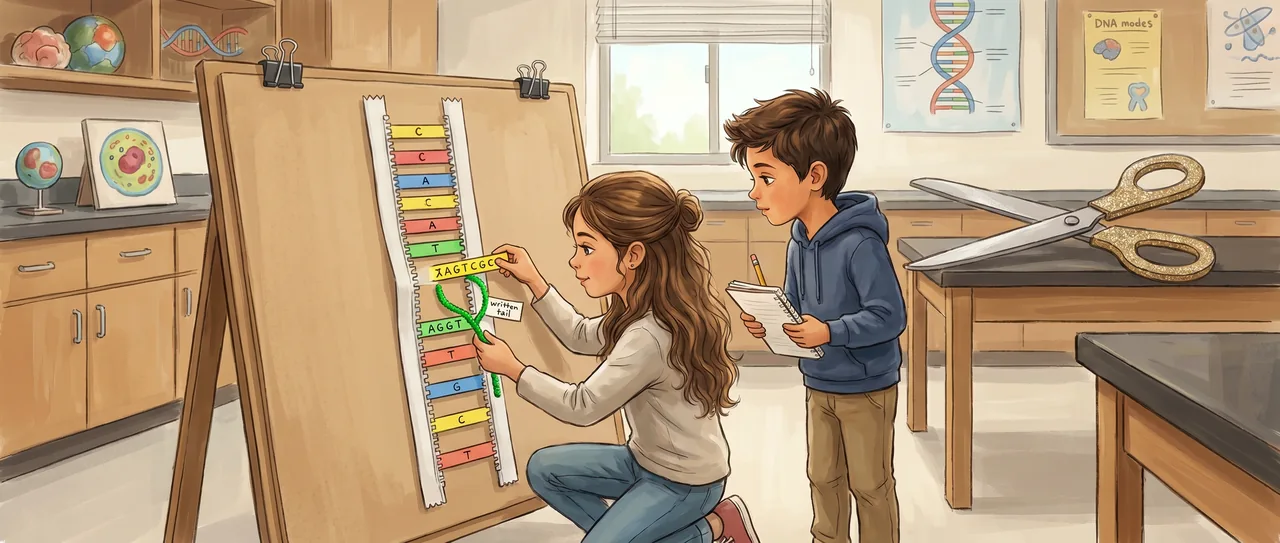
They raided the outreach shelves. There were magnet tiles, pipe cleaners, binder clips, sticky labels, and a long plastic zipper left from a craft about proteins. Maya zipped and unzipped it twice, then grinned.
“DNA ladder,” she said.
Soren tested the zipper teeth. “If we unzip both sides, it is a double-strand break.”
“So we don’t.”
They taped colored letters onto the zipper teeth. A paired with T. C paired with G. The zipper became a neat little ladder, until Maya tugged one side loose near the middle.
“Nick,” she said.
The zipper gaped. The whole thing twisted. Three letters peeled off and stuck to her sleeve.
“That is too much nick,” Soren said.
“It’s dramatic.”
“It is inaccurate.”
Maya pulled the letters from her sleeve and pressed them back on. “Less dramatic, then.”
She made a tiny cut in only one strip of clear tape on one side of the zipper. The other side held. The ladder bent but did not fall apart.
Soren’s shoulders dropped a little. “That.”
They needed the searching part. Maya found a green pipe cleaner and curled it along the zipper until only one stretch fit snugly against the matching letters. Everywhere else, it buckled, wrong shape against wrong shape. At one place, it lay flat.
Soren added a paper tail to the pipe cleaner. On the tail he wrote a short new sequence, three letters long, then another stretch that matched the DNA beside the nick.
Maya watched him write.
“You put the replacement on the searching thing,” she said.
“The pegRNA carries the address and the edit.”
“Peg?”
“Prime editing guide RNA.”
“Good name. It pegs the place.”
“It also has a primer binding site.”
Maya pinched the loose end of the nicked DNA and rested it against the matching part of the green tail. “The broken little end has to sit down here first.”
“Not broken,” Soren said.
Maya looked at the enormous scissors, glittering in the middle of the room.
“Not broken,” she said.
For a moment the room became very quiet, except for the hum of the refrigerator behind the staff desk. The DNA zipper lay between them, held together almost everywhere, opened only where it needed to be opened. The smallest looseness was enough for the new letters to have a place to begin.
Maya picked up a strip of yellow paper and slid it along the green tail, copying its letters onto the loose DNA side. “Reverse transcriptase.”
Soren stared at her.
“What?” she said.
“You remembered that?”
“You said it. It sounded like a machine walking backward.”
“It makes DNA from an RNA template.”
“That is a machine walking backward.”
The new yellow strip made a flap that stuck out past the old DNA letters. They had two versions now, one old, one new, both attached to the same place.
Maya frowned. “Which flap wins?”
Soren flipped pages. “Cells have repair machinery. Prime editing can favor the edited strand. Sometimes they nick the other strand too, later, to encourage copying the change.”
“Sometimes?”
“Sometimes. It depends on the cell and the edit and the place.”
Maya smiled at the model. “Good. It shouldn’t pretend to be magic.”
The swinging door opened. Dr. Imani came back carrying a tablet and wearing one blue glove and one purple glove.
“Oh,” she said.
The giant scissors were on their side. The zipper ladder was clipped to the display board. A green pipe cleaner ran along it like a vine. The yellow copied letters made a tiny bright tongue at the nick.
Dr. Imani leaned closer.
Maya said, “It searches by matching.”
Soren said, “It replaces by copying a short template.”
Maya said, “It does not smash the ladder.”
Soren said, “The giant scissors can go somewhere else.”
Dr. Imani touched the cardboard blade with her purple glove. “The art club will be devastated.”
“They can be devastated accurately,” Maya said.
A laugh escaped Dr. Imani before she could stop it. She handed Soren the tablet. “If you are going to overthrow my exhibit, you may as well run the animation.”
On the screen was a practice sequence. One letter glowed amber. Beside it, the program offered tools: cut, silence, replace. Soren chose replace. A small line appeared, asking for the edit.
Maya read the old letters aloud. Soren entered the new one. The program did not explode into fireworks. It showed a guide sliding through DNA, failing to match, failing again, then settling at one exact place. A single strand opened. New letters grew from the loose end,
Then the animation paused.
Under the practice sequence, a real panel appeared from the lab database. Short edits. Possible designs. Warnings. Efficiencies unknown. Cell type matters. Not all targets work. Thousands of tiny amber marks stood in rows, each one no bigger than a freckle on the screen.
Maya did not touch anything.
Soren’s pencil hovered above his notebook and stayed there.
The room seemed to have too many doors. Not walls with doors in them, but doors inside letters, doors inside cells, doors so small a person could spend a whole life learning how to knock politely.
Voices gathered in the hallway. Dr. Imani straightened. “Families,” she said. “Remember, no promises. This is research and medicine, not wishing.”
A little boy came in first, holding the hand of a woman with tired eyes. Behind them came older kids, parents, a grandfather with a cane, two nurses, and a girl who walked straight to the toppled cardboard scissors.
“Are those broken?” the girl asked.
“They were too big,” Maya said.
The girl looked at the zipper model. “What does this one do?”
Soren stepped aside so she could see. “It finds a small place.”
Maya held up the green pipe cleaner. “Then it brings the small change with it.”
The girl leaned close. Her forehead nearly touched the display board. “That little thing?”
“That little thing,” said Soren.
Dr. Imani opened her mouth, then closed it again.
Maya handed the girl the yellow strip. “Here. Make the new letters.”
The girl slid the strip into the narrow gap, and the zipper held.
Read the interactive version, listen to the narration, and earn a gold star →
A science-verified short story for curious kids · Curiosity Land