The Side Door
The memory room was beautiful and completely wrong.
Maya knew it before the lights finished dimming.
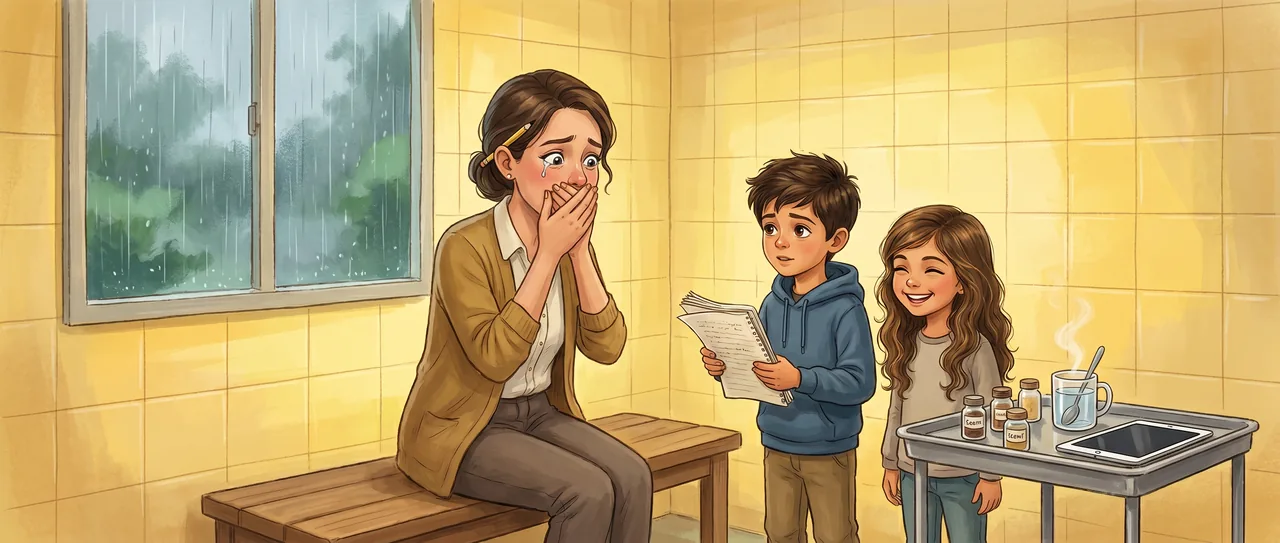
The walls became a kitchen. Sun slid across yellow tiles. A kettle clicked. A spoon tapped a mug. Somewhere, invisible rain ticked against a window. The exhibit director stood with her tablet hugged to her chest, smiling too hard.
"This is Mrs. Alvarez's kitchen in nineteen ninety-nine," she said. "Reconstructed from photographs, interviews, and sound recordings. Tell me what you feel. Be honest, but not cruel. The donors arrive in forty minutes."
Soren sat on the bench with his paper notebook balanced on one knee. He wrote one word, then stopped.
Maya leaned forward. "It's like a picture of feeling."
The director's smile bent. "That is not a usable evaluation."
"It doesn't have edges," Maya said.
"Kitchens have edges," Soren said. "Counters. Cabinets. Table legs. This has those."
"Not those edges."
The kettle clicked again. The sound was perfect. Too perfect. No chair squeak. No refrigerator hum that changed when the motor came on. No old dust in the corners of heat.
The director pinched the bridge of her nose. Her hair had two pencils stuck through it, one red and one blue, like crossed antennas. "Children are supposed to be better at this than adults. Adults try to sound impressive. Children say the useful thing."
"It smells like nothing," Soren said.
The director looked pained. "Yes. Because the scent system is still being calibrated, and because scents leak into other exhibits, and because last Tuesday someone made the dinosaur hall smell like burnt toast for six hours."
Maya stood up. "Then it isn't her kitchen."
"It is visually accurate to within two centimeters," the director said. "The audio is layered from surviving recordings."
Soren closed his notebook. The paper made a soft flap. "Could we use the old smell shelf? From the nose lab?"
"No fire, no allergens, no mystery liquids, no opening the formaldehyde cabinet," the director said. She was already walking backward toward the control booth. "If you ruin my vents, I will remember you forever, and not in the exhibit way."
Then she was gone behind glass, arguing with a projector that had turned the rain green.
Maya and Soren crossed the hall to the nose lab.
It was the least fancy room in the museum. No glowing floor. No floating labels. Just a counter, a sink, cotton strips, and rows of small jars with plain lids. Orange peel. Vinegar. Cinnamon. Cedar. Damp soil. Pencil shavings. Soap. Metal. Coffee. Crayon wax. Old book.
Above the shelf was a cartoon brain with a nose drawn in purple. Most arrows from eyes and ears stopped first at a lump labeled thalamus. The purple arrow from the nose went another way, straight toward two little shapes labeled amygdala and hippocampus.
Soren tapped the purple arrow. "Side door."
Maya was already unscrewing coffee. "Mrs. Alvarez's kitchen had a kettle. Coffee maybe."
"Kettle isn't coffee."
"Kitchens collect things."
They brought jars back on a rolling tray. The memory room kept being beautiful at them. Yellow tiles. Kettle. Rain. Spoon.
Soren dipped a cotton strip into coffee and held it low, not waving it around. The room filled a little, but not enough.
"Too morning," Maya said.
He added cinnamon.
"Too bakery."
Cedar.
"Now it's a hamster cage with opinions."
Soren crossed out something in his notebook. "We need kitchen, not kitchen idea. What did she say in the interview?"
They found the transcript on the tablet left beside the bench. Mrs. Alvarez had talked about rain, a blue mug, her brother stealing toast, her mother ironing school shirts at the table because the apartment was too small.
"Ironing," Maya said.
"Hot cloth," Soren said.
The smell shelf had soap, metal, and something labeled warm dust for the old radiator demonstration. Soren hesitated. "Warm dust is not cloth."
"But heat makes hidden things stand up."
He looked at her. "What made you think that?"
Maya pointed to the projector vent. "When it warmed, the room changed. Not enough. But changed."
They set a mug of hot water under a metal spoon, not touching the electronics, and placed a cotton strip with soap nearby. Soren added the smallest touch of warm dust from the demonstration jar. Maya found toast scent in the food chemistry drawer, approved for school groups and labeled please do not eat.
The room shifted.
Not the picture. Not the sound. The yellow tiles stayed yellow. The kettle clicked on schedule. But Soren's hand stopped over the tray.
He was seven for half a second, sitting under the ironing board while his aunt pressed a white shirt above him. Steam breathed down. Someone laughed because he had put both socks on one foot. He could see the underside of the board, silver and dotted with holes.
He put the strip down very carefully.
Maya's face had gone still.
"What?" Soren asked.
"My grandmother's hallway," she said. "Not the kitchen. The hallway outside. The one with the floor that stuck to your shoes after rain. I haven't been there since I was little."
The director's voice crackled through the speaker. "Why did you both freeze? Is something broken? Please say no."
Maya looked at the purple arrow on the tablet screen, then at the jars.
Soren said into the room microphone, "Nothing is broken. That's the problem."
"That sentence has no comfort in it," the director said.
"The pictures are going the long way," Maya said. "The smell isn't."
The director came out of the booth with one pencil fallen behind her ear. "Say that again, but with fewer ghosts."
Soren pointed through the hall toward the nose lab. "The diagram says smell has direct connections to the memory and emotion parts. The other senses stop at the thalamus first. This room is all thalamus."
"That is not how museum labels are supposed to be used against me," the director said.
But she was staring at the tray now.
Maya lifted Soren's notebook from the bench without asking, then paused and held it out to him. "Can I?"
He knew what she wanted. Everyone at school thought the notebook was odd. Too papery. Too slow. Too easy to lose. Teachers sent assignments to lenses and wall screens, but Soren liked the drag of graphite, the way paper kept pressure after the word was gone.
He opened to the middle and bent the pages back and forth once.
The smell rose. Paper. Graphite. The faint dusty sweetness of an eraser worn into crumbs.
The director blinked.
"Oh," she said.
That was all.
Then she sat down on the bench in the pretend kitchen and covered her mouth with one hand. Not crying exactly. More like stopping something from running out. On the wall, rain slid down a window that was not a window.
"Fifth grade," she said behind her fingers. "Back row. I was supposed to be doing fractions. I drew rockets in the margins. The teacher said margins were not for leaving Earth."
Soren kept both hands on the notebook. He did not close it.
Maya grinned at him, quick and bright. "Your weird paper thing is a key."
"It is a notebook," he said, but his ears felt hot.
"Keys can have lines."
Read the interactive version, listen to the narration, and earn a gold star →
A science-verified short story for curious kids · Curiosity Land