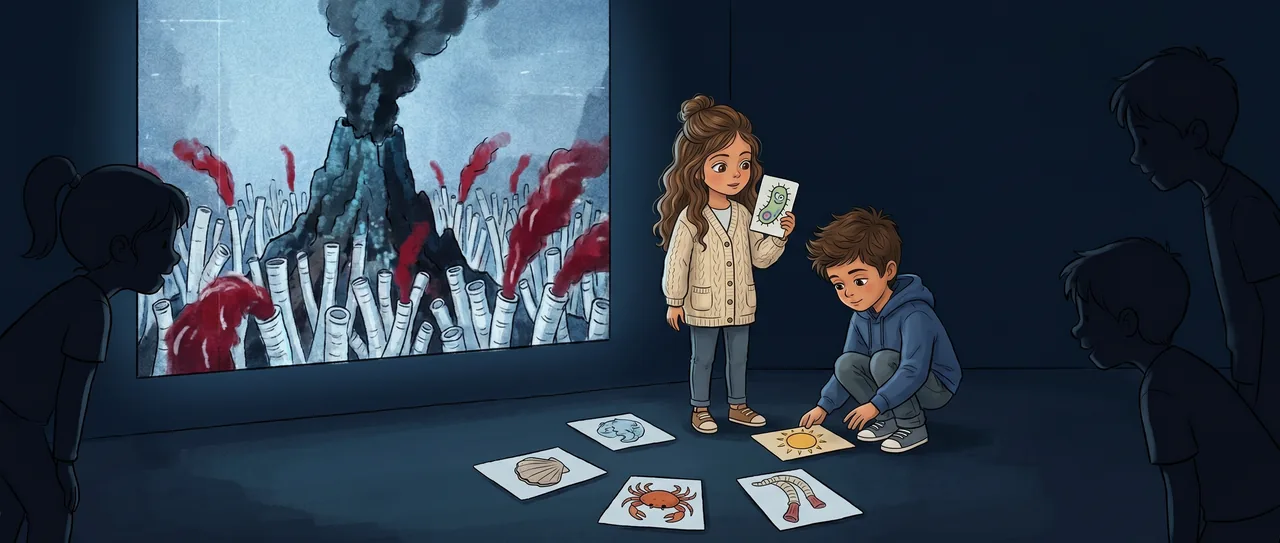
The Room Without Sun
The sun broke ten minutes before the school group arrived.
Not the real sun. The real sun was outside the ocean science center, throwing silver squares across the harbor. This was the exhibit sun, a white-hot ball of lamps over the coral reef room, and it went out with a click, a sigh, and a smell like warm dust.
The exhibit director stared up at the dark ceiling.
“No,” she said. “No, no, no. The reef is the beginning. Children need the beginning.”
Maya had been standing under a plastic school of yellow tangs, reading a sign that said ALL FOOD CHAINS BEGIN WITH SUNLIGHT.
She read it twice because the sentence made her teeth feel wrong.
Soren was beside the tide pool model with his notebook open, copying the schedule because he liked knowing where a thing was supposed to go before it didn’t. His pencil stopped.
“That sign is not always true,” he said.
“I know,” Maya said. “That’s the problem.”
The exhibit director was already talking into a headset. “Send maintenance to sunlight. Not the lobby sun. Reef sun. Yes, that one.”
Beyond the reef room waited the deep-sea hallway. It had black walls, soft floor lights, and a round doorway painted like the window of a submersible. At the end was the vent room, which the director had called “a surprise after the normal ocean.”
Maya had not liked that either.
The first visitors pressed their faces against the glass doors. Small hands. Fogged circles. Backpacks shaped like animals.
“We can start in the dark,” Maya said.
The director lowered her headset. “The dark is the ending.”
Soren looked down at the schedule. “Only if the sun works.”
The director shut her eyes for one second. When she opened them, she had the face of a person balancing nine disasters in two hands. “You two know the stations?”
“Yes,” Maya said.
“Enough,” Soren said.
“That is not the same answer.”
“It’s better,” Maya said.
A buzzer sounded from the reef room. The director pointed toward the deep-sea hallway. “No climbing on rails. No touching the glass. Do not let anyone unplug anything. I am going to find someone who understands lamps.”
She hurried away.
Maya and Soren stood alone under the dead exhibit sun.
The school group came in whispering, because darkness makes people whisper even when no one asks them to. Their teacher began to say something about waiting, but Maya was already walking backward into the deep-sea hallway.
“This way,” she said. “We’re starting where almost nobody expected anything to start.”
The hallway swallowed the harbor light. The floor sloped gently down. On the walls, blue faded to black. The last painted fish vanished. A sign said TWO HUNDRED METERS, THEN ONE THOUSAND, THEN TWO THOUSAND.
One child asked, “Are there sharks?”
“Not the important part,” Maya said.
Soren clicked on the first station. A screen glowed with gray water and white specks.
“Marine snow,” he said. “Dead bits. Tiny bits. Food falling from above.”
“Like crumbs under a table,” said a visitor.
“Yes,” Soren said. “For a long time, people thought the deep ocean mostly had to live on crumbs.”
Maya walked ahead to the next doorway. She put both hands on the round metal frame.
“Then a submersible went down near the Galápagos Rift in nineteen seventy-seven,” she said.
The word Galápagos made the group lean in. It sounded like a password.
Inside the vent room, everything was black except the screen.
The old footage was not smooth and shiny like the reef videos. It wobbled. It drifted. The camera light caught pale shapes in a world that looked impossible to enter. Then the seafloor rose into view, cracked and strange. Dark smoke poured from a chimney of rock.
A child near the front said, “That looks broken.”
Soren’s pencil moved once in his notebook, then stopped. He did not write. He watched.
The camera slid closer.
White tubes crowded the bottom like a city of straws. Red plumes opened at their tips. Clams packed the rocks. Crabs moved through the hot shimmer. The black water kept pouring upward.
No one whispered now.
Maya had seen the footage before on the center’s website. Small on a tablet, it had looked interesting. On the wall, taller than she was, it looked like the ocean had kept a second set of rules folded in its pocket.
The visitors stared at the red-tipped worms.
“They don’t have mouths,” Soren said.
One child turned around. “Then how do they eat?”
Soren looked at Maya.
Maya looked at the screen.
The exhibit had a panel for this. It was printed with arrows and tidy words: hydrogen sulfide, bacteria, chemical energy. But the panel was on the far wall where nobody could read it in the dark.
Maya reached into the demonstration bin and pulled out three cards. One had a sun on it. One had green leaves. One had a cartoon bacterium.
She put the sun card face down on the floor.
The teacher made a small sound, but did not stop her.
Maya held up the bacterium.
“Some bacteria can use chemicals coming from the vents,” she said. “Not sunlight. Chemicals.”
Soren took the card with leaves and set it beside the face-down sun. “Plants do the first making in bright places. Here, bacteria do the first making.”
“Making what?” asked the child with the shark question.
“Food,” Soren said.
On the screen, the black smoker breathed and breathed.
Maya picked up a sealed scent jar from the bin. It was labeled SULFUR. She opened it and held it out. The front row leaned in, then jumped back, laughing and gagging.
“Rotten eggs,” someone said.
“Poison to a lot of living things,” Maya said.
“But not to the bacteria?”
“Not the way it is to us,” Soren said. “For them, it can be part of dinner.”
The room changed after that. Not the walls, not the screen, not the fake rock chimney in the corner. The change was in how the visitors stood. They stopped waiting for the reef room to be fixed. They moved closer to the dark.
Maya moved closer too.
The white tubes no longer looked like decorations around the vent. They looked like a crowd around a fire nobody on the surface had known how to see.
Soren crouched by the floor cards. The sun was still face down. The bacterium card was at the center. Around it, the visitors had begun placing animal cards from the bin: clam, crab, mussel, tube worm.
The teacher said softly, “I thought we were supposed to begin with sunlight.”
Maya almost answered too fast. She felt the answer leap up before the reason arrived.
Soren tapped the face-down sun card. “This is one beginning.”
Maya tapped the bacterium. “This is another.”
At the back of the room, the exhibit director appeared. A maintenance badge hung crooked from her fist. She looked at the dead reef hallway, then at the full vent room, then at the sun card lying on the floor with its bright face hidden.
“Nobody touched the wires?” she asked.
“No,” Maya said.
“Nobody climbed on anything?”
“No,” Soren said.
The director watched the old Alvin footage. The black smoker rolled upward. The tube worms did not wave like plants. They stood there, red and white and impossible-looking, while everything alive around them depended on a kind of making that had no need for noon.
The director lowered the maintenance badge.
“The reef lights are back in five minutes,” she said.
“We’re not done,” said a visitor.
The director looked at Maya, then Soren. “Apparently not.”
When the group finally moved on, they did not go to the reef first. Maya led them to a table the center had placed near the exit, almost as an afterthought. It was called BUILD A WORLD. There were plastic planets, an orange sun, gray moons, a striped Jupiter, a ringed Saturn, and two small icy balls labeled Europa and Enceladus.
The original activity card said: Put your world close enough to the sun for life.
Soren read it and made the same face Maya had made at the food chain sign.
Maya picked up Europa. It was white, with thin brown cracks painted across it.
“Ice on top,” she said.
“Maybe ocean underneath,” Soren said.
“Too far for warm sunlight.”
“But maybe not too far for chemistry.”
The teacher had followed them. So had the exhibit director. So had three visitors who were supposed to be looking at coral but were not.
Soren opened a drawer under the table and found a clear bowl used for the water-cycle activity. He filled it at the sink. Maya held Europa above it.
The director said, “We cannot say there is life there.”
“No,” Soren said. “We can say where people learned to look.”
Maya set Europa into the bowl. It bobbed once, white and cracked, with water licking its sides.
The reef lights flashed on behind them, bright as noon.
Nobody turned around.
Maya pushed the tiny sun to the edge of the table. Soren lowered Europa into the dark bowl of water.
Read the interactive version, listen to the narration, and earn a gold star →
A science-verified short story for curious kids · Curiosity Land