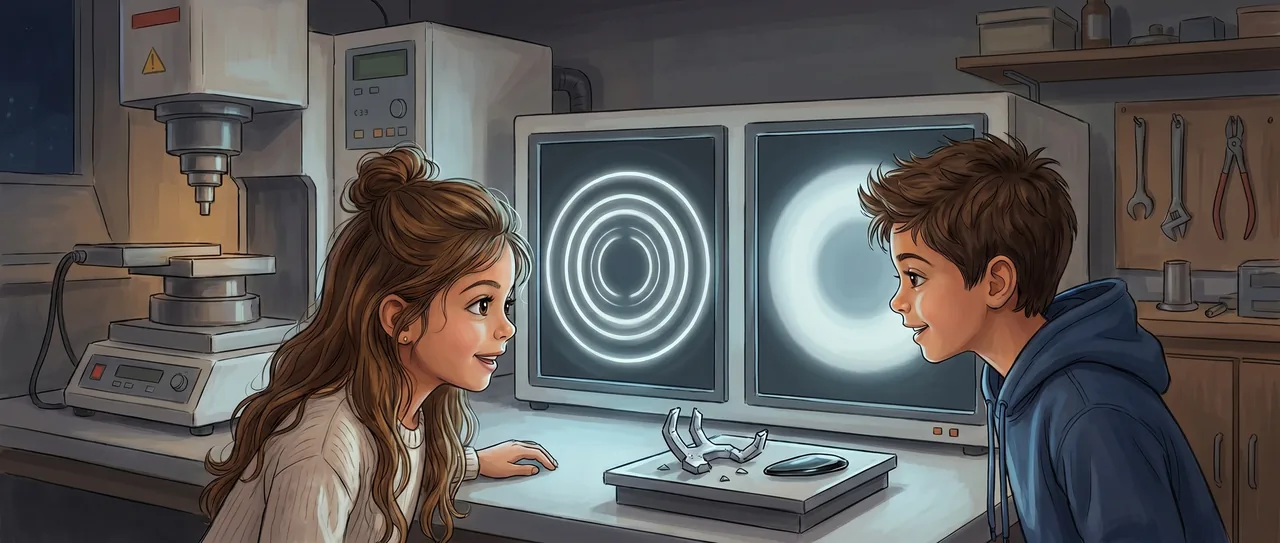
The Metal That Would Not Line Up
The first claw broke while doing nothing heroic.
It had not lifted the rescue bead. It had not climbed the ramp. It had not even touched the little foam boulder that waited at the end of the test track.
It broke when Soren tightened the last screw.
A silver jaw snapped off and pinged across the university materials lab, landing under a poster that said STRONGER BY DESIGN.
Maya crouched and picked it up. The broken edge was jagged and glittery.
“That was our good one,” Soren said.
“It was our thick one,” Maya said.
Around them, the lab hummed with machines behind clear doors. Other worktables had neat trays of aluminum strips, steel pins, copper wire, and plastic gears. Maya and Soren had been given the overflow bench near the safety goggles bin because they had arrived late after Soren stopped outside to read the plaque beside a meteorite.
The lab manager hurried past with a tablet tucked under one arm and three rolls of tape stacked on her wrist.
“Aluminum is easiest,” she said without stopping. “Use the green tray. No exotic samples. The robot run starts in forty minutes.”
Maya looked at the green tray. Every strip in it was straight, flat, labeled, and already scratched by other people’s attempts.
Soren put the broken jaw under the little bench microscope. The screen showed the fracture larger than his hand. It was not one clean break. It was a mountain range of shiny planes.
“It split in steps,” he said.
Maya leaned in. “Like it knew where to go.”
Soren turned the second aluminum strip sideways, marked it, bent it in the small vise, and tightened a screw through it. It cracked halfway through.
“Same place?” Maya asked.
“Same kind of place.”
He tried steel next. It did not snap right away, but when the robot’s motor closed the claw, the jaw bent just enough to drop the glass bead. The bead rolled across the track and stopped against Maya’s shoe.
Maya picked up the bead and held it against the broken aluminum edge. The glittering planes caught the light in separate flashes.
“This metal has pieces inside it,” she said.
“Crystals,” Soren said. “Metals are usually crystals. Tiny ones.”
“Then the crack is using the borders.”
Soren looked at her, then back at the screen. He did not say yes. He moved the microscope stage until a long line crossed the fracture like a road on a map.
The lab manager returned, carrying a box of foam boulders.
“Steel if aluminum fails,” she said. “But do not overcomplicate. You need a working claw, not a research project.”
Maya was already looking past her.
Behind the bench, on a shelf labeled DEMONSTRATION ONLY, sat a row of black sample cases. Most held ordinary things, a copper coin, a steel ball, a strip of spring metal. One case held a dark, smooth piece shaped like a thick raindrop.
Its label read: BULK METALLIC GLASS. AMORPHOUS ALLOY. COOLED FAST ENOUGH TO AVOID CRYSTALS.
Maya lifted the case.
The lab manager made a sound like a drawer being shut. “Not that one.”
“Why?” Maya asked.
“It is fussy. It has to be warm formed, not hammered. And if you heat it wrong, it can crystallize. Use the green tray.”
Then someone at the far end called, “The printer jammed,” and the lab manager walked away fast.
Soren read the label again, lips moving without sound.
“No crystals,” Maya said.
“No grain boundaries,” Soren said.
“No roads for cracks.”
The sample case was locked, but beside it was a drawer of smaller visitor blanks, each one sealed in a clear packet with a barcode. The drawer was not labeled demonstration only. It was labeled WARM FORMING STATION.
The forming station looked like a waffle iron designed by a spaceship. It had a thick clear shield, a red emergency button, and a drawer for graphite mold tiles. A screen showed three steps.
Heat below melting.
Press while softened.
Cool in shape.
Soren touched nothing. He read the whole screen, including the warnings at the bottom.
Maya was less still. She opened the mold-design program and drew a claw jaw with a wide base, a curved throat, and no sharp inside corner where a crack could begin. Soren changed one angle by five degrees.
“Why?” Maya asked.
“Less notch. If we are making a better material, we should not give it a stupid shape.”
Maya grinned. “Fair.”
The graphite cutter whispered over the mold tile, shaving black dust into a sealed cup. While it worked, Soren took one of the cracked aluminum pieces to the X-ray diffraction viewer. The lab had set it up for visitors, with sample buttons and a screen that turned crystal patterns into bright rings.
He slid the aluminum in. The screen flashed with sharp circles and speckles.
Maya put her face close to the glass. “It is lined up even when it looks solid.”
“Lots of little lined-up places,” Soren said.
He scanned the barcode on the metallic glass packet. The station recognized it and offered a narrow warm-forming range. Not melting. Not glowing. Just hot enough for the metal’s atoms to slide before they found time to arrange themselves.
Maya watched the temperature climb.
The dark blank sat in the machine between the graphite mold halves. It looked like nothing special. Not magic. Not shiny enough. Not a new kind of metal that had forgotten how to be metal in the usual way.
At the target temperature, the press lowered.
There was no clang. No spark. The machine made a firm, patient sound. The graph on the screen showed pressure rising, holding, easing. A small fan started. The temperature line fell.
Soren did not breathe loudly until the station unlocked.
Maya slid the drawer open with the heat gloves. Inside the mold was a claw jaw, dark gray and smooth, with edges so crisp they looked drawn.
“It took the shape,” Soren said.
Maya lifted it with tweezers and set it on the cooling tile. “Like plastic.”
“But metal.”
The lab manager came back exactly when they were fastening the new jaw to the robot.
Her eyebrows went up. “You used the glassy alloy.”
“The visitor drawer was unlocked,” Maya said.
“The station chose the range,” Soren said. “We did not melt it.”
The lab manager opened her mouth, closed it, and looked at the clock. “Robot run in four minutes.”
The rescue robot was the size of a sandwich and had six little wheels. Its job was simple. Cross the ridged ramp, push through the foam boulders, pick up the glass bead, and bring it home without dropping it.
Their old aluminum jaw had snapped before the first screw was tight. The steel jaw had bent just enough to fail.
The glass-metal jaw closed around the bead with a tiny click.
The robot climbed.
At the top of the ramp, one wheel lifted and spun in the air. Maya tapped the table once, not the robot, just the table beside it. The wheel caught. The robot bumped through the foam boulders.
The bead stayed in the claw.
At the finish square, the motor opened. The bead dropped into the cup and rang against the bottom.
The lab manager picked up the robot and turned the claw toward the light. “It held.”
Soren already had the leftover sliver of metallic glass in his hand.
“Can we put it in the viewer?” he asked.
The lab manager looked toward the jammed printer, the crowded benches, the clock, and then the dark sliver between Soren’s fingers.
“Thirty seconds,” she said.
Maya placed the broken aluminum claw on the left side of the X-ray screen. Soren placed the glass-metal sliver on the right. The left side sparked with hard little rings. On the right side, one pale halo opened on the screen.
Read the interactive version, listen to the narration, and earn a gold star →
A science-verified short story for curious kids · Curiosity Land