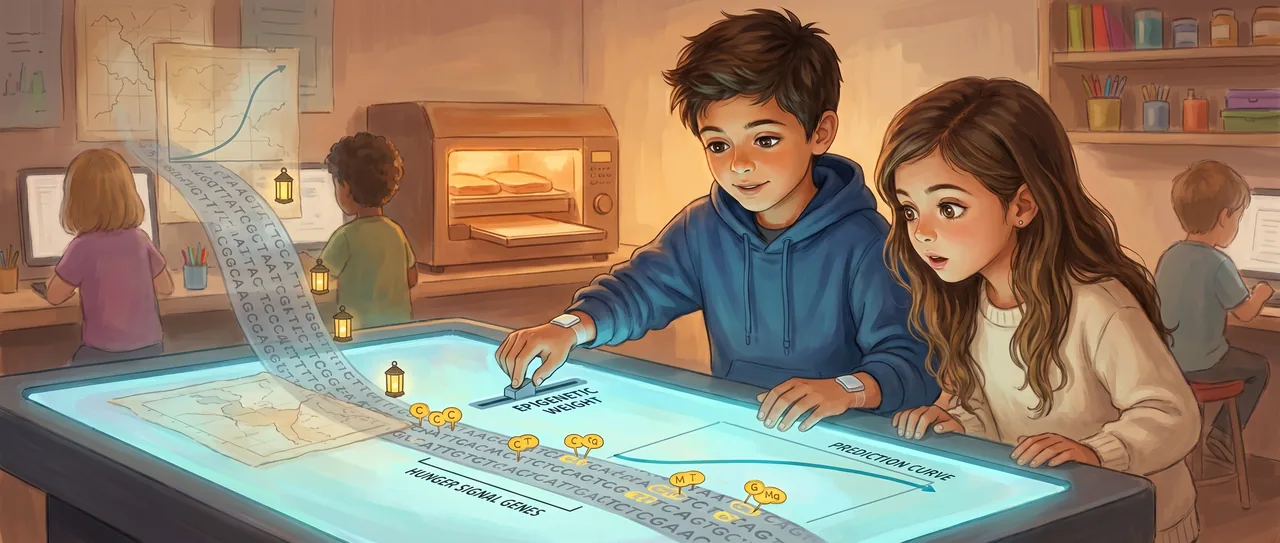
The Marks Between the Letters
The breakfast printer refused Soren.
It hummed politely. It warmed its silver trays. It made a stack of oat moons for Maya, each one stamped with a tiny spiral of cinnamon.
Then Soren placed his wrist under the blue scanner, and the printer folded its trays shut.
On the screen, a calm green sentence appeared.
PREDICTION DOES NOT MATCH RESPONSE.
The guide hurried over with a tablet hugged to her chest. Her badge said VOLUNTEER, and her hair had a pencil stuck through it like she had been interrupted in the middle of inventing something.
"It does that when someone sneaks candy before the workshop," she said.
"I didn't," Soren said.
He did not sound offended. He sounded like he had been handed a puzzle with one corner piece missing.
Maya leaned over the screen. "It predicted low. His patch says high. Why?"
"Usually a loose sensor," the guide said. She tapped her tablet too fast. "We have twenty-six kids to feed before the microbiome maze opens. I'll reset him."
Soren moved his wrist away.
The guide blinked.
"Not yet," he said. "If the sensor is wrong, it should be wrong twice. Can I do the test twice?"
Maya had already picked up the spare patch from the tray. "And switch arms. And don't tell the printer which arm."
The guide looked at the line of waiting children, then at the sealed breakfast printer, then at the two of them.
"Three minutes," she said. "If it still sulks, I'm giving you a banana and calling it breakfast."
Soren washed both wrists at the sink because the instruction card said skin oils mattered. Maya stuck one patch to his left wrist and one to his right. The printer scanned both. The numbers climbed in matching little steps.
PREDICTION DOES NOT MATCH RESPONSE.
The guide made a face. "That is inconvenient."
"The patch isn't wrong," Maya said.
"The prediction is," Soren said.
On the wall above the printer, a bright diagram showed four layers of a person. The first layer was a smiling outline. The second was a ribbon of DNA letters, A, C, G, T, curling like a ladder made of beads. The third was covered in little yellow dots. The fourth was a bowl of soup.
Maya pointed to the yellow dots. "What's that layer?"
"Epigenetics," the guide said. "Chemical marks. Mostly little methyl tags. They sit on DNA or on the proteins wrapped around it and help cells decide which genes to read more or less. Same letters, different volume knobs. Very beautiful. Very annoying for breakfast printers."
Soren looked at his sealed oat moons trapped behind the glass. "Did your prediction use that layer?"
The guide stopped tapping.
"For most visitors, the fast setting uses sequence plus current patch data," she said. "The epigenetic scan takes longer, and parents get nervous when machines say their children have volume knobs."
"I want the slow setting," Soren said.
"Of course you do," the guide said, but she smiled while she said it.
She opened a drawer and handed him a clear tube. "Saliva to the line. No bubbles if you can help it. The reader can map some common methylation sites. It is not a prophecy. It is not a diagnosis. It is a smudgy weather report for cells."
Soren filled the tube. Maya held it up to the light and turned it slowly.
"It looks like nothing," she said.
"Most things do," Soren said.
The epigenetic reader was a white box with a soft blue mouth. It swallowed the tube and began to click. On the table screen, Soren's DNA sequence appeared first, a long necklace of letters scrolling so fast it became a gray river.
LOW COMMON SEQUENCE RISK FOR GLUCOSE SPIKE, the printer wrote.
"That's what it used," the guide said. "See? It expected your body to handle the oat moons neatly."
The reader clicked again.
Yellow dots appeared over the river of letters. Not everywhere. In clusters. Some near genes the screen labeled with small plain words, growth, insulin, fat storage, hunger signals.
Maya stopped moving.
Soren knew that stillness. It meant something in her head had turned sharply and was now facing a new direction.
"Those dots are not in the letters," she said.
"No," the guide said. "They are on the letters. Or near them. They can change when bodies grow, age, exercise, get sick, heal, eat differently, worry for a long time, rest for a long time. Cells keep notes."
Soren touched the edge of the table screen. The yellow clusters brightened under his finger.
"My DNA didn't say this," he said.
"Your DNA isn't all your cells are listening to," Maya said.
The guide pulled up a comparison menu. "We are supposed to use this part for the afternoon history lab. There are public research sets in here. Twins. Athletes. Long-term spaceflight. Famine studies."
"Famine," Soren said.
The word made the printer's warm cinnamon smell seem suddenly too large for the room.
Maya turned to him. "Why that one?"
Soren unzipped the side pocket of his backpack. He did not take out his notebook. He took out the folded family intake form everyone had been told to bring and almost no one had filled in carefully.
His had extra paper clipped to it.
"It asked for grandparent health history," he said. "My grandfather was a child during the coast famine. He used to hide bread under his pillow even when there was plenty. My dad says he never stopped. I wrote it down because the form had only one tiny line."
The guide's fingers slowed.
"There are human studies," she said carefully, "where famine around a grandparent's early life is linked with changes in grandchildren's metabolism. Scientists still argue over how much comes through epigenetic marks and how much comes through family life, food, stress, everything around a child. But some marks can last a surprisingly long time. The DNA letters stay the same. The reading changes."
"Compare it," Maya said.
The guide hesitated, then slid the tablet to them. "You choose. I am officially supervising from one step away."
Soren selected PUBLIC ARCHIVES. He selected METABOLIC MARKS. He selected GRANDPARENTAL FAMINE EXPOSURE.
Maya did not touch the screen. She watched his face, then the dots.
The table filled with ghost maps. They were not identical to Soren's. Some were faint. Some were missing. Some shone in places his did not. But near the hunger signal genes, several yellow clusters sat almost exactly where his clusters sat, like small lanterns placed along the same road.
The room did not get quiet. Children still laughed at the microbiome maze. The printer still hummed. The guide's tablet chirped for attention.
At the table, Soren's breakfast had become older than him.
Maya whispered, "Your cells have margin notes from before you were born."
Soren looked at the gray river of letters and the yellow lights resting on it. In school, when he needed one more step than everyone else, people looked at him like he was making the page messy. Here was a page where the marks between the letters mattered.
He moved two sliders on the screen. One said DNA SEQUENCE. One said EPIGENETIC WEIGHT. When he raised the second slider, the printer's prediction curve bent upward until it matched the patches on both his wrists.
The breakfast printer opened.
It did not give him oat moons. It printed a small bowl of almond yogurt, berries, and two warm oat moons half the size of Maya's. The screen added, SLOWER GLUCOSE RELEASE OPTION.
The guide exhaled. "You fixed my demonstration. I was going to blame the patch."
"It wasn't broken," Soren said.
"It was incomplete," Maya said.
The guide looked at the line of children, then at the epigenetic reader. Her rushed expression had changed into the face of someone whose schedule had just been ruined by something better.
"All right," she called to the room. "New plan. Breakfast is going to take longer. Apparently some of you are carrying very old annotations."
Nobody understood her yet. They came anyway.
Maya stood beside Soren as he ate one careful spoonful of yogurt. His wrist patch rose, but not sharply this time. The curve climbed like a hill instead of a wall.
On the table screen, the public archive remained open. Under famine studies were other folders. Sleep shift workers. High altitude families. Long-distance swimmers. Children born after storms. Children born after gardens.
Maya's finger hovered over the folders.
"If hunger can leave a mark," she said, "what about wonder?"
The guide opened her mouth, then closed it.
Soren pushed his empty sample tube toward Maya.
Maya slid a clean tube from the rack, and the blue reader opened its little mouth.
Read the interactive version, listen to the narration, and earn a gold star →
A science-verified short story for curious kids · Curiosity Land