The Learner That Had Never Touched an Atom
By lunch, every drop that was supposed to glow had gone the color of old dishwater.
Soren held the clear plastic plate under the dark box and counted anyway. One row. Two rows. Twelve little wells, all dim. He wrote dim beside each square in his paper notebook, then underlined the word heat.
The protein had glowed perfectly in the morning. Blue light in, green light out. Then the lab heater had clicked on too high while his aunt filmed a tour for new students, and the little folded machines inside the drops had slumped into useless shapes.
His aunt leaned past him with a tablet in one hand and a coil of microphone wire around her wrist. 'Still nothing?'
'Nothing that counts,' Soren said.
'Try the sequence learner,' she said. 'It is good at this kind of thing.'
Soren looked at the terminal across the bench. Its screen showed a box for amino acid letters and a button marked score mutations. No folded ribbon picture. No atoms. No bonds. Just letters.
'It was not taught heat,' Soren said.
His aunt tucked the microphone wire into her pocket and glanced toward the room where someone had started the printer without paper. 'It was trained on protein sequences. Millions of them. Bacteria, plants, animals, hot springs, ice, ordinary mud. It finds patterns.'
'Patterns are not folding.'
'Usually I would argue,' she said, already moving. 'Today I have forty minutes of video and a printer eating itself. Use gloves.'
Then she was gone.
Soren did not touch the terminal. He liked models when he knew what they were doing. He did not like a blank box that had never felt heat telling him which tiny change would keep a protein from melting.
He turned back through his notebook.
Most people wrote the successful wells first. Soren did not. The failed ones had sharper edges. This one glowed until warmed. This one never glowed. This one glowed weakly but survived the heater. This one made a cloudy smear. The inside of his head got too crowded if he did not put them somewhere.
He copied the original protein sequence into the terminal. It was a long necklace of one-letter amino acid codes, hundreds of them, a sentence no person would say aloud. Then he clicked the setting that showed single changes, one position at a time.
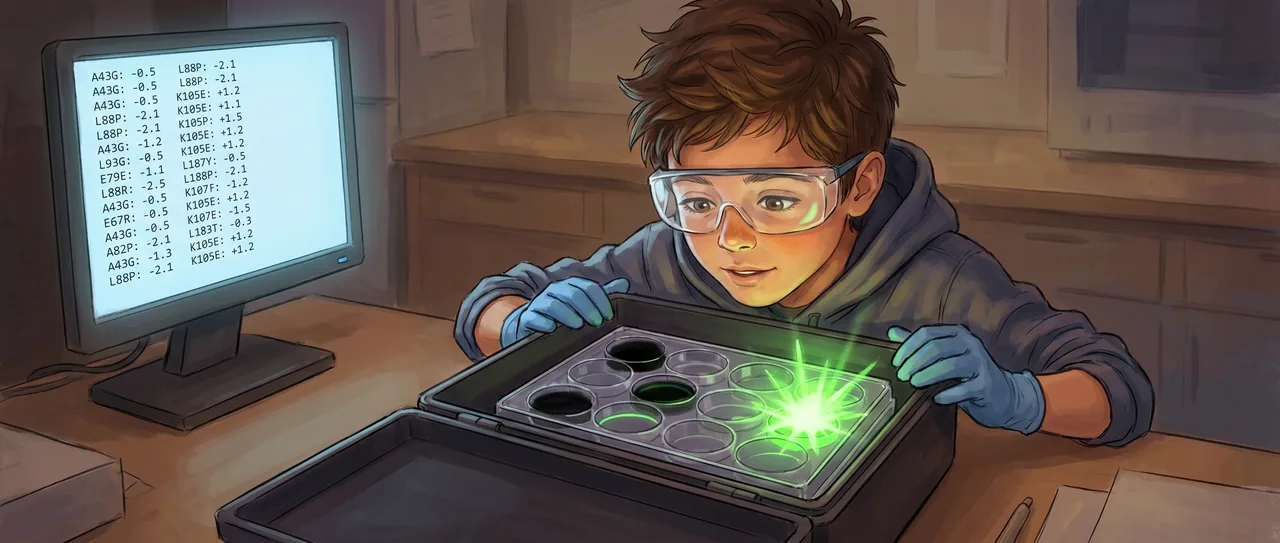
The learner filled the screen with rows.
Change here, score down.
Change there, score up.
Most changes were bad. Some were terrible. A few were marked as possibly better.
Soren did not believe it yet.
He took the mutations he had already tried and hid their results under his palm. One by one, he typed them into the score box.
The cloudy smear scored low.
The never-glowed one scored lower.
The weak survivor scored higher than the bright one that had died in the heat.
Soren sat very still.
The terminal hummed. In the next room, his aunt said, 'No, not that button,' and the printer made a noise like a goose.
Soren checked the training note at the bottom of the screen. The learner had not been given chemical rules. It had not been shown which amino acids were oily or charged. It had not been taught how proteins fold. It had been given sequences from living things and asked, again and again, what letters belonged near what other letters.
He pictured them, not as letters now, but as old answers. Proteins from bacteria that liked boiling water. Proteins from fish under ice. Proteins from leaves, mold, skin, seeds, salt ponds, vents in the sea floor. Every sequence was something that had worked well enough to be carried forward.
The room seemed to acquire extra walls, far away and invisible.
Soren bent closer to the screen.
'You learned from what lived,' he said.
The learner did not answer. It listed another mutation.
Soren made a test, because tests were better than being impressed. He chose four changes. Two the learner liked. Two it disliked. He made sure none were the exact ones he had already tried. The machine on the side bench printed four small DNA cards, each one a recipe for the cell-free drops to make a slightly changed version of the glowing protein.
His aunt came back just as he was loading pipette tips.
'Those are authorized sequences?' she asked.
Soren pointed to the green safety check on the printer.
'Good,' she said. 'Why four?'
'Two it thinks will work. Two it thinks will break.'
'Efficient.'
'Mean,' Soren said.
She smiled and almost stayed, but someone called from the doorway about the printer again. 'Timer on. Heater capped at the test temperature. Do not improvise with the incubator.'
'I am not improvising with the incubator.'
'That is what people say right before improvising with the incubator.'
'I wrote it down.'
His aunt looked at his notebook, with its crooked grid and scratched-out labels and the word dim underlined three times. For a moment her face changed, not into pride exactly, and not into surprise. More like she had found a tool where she had expected clutter.
'Then you are dangerous in the useful way,' she said, and left.
The drops began clear. They always did. Soren sealed the plate and slid it into the small incubator. While the protein recipes copied and folded in their warm wells, he cleaned the bench twice, then opened the public database his aunt had mentioned.
There were more sequences than he knew how to think about. Pages and pages of them. Some had names. Some had only codes. Some belonged to creatures everyone knew. Some came from scoops of seawater, from soil, from places where people had not even grown the organism, only read its genetic traces.
Soren clicked a protein family related to his glowing one. The screen showed a tree of sequences branching and branching. Many were similar. Some had strange letters in places where his protein could not survive a change.
He zoomed out.
The branches kept branching.
For a while he forgot the timer.
When it chimed, he carried the plate to the dark box. His hands did not shake. He had done this part before.
Blue light washed over the wells.
The two mutations the learner had disliked were dark. Not almost dark. Dark.
One liked mutation glowed green, but thinly.
The other glowed hard and bright, brighter than the original had after warming. A tiny square of green sat in the plate as if someone had pinned a star under plastic.
Soren checked the labels. He checked them again. Then he put the warm plate back under the dark box and checked the old results in his notebook.
The bright survivor was a change he would not have chosen. It did not sit in the obvious place. It did not look dramatic. It was one letter, tucked among hundreds, and the learner had picked it out from sequences made by things that had never seen this lab, this bench, or Soren.
His aunt came in quietly this time.
'Which one?' she asked.
Soren pointed.
She leaned over the dark box. Green light touched her chin.
'That is a real improvement,' she said.
Soren waited for her to explain it away. She did not.
Instead she said, 'It still does not know atoms.'
'I know.'
'And it still found that.'
'I know.'
On the screen behind them, the tree of sequences waited, crowded with branches.
Soren took off his gloves, put on clean ones, and pulled the keyboard closer. He did not open his notebook. Not yet.
The database list still showed proteins with no tested mutations. The learner was ready to score them anyway.
Soren moved the cursor to the next protein in the list and pressed enter.
On the screen, three letters blinked beside the word unmeasured.
Read the interactive version, listen to the narration, and earn a gold star →
A science-verified short story for curious kids · Curiosity Land