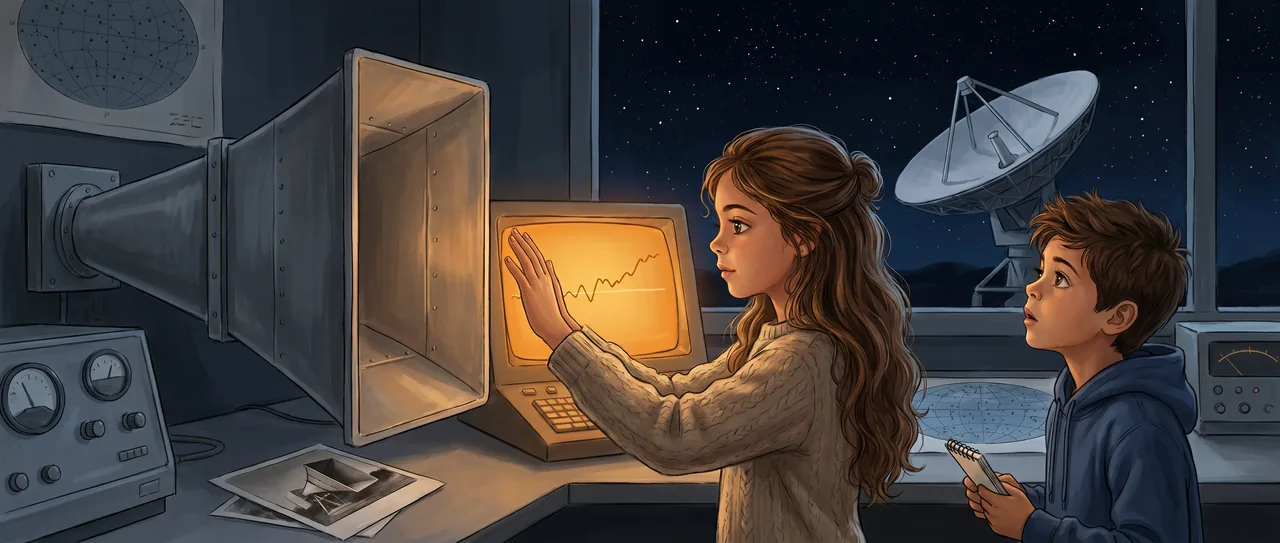
The Hiss That Stayed
They had come to help erase the universe.
That was not what the engineer called it. She called it subtracting the background. She said it while pinning her gray hair under a wool hat and scowling at the screen in the control room.
Outside, the dish pointed at the desert sky like a white ear. Inside, the speaker made a thin steady hiss.
The engineer tapped the screen with one knuckle. “That should be gone.”
Maya leaned closer. “It sounds gone already.”
“It sounds like failure,” the engineer said. “People drove two hours to hear Jupiter’s radio storms. Not a refrigerator gargling at the edge of space.”
Soren had his notebook open, because the room was full of labels that used words like receiver temperature and microwave horn and absolute zero, and his head was already too crowded. He wrote: failure has a sound.
The engineer gave them a black square of foam on a pole. “Microwave absorber. Warm load. Do not lick it, do not fold it, do not invent a game with it. Hold it in front of the horn when I say. I need to find the offset before the visitors arrive.”
Maya took the pole. “What offset?”
“The part that is not sky.” The engineer turned back to the console. “Every machine has its own mutter.”
Soren looked at the speaker. The hiss did not mutter. It held one note, too thin to be a note.
The engineer slewed the dish toward the east. Motors hummed under the floor. The stars on the monitor shifted. The hiss stayed.
“West,” the engineer said.
The dish moved again. The hiss stayed.
“Higher.”
The dish lifted toward the black bowl of the sky. The hiss stayed.
Maya’s eyes narrowed. “It’s too good.”
The engineer did not look away from the screen. “Too bad, you mean.”
“No. Bad wiggles. This isn’t wiggling.”
Soren wrote the directions in a little column. East. West. Zenith. Same. Then he crossed out same and wrote nearly same, because the engineer would have said nothing was exactly same if you measured hard enough.
A group of visitors stamped into the room, bringing cold air and the smell of dust. The engineer smiled at them too brightly.
“Tiny delay,” she said. “The sky is being rude.”
Maya whispered, “The sky is being consistent.”
Soren looked at the old photograph on the wall. Two scientists stood beside a strange horn-shaped antenna, both squinting in sunlight. Under the photograph, a label said they had found extra microwave noise they could not get rid of. Not pigeons. Not the city. Not the instrument. It was radiation from the early universe, cooled and stretched by the expansion of space until it was only a few degrees above absolute zero.
He had read about it before. Cosmic microwave background. The afterglow of the Big Bang. Faint radiation from every direction.
He had known those words yesterday.
The engineer called, “Warm load.”
Maya swung the black foam square in front of the open horn. The speaker hissed louder, thicker, like rain suddenly striking a roof.
The visitors murmured.
“Good,” the engineer said. “Receiver sees warm things.”
Maya pulled the square away. The hiss thinned again.
Soren stopped writing.
He took one step toward the window, where the dish sat under stars so sharp they looked close enough to scratch. “If it were the machine,” he said, “covering the horn would not make that shape.”
The engineer glanced at him. “It would make some shape.”
“But not the sky shape coming back.” He pointed at the screen, then at his column. “It changes for warm foam. It changes for ground. It does not change much for sky.”
“Which is the problem,” the engineer said.
Maya said, “Or the answer you keep subtracting.”
The engineer opened her mouth, then shut it. Her pencil slid out from behind her ear and bounced under the console.
The visitors had gone quiet. Someone’s little brother was chewing on the zipper of his coat.
The engineer crouched for the pencil. “We are not running a cosmology lecture with a half-calibrated school receiver.”
Maya was already at the console. She did not touch anything yet. Her hand hovered above the direction buttons. “Can we choose the emptiest place?”
“No Milky Way,” Soren said. “No Moon. Not low near the horizon. Atmosphere gets in the way.”
The engineer looked at the clock. Her face did the kind of math adults did when they were deciding whether children had used up all their patience. “You get five minutes. If anyone breaks the receiver, I will haunt your science fair projects.”
Maya smiled with one side of her mouth. “Fair.”
Soren found a printed sky map clipped beside the console. It had bright radio sources circled in red. He traced the blank places, not the marked ones. That felt backward, and exactly right.
“There,” he said. “Between those.”
Maya tapped the controls. The dish turned slowly. The room listened to the motors, then to the speaker.
The hiss stayed.
Maya pointed the dish to another blank place. Soren checked the map, then nodded.
The hiss stayed.
Again.
The hiss stayed.
A girl in the visitor group whispered, “Is it broken everywhere?”
Soren looked at the photograph of the horn antenna, then at the black sky beyond the glass. “That’s what they thought.”
Maya took the foam square and held it up. “This is warm.”
She covered the horn. The hiss swelled.
She uncovered it. The hiss thinned.
Soren said, “Your hand would be loud too.”
Maya put her palm near the horn but not over it. The line on the screen jumped a little.
The little brother stopped chewing his zipper.
“People are warm,” Maya said.
“Ground is warm,” Soren said.
“The sky is cold,” Maya said.
Soren looked at the steady line that had annoyed the engineer so much. The room’s machines clicked and breathed. The black window held the dish, the dish held the sky, and the sky held a sound that had traveled longer than mountains had existed. Longer than the Sun. Longer than there had been ears, or deserts, or names for anything.
Maya did not look impatient now. She looked almost angry, but not at anyone in the room. More like the room was too small and had been pretending not to be.
The engineer stood behind them with her pencil in her hand.
“The radiation is not really a sound,” she said to the visitors. “The speaker is translating the receiver signal.”
Maya said, “But it is really there.”
The engineer’s smile this time was smaller and better. “Yes.”
Soren said, “And it comes from every direction.”
“Almost perfectly,” the engineer said. “There are tiny differences, but this instrument will not map them tonight.”
Maya glanced at Soren. “Tiny differences matter.”
Soren nodded. He did not write that down. He wanted both hands empty for the next part.
The engineer stepped away from the console. “Show them again.”
So they did.
They pointed the dish to a black place where the sky map showed nothing bright. The speaker hissed.
They pointed it somewhere else empty. The speaker hissed.
They covered the horn with the warm black foam. The hiss grew thick.
They uncovered it. The old thin hiss returned.
No one clapped. Clapping would have been the wrong size.
The visitors leaned toward the speaker as if it were very far away, which it was, and also right there in the room.
After the public night ended, after the cars rolled down the gravel road and the engineer went outside to lock the gate, Maya and Soren stayed by the console.
The dish was parked high. The sky beyond the window looked empty between two stars.
Maya raised her hand and slowly covered the mouth of the horn.
The hiss grew heavy.
She pulled her hand away.
The thin sound came back.
Read the interactive version, listen to the narration, and earn a gold star →
A science-verified short story for curious kids · Curiosity Land