The Fingerprints of Ultraviolet
The roof lab smelled like hot metal, wet concrete, and the orange sunscreen everyone had been told to wear.
Maya had put too much on her nose and not enough on one ear. Soren had read the back of the tube twice, then rubbed the lotion over his hands as if he were sealing an envelope. The rest of the visiting class stood in a restless clump under the shade sail, blinking at the row of glass panes propped on silver frames.
Dr. Pell hurried between the frames with a spray bottle in one hand and a tray of black paste in the other. His gray hair stuck up in separate ideas.
“We are already nine minutes behind,” he said. “So you will have to be impressed efficiently.”
He smeared the black paste across two panes. One smear sat on ordinary glass. The other sat on glass with a coating so thin it looked like nothing at all.
“This one is regular,” Dr. Pell said, tapping the first pane. “This one is self-cleaning. Same sunlight. Same rain. Different surface.”
“That paste is dirt?” Soren asked.
“City dirt,” Dr. Pell said. “A little soot, a little oil. The sort that makes buildings look tired.”
Maya leaned forward. The coated pane did not look special. That bothered her. Special things usually hid badly.
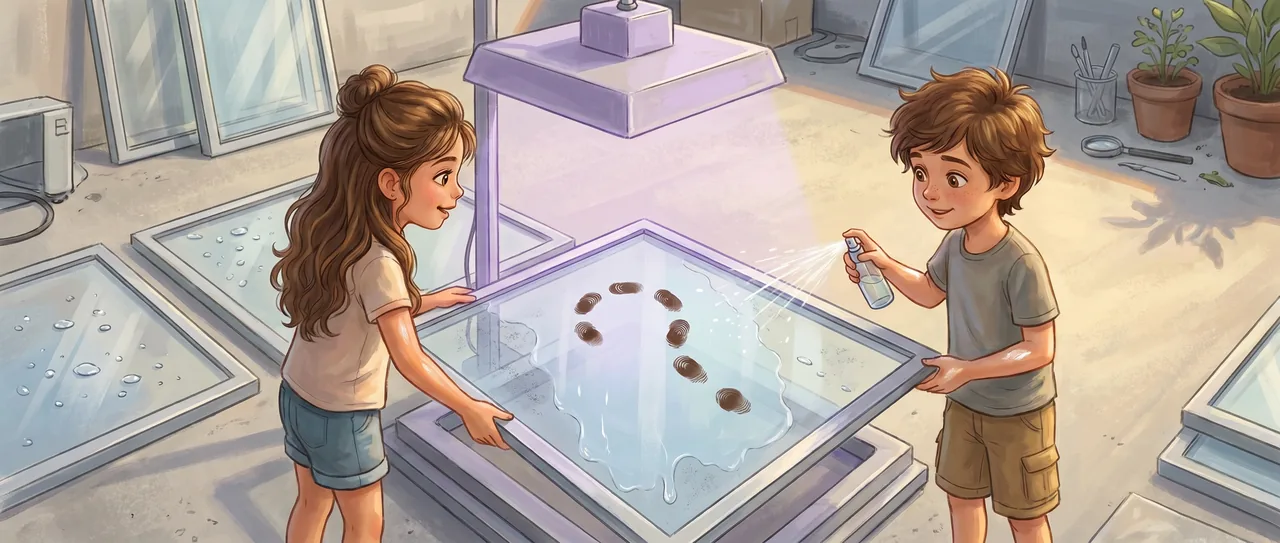
Dr. Pell flicked on a square lamp fixed above the panes. It gave off a pale violet edge that made everyone’s shoelaces look ghostly. A warning label said ultraviolet source, do not stare.
“Sunlight has ultraviolet in it,” Dr. Pell said. “The coating uses it. Then water helps carry the loosened dirt away.”
He sprayed both panes. On the ordinary glass, the water gathered into beads and crawled down through the black paste, leaving crooked trails.
On the coated glass, the water spread wide and flat like a clear blanket.
For three seconds, it was perfect.
Then the blanket thinned and slid down, and five dark smudges stayed behind.
They were not streaks. They were not drips. They were fingerprints.
Dr. Pell stopped spraying.
The class made the sound a class makes when a machine does something wrong.
“No,” Dr. Pell said. “That should not be there.”
Maya stepped sideways. The fingerprints sat near the lower edge of the coated pane, exactly where children had held it while Dr. Pell arranged the frames.
“Hands,” she said.
“Yes, thank you,” Dr. Pell said, already unscrewing the spray bottle. “Someone had oil on their hands. It happens. The glass will manage.”
“It didn’t,” Maya said.
Dr. Pell frowned at the bottle. “Maybe the water tank has soap in it. That ruins the sheeting. Or dust from the construction netting. We’ll reset after lunch.”
The class groaned. Their bus was due before lunch.
Soren looked at his own palms. They shone faintly with sunscreen.
“It might not be hand oil,” he said.
Maya turned to him. “Sunscreen.”
Soren nodded once, not because he was sure, but because the guess had a shape.
Dr. Pell was already talking into his wrist com. “Can someone check the roof tank? No, not later. Before the donor walk-through.”
Maya found a stack of small test panes on the cart. Some had blue tape on one corner. Some did not.
“Which ones are coated?” she asked.
Dr. Pell covered the com with his hand. “Blue tape. Do not scratch them. Do not touch the lamp. Do not make me more behind.”
He went back to the com.
Soren took one blue-taped pane and one plain pane. Maya held them by the edges. He washed one thumb at the little sink, dried it on his shorts, and pressed it to the coated pane.
“Bare thumb,” he said.
Then he pressed a shiny sunscreen thumb beside it.
“Sunscreen thumb.”
Maya dipped a cotton swab into the black paste and painted a careful stripe over both prints. The paste smelled like bicycle chains and burned toast.
“Now the light,” she said.
“We can slide it under the fixed lamp,” Soren said. “Not touch it.”
They slid the pane beneath the violet glow. The black stripe did nothing for a while. That was the hardest part. Waiting made everybody else look away.
Maya did not look away.
Tiny clear freckles began to appear in the stripe around the bare thumbprint. The blackness there loosened first at the edges, then in the middle, as if the glass were quietly refusing to stay dirty.
The sunscreen thumb stayed black.
Soren sprayed once.
Water spread across the coated pane in a sheet. Around the bare thumbprint, the paste washed thin and gray and then nearly gone. Around the sunscreen thumbprint, the paste clung in a dark oval with the whorls of Soren’s skin still inside it.
Maya’s mouth opened, but no sound came out.
The smudge was not just dirt. It was a shadow cast by something invisible.
Soren grabbed the sunscreen tube from his pocket and turned it over. “Titanium dioxide,” he read. “Active ingredient.”
Maya pointed to the sign beside the self-cleaning panes. “Titanium dioxide coating.”
They stared at the two labels.
“That’s rude,” Maya said. “Same thing.”
“Not the same place,” Soren said.
He rubbed his finger over the sunscreen oval on the glass. It left a pale smear. “On skin, it stops ultraviolet before it gets in.”
“On glass, it needs ultraviolet to do the cleaning,” Maya said.
“So the sunscreen is protecting the dirt from the self-cleaning glass.”
Maya laughed once, sharp and delighted. “The dirt is wearing sunscreen.”
Dr. Pell lowered his wrist.
“What did you say?” he asked.
Maya held up the test pane. Soren angled it so the dark oval caught the light.
Dr. Pell looked annoyed for one second, then interested for three, then completely stolen by the idea.
“Again,” he said.
“Not with the same pane,” Soren said. “We need one coated and one plain. Same paste. Same lamp. Same water. Three marks each.”
Dr. Pell blinked. “Yes. Good. Yes, do that.”
He reached for the panes.
Maya pulled them back.
“We can,” she said.
Dr. Pell’s hand hung there. Then he gave a small, impatient bow, as if handing over a kingdom he had no time to rule.
Maya and Soren set up the second test. On each pane, Soren made three marks, bare thumb, sunscreen thumb, and a place rubbed with sunscreen then wiped almost clean. Maya painted the soot paste in one long stripe across all of them.
Under the lamp, the plain glass remained dirty everywhere.
The coated glass changed only where ultraviolet could reach it.
The bare thumbprint faded. The wiped place faded slowly, with a stubborn gray rim. The sunscreen thumb stayed dark, exact as a stamp.
When Soren sprayed the coated pane, water did not bead. It ran as one clear skin, carrying loosened grime with it. On the plain pane, water made little round drops, each holding its own tiny upside-down roof.
Dr. Pell whispered, “Of course.”
Maya looked up at him.
He cleared his throat. “I mean, I should have thought of that.”
“You were thinking about the tank,” Soren said.
“I was thinking about the donors,” Dr. Pell said. “Which is worse.”
The class pressed closer now. Someone asked if the glass was eating the dirt. Someone else asked if sunscreen made windows dirty forever. Dr. Pell opened his mouth with his lecture face on.
Maya spoke first.
“It’s not eating like teeth,” she said. “The light starts it. The coating helps. Water takes things away.”
Soren added, “And sunscreen blocks the ultraviolet before it reaches the coating. That is what it is for.”
Dr. Pell nodded. “Titanium dioxide particles in sunscreen absorb ultraviolet and release the energy as tiny amounts of heat, too small for you to feel. In this glass, titanium dioxide is fixed as a surface coating. With ultraviolet and water, it helps break down oily dirt.”
“Same material,” Maya said.
“Different job,” Soren said.
“Different neighborhood,” Maya said.
For once, nobody told her that was not the proper word.
Dr. Pell checked the roof clock and winced. “The donor walk-through is in four minutes. The official demonstration currently has fingerprints all over it.”
“They’re useful fingerprints,” Maya said.
Dr. Pell looked at the large coated pane, still marked with the five dark smudges. “Useful is not usually the look we choose for donors.”
Maya picked up the sunscreen tube.
Soren picked up a clean blue-taped pane.
They did not need to explain at first. Maya drew five small dots of sunscreen on the clean coated glass. Soren dusted the pane with the thinnest possible wash of black paste, just enough to make the surface look smoky. Maya set a cardboard star stencil over one corner, then shook her head and moved it away.
“No stencil,” she said. “Fingers are better.”
Soren looked at the five dots. “Constellation?”
“Question mark,” Maya said.
He added two smaller sunscreen marks beneath the curve.
Dr. Pell stared. “You are making dirt survive on purpose.”
“Only where the ultraviolet can’t get through,” Soren said.
The roof door opened. Adult shoes clicked onto the concrete. The class went quiet in the sudden way that made every spray bottle drip sound enormous.
Dr. Pell stood a little straighter, then stepped aside.
Maya slid the marked pane under the ultraviolet lamp. Soren held the spray bottle ready.
The smoky paste began to loosen around the sunscreen dots. Clear halos widened. The dots stayed dark.
“Now,” Maya said.
Soren sprayed.
Water spread over the glass in one shining sheet, and the soot ran down in gray threads.
On the pane, seven dark fingerprints curved into a question mark while the glass around them washed itself clear.
Read the interactive version, listen to the narration, and earn a gold star →
A science-verified short story for curious kids · Curiosity Land