The Cup That Could Not Hold
The helium had vanished before breakfast.
That was not supposed to happen.
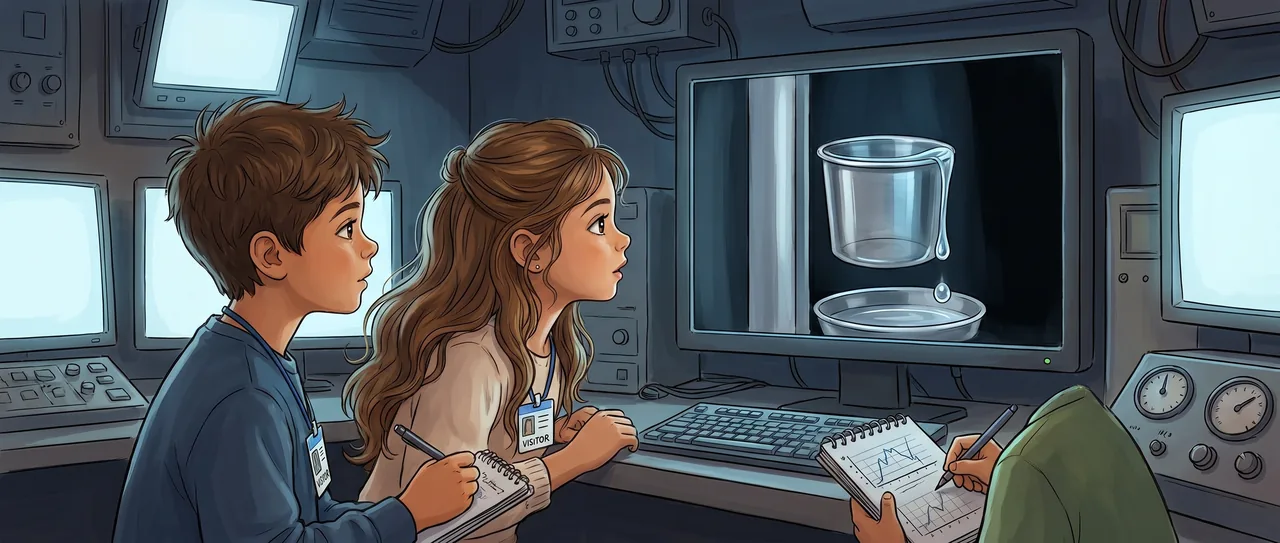
Maya and Soren stood in the control room of the university cold lab, wearing visitor badges that made them look more official than they felt. On the other side of a thick window sat a silver cylinder taller than a refrigerator. Inside it, behind layers of vacuum and glass and polished metal, a small cup held liquid helium colder than space between the stars.
Or it had held liquid helium.
Dr. Vale tapped the screen with one knuckle. She had three pencils stuck through her hair and a smudge of grease on her cheek. She had invited them because Soren’s mother repaired the lab’s old elevator, and because Maya had once asked her why cold did not pour downward like water.
Now Dr. Vale looked as if she regretted all invitations ever made.
“Level at seven o’clock,” she said, pointing to a line on the graph. “Full. Level at eight o’clock. Not full. No one touched it. No alarms. No broken seal. The public stream begins in forty minutes.”
Maya leaned close to the window. The cup inside the cryostat looked dry and ordinary, which made no sense. Ordinary things did not sit at one point eight kelvin.
“It left,” she said.
“Yes,” Dr. Vale said. “That is the problem.”
“No. It left by a way you are not calling a way.”
Dr. Vale shut her eyes for half a second. “Leaks come from joints, valves, cracked seals, and human mistakes. The top of a cup is not a leak.”
Soren had already opened his notebook, but he was not writing a conclusion. He drew the cup, the pipes, the level sensor, and a small question mark at every place a thing could fail.
“What changed before it started leaving?” he asked.
“The pump brought it below the lambda point,” Dr. Vale said. “Two point one seven kelvin. That is when helium becomes superfluid. But this is not a superfluid demonstration. This is supposed to be a nice, clean container calibration.”
Maya turned from the window. “What does superfluid change?”
Dr. Vale was already checking another panel. “No viscosity. It flows without internal friction. It goes through tiny openings normal liquids cannot manage. Which is why I am checking the seals.”
Soren underlined two point one seven kelvin. “Can we see yesterday’s run?”
Dr. Vale hesitated. Then she dragged the old graph beside the new one. “Yesterday stayed above the lambda point. The helium behaved itself.”
Maya pointed. “Today drops here.”
Soren put his pencil tip on the same place. “Right after two point one seven.”
“Coincidence does not repair equipment,” Dr. Vale said.
“It can accuse it,” Soren said.
Dr. Vale gave him a look, then almost smiled.
Maya walked to the second screen. It showed a camera view from inside the cryostat, aimed at the bottom of the cup where the pipe entered. Everything there was still. Too still.
“The camera is looking where you already believe the leak is,” Maya said.
“Because that is where leaks are.”
“The helium doesn’t care what leaks are called.”
Soren looked up from his drawing. “If it’s a seal, warming above two point one seven should not stop it. If it’s something superfluid does, warming should stop it.”
Dr. Vale stopped tapping.
The room hummed. Somewhere in the wall, a pump made a patient, chewing sound.
“You want me to warm the sample,” she said.
“A little,” Soren said. “Not much. Above the line.”
“The stream begins in thirty-five minutes.”
“You have a broken demonstration either way,” Maya said.
Dr. Vale stared at the graph as if it had personally insulted her. Then she typed a command.
The temperature number crawled upward. One point nine. Two point zero. Two point one. Two point two.
The falling level mark slowed.
At two point three kelvin, it stopped.
Nobody spoke.
Dr. Vale lowered the temperature again.
Two point two. Two point one eight. Two point one seven.
The level mark began to slide.
Maya did not say anything. She just looked at Soren.
Soren made one small, fierce dot in his notebook.
Dr. Vale whispered a word Maya was fairly sure visitors were not supposed to learn in laboratories.
“Move the camera,” Maya said.
“To what?”
“The rim.”
Dr. Vale looked at the quiet bottom seal on the screen, then at the time, then at Maya. “The rim is not where the engineering diagram ends.”
“It is where the cup ends,” Maya said.
The camera inside the cryostat was not meant for drama. It rotated slowly, with little jerks, as if waking up from a long sleep. The bottom pipe slid away. The inner wall of the cup filled the screen, silver and smooth. At first there was nothing.
Then the light changed.
It was so faint Maya thought her eyes had invented it. A sheen, thinner than breath on a mirror, moved upward along the inside of the cup. It did not splash. It did not climb like a bug or crawl like syrup. It simply occupied the wall higher than liquid was supposed to be.
Soren leaned forward until his badge knocked the console.
The shining film reached the rim.
It went over.
On the outside of the cup, a bright line crept downward. A bead formed underneath, round and trembling, where there was no joint, no valve, no crack, no hole anyone had bothered to name.
Maya’s skin prickled under her sleeves.
The room had always been large, full of pipes and pumps and warning signs, but now it seemed much too small to contain what was happening in the little cold chamber. A liquid had been put in a cup. The cup had made a promise. The liquid had found the promise full of surfaces.
Dr. Vale sat down very slowly.
“It’s a Rollin film,” she said. “A superfluid film. It can climb the wall and run over the edge. I know that. I know that perfectly well.”
“You knew it in a different room,” Soren said.
Dr. Vale looked at him.
He did not apologize. “I do that too.”
Maya watched the bead fall from the outside of the cup into the colder darkness below. Another bead began forming almost at once.
“It isn’t escaping from one place,” she said. “It’s escaping from the whole edge.”
Dr. Vale stood up so fast the pencils in her hair wobbled. “The catch dish.”
She opened a control panel and moved a small dish on a mechanical arm. It slid into view below the outside of the cup. The next bead dropped neatly into it.
“Can you show both?” Maya asked. “The level going down and the outside bead?”
“The camera can split screen,” Dr. Vale said. “If the software behaves.”
Soren was already at the spare keyboard. “Which window controls the graph?”
Dr. Vale pointed. “That one. Do not touch the red controls. Or the orange controls. Or anything shaped like a skull.”
“The graph only,” Soren said.
Maya dragged a chair to the monitor and adjusted the camera with tiny taps. Too high showed only the rim. Too low missed the place where the bead gathered. She found the angle where the inside wall, the lip, and the outside drop all fit together.
The cup looked impossible from that angle. Not broken. Not failed. Outwitted.
Dr. Vale checked the countdown to the stream. Twelve minutes.
“I was going to show a stable calibration vessel,” she said.
“No one wants that,” Maya said.
“I did.”
Maya considered this. “No one under twelve wants that.”
Dr. Vale laughed once, surprised and sharp.
They ran the test again. Warm it above the lambda point, and the shining wall went dull. Cool it below, and the film returned, silent and exact, rising over the rim as if gravity were only one vote in a meeting.
By the third run, Soren could say when the level line would begin to fall. Maya could bring the camera to the rim just before the first silver thread appeared. Dr. Vale stopped swearing at the equipment and started swearing happily at the universe.
When the stream light blinked green, Dr. Vale did not use her old script.
She looked into the camera and said, “We planned to show you a cup holding liquid helium. Instead, two visitors helped us notice why the cup could not.”
Maya crouched beside the screen. Soren stood with one hand on the graph controls.
Inside the cold chamber, a silver bead fell into the waiting dish, and another bead gathered above it on the wall.
Read the interactive version, listen to the narration, and earn a gold star →
A science-verified short story for curious kids · Curiosity Land