The Box for Things That Float Through Glass
The first argument began before the storm reached the mountain.
The director of Ridge Weather Station slapped a stack of yellow report forms on the table and said, "Weather is only useful when it fits in boxes. Time. Place. Direction. Duration. Size. Color. Sound. Damage. Witnesses. If you leave boxes empty, the sky gets away with things."
Soren liked boxes. He liked that a blank square waited without rushing him. He lined up his pencil with the edge of the form.
Maya leaned over his shoulder. "What if it does something that is not on the form?"
"Then," the director said, "write clearly in the margin and hope I am in a generous mood."
She was not in a generous mood. The rain gauge on the south roof was sending nonsense. The lightning counter had already clicked seventeen times in ten minutes. Every screen in the station control room glowed with maps, numbers, and moving green smudges.
Maya looked at the form again. "There is no box for wrong shape."
"Lightning has shapes," the director said. "Branching. Sheet. Cloud to ground. Cloud to cloud. Upward. Be specific."
"What about sideways?" Maya asked.
The director pinched the bridge of her nose. "If the sky does something sideways, you may invent a box."
Then the radio crackled, the rain gauge alarm complained, and the director hurried down the metal stairs, muttering about leaves, bad calibration, and people who called every porch reflection a miracle.
The observation room went quiet except for rain.
It was a round room with windows on three sides. During the day, visitors could see the valley, the road, and the switchback trail like a pale scratch through the pines. Now the windows were black mirrors full of lightning.
Soren wrote the station time at the top of his practice form. Twenty-one seventeen. He had been told to copy the clock exactly.
Maya walked along the windows, not touching the glass. "The reflections are behind us," she said.
"Yes," Soren said.
"So that one is outside."
He looked up.
At first he saw only rain stripes and the white flash of clouds. Then he saw the ball.
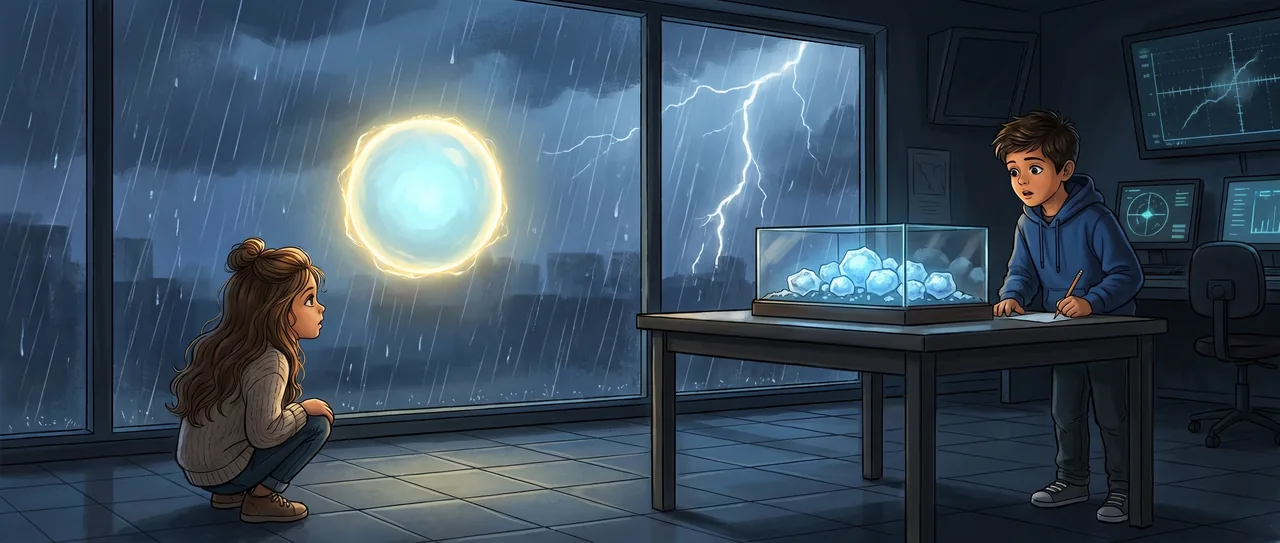
It hung beyond the west window, lower than the roof and higher than the railing. It was about the size of a grapefruit, though Soren did not write that yet because he wanted a better comparison. Its edges were not sharp. They trembled. The color was pale blue in the middle and yellowish around the rim, like the flame on a gas stove when it is trying to decide what it is.
It drifted toward the station.
Maya stopped moving.
"Do not touch anything metal," Soren said, because that was the rule printed on the lightning safety poster.
"I am not planning to pet it," Maya said.
The ball reached the window.
Rain ran down the outside of the glass. Soren could see the water between them and the light. He could see each drop brighten as it passed in front of the sphere.
Then the sphere was inside.
The window did not open. It did not crack. It did not make the smallest sound.
Maya took one step backward. Soren did too, because her step was the correct size.
The ball floated over the sill, slow as a soap bubble, except it was not a bubble. It did not rise. It did not fall. It crossed the room at the height of Soren’s chest.
"Time," Maya said.
Soren looked at the wall clock. "Twenty-one eighteen and twelve seconds."
"Say it again when it changes."
He did not ask why. He wrote.
Maya crouched beside the row of floor tiles without taking her eyes off the light. "It came through the west window. Third pane from the left. Height, maybe one meter. Moving east. No wind inside."
"No sound," Soren said.
"No heat I can feel. Do not get closer."
The ball passed in front of the display case that held old hailstones preserved in clear resin. The resin flashed blue. The hailstones looked like small captured moons.
Not because it was magical. Magic would have been easier. Magic did not need the window to stay whole.
The sphere paused above the yellow report forms. Its light slid across the printed boxes. Time. Place. Direction. Duration.
Maya whispered, "It is reading the form wrong."
Soren nearly laughed, but the laugh got stuck.
The sphere moved again. It drifted toward the east window, crossed in front of the dark valley, and vanished.
There was no pop. No smoke. No fading tail. One moment the ball was there. The next moment there was only black glass and Soren’s pencil making a dent in the paper.
"Twenty-one eighteen and twenty-nine seconds," he said.
Maya stayed crouched. "Seventeen seconds."
"From when I saw it inside. Longer if we count outside."
"Count both. Use two lines."
Soren wrote so fast his letters leaned into each other.
The director came back with wet sleeves and a leaf stuck in her hair. "The south gauge is a disgrace," she said. Then she saw them.
Maya was still by the tiles. Soren was standing with one hand on the table and the other around his pencil as if someone might try to steal it.
The director looked at the window. "What happened?"
"Something sideways," Maya said.
The director’s mouth became a straight line.
Soren handed her the form before she could choose a smaller word. The boxes were filled. Time. Place. Direction. Duration. Size. Color. Sound. Witnesses. In the margin, Maya had added a rectangle and written, passed through closed glass, no break.
The director read it once. Then again.
"Reflection," she said.
Maya pointed to the west pane. "Rain was between us and it."
"Afterimage."
Soren turned the form over and showed where he had drawn the room, the window, the display case, the table, and the ball’s path. "It lit the resin from this side after it came through. The shadow moved east."
The director looked at the old hailstones in their case. She looked at the unbroken window.
The lightning counter clicked in the control room.
"How many seconds?" she asked.
"Seventeen inside," Soren said. "More than that outside. I did not start in time."
"Good," the director said, though she sounded annoyed about it.
She went to a locked gray cabinet beneath the map table. From her pocket she took a key on a coil. The drawer stuck halfway, and she kicked it with her boot.
Inside were folders. Not many. Enough.
On the first tab someone had written, luminous spheres, unresolved.
Maya moved closer.
The director pulled out a folder and laid it open. There were photocopies of old reports, typed letters, diagrams, and photographs of windows with no cracks in them. One report had been written by a pilot. One by an electrical engineer. One by a person who had drawn a kitchen table, a stove, a closed window, and a round light that should not have been there.
Soren read a sentence near the bottom of the page.
I know this sounds wrong, but the glass did not break.
Maya’s hand flattened on the table beside the paper.
"Ball lightning," the director said. "Documented, reported for a long time, and nobody has an explanation everyone accepts. There are ideas. Many ideas. None that fit all the reports."
"So it is real," Maya said.
"Real enough to make careful people uncomfortable," the director said.
Soren looked at the cabinet. "Why is it locked?"
"Because visitors like answers," the director said. "This drawer is bad at answers."
Maya picked up the yellow form. "It is good at questions."
The director took a blank label from the table. She did not smile. She wrote the date, the station name, and west observation room. Then she slid their report into a new folder.
"You invented a box," she said.
Thunder rolled so close that the window frames buzzed.
Maya took a strip of blue tape from the repair cart. Soren took another. They went to the west window, to the third pane from the left.
Maya pressed one strip to the glass. Soren pressed the other beside it. Between the strips, the window was whole.
Read the interactive version, listen to the narration, and earn a gold star →
A science-verified short story for curious kids · Curiosity Land