The Blank Column
The first pellet failed at seven minutes after six.
The second failed before the cooling arm had even finished hissing.
By the ninth failure, Dr. Vega had stopped making hopeful noises. She stood beside the long glass testing box with a mug in one hand and a tablet in the other, tapping the same corner of the screen harder each time, as if the results might improve from being annoyed.
Inside the box, a black disk no wider than a button sat between two copper clips. Wires ran from it like insect legs. Frost crawled over the sample holder. On the wall display, a blue line showed electrical resistance.
If the pellet became superconducting, the line would drop straight to zero.
It did not.
It wobbled. It dipped. It stayed stubbornly above the bottom.
“Another almost,” Dr. Vega said. “The companion has given us nine almosts and three absolute disasters.”
Maya leaned closer to the display. “Almosts are different shapes.”
Dr. Vega blinked at her. “That is true, and not comforting.”
Soren was sitting cross-legged on the floor with the rejected candidate sheets spread around him. He had arranged them into piles. Not by rank. Not by element. By how they had failed.
“This one cracked before testing,” he said. “These three conducted, but not perfectly. This one turned into something else when you heated it.”
“It was not supposed to do that,” Dr. Vega said.
“That is why it has its own pile,” Soren said.
The lab companion had generated five thousand possible materials from old crystal structures, pressure experiments, and databases full of numbers. It had ranked the ones that might superconduct at temperatures warmer than the usual deep, shivery cold. Most of them would fail. Dr. Vega had said that at the start, brightly, as if failure were a weather forecast.
Maya had believed her.
Now the reject sheets covered the floor like white leaves.
On the big screen, the companion showed the next candidate.
Rank: seven.
Predicted material: yttrium nitrogen hydride.
Pressure: one hundred eighty gigapascals.
Confidence: uncertain.
Maya read the line twice.
“That one is ugly,” she said.
Dr. Vega sighed. “Scientific term?”
“No. Shape term.” Maya pointed. “Look at the structure picture.”
It looked like a wire cage that had been sat on by a giant. Nitrogen at the corners. Yttrium off center. Hydrogen everywhere, little pale dots crowded into tunnels that did not look wide enough to hold them.
Soren crawled over and looked up. “It ranked seven?”
“Yes,” Dr. Vega said. “And I am not testing it tonight. High pressure hydrides are fussy, the structure may not form, and I have already let the companion waste two hours on shiny nonsense.”
“It liked this more than the nice symmetrical one?” Maya asked.
“The nice symmetrical one failed.”
“That is not an answer.”
Dr. Vega took a long drink from the mug. “The answer is that machine learning models are very good at finding patterns and very good at being confidently strange. Both things can happen in the same afternoon.”
Soren had taken out his paper notebook. The lab had tablets in every drawer, but he liked paper because it did not go dark while he was thinking.
“What patterns?” he asked.
Dr. Vega waved at the screen. “Light hydrogen atoms. Squeezed lattices. Similarities to other hydrides. Probably a thousand tiny signals. The explanation view is there, but it is never the whole mind of the model.”
“Open it,” Maya said.
Dr. Vega looked at the cooling box, where the ninth pellet was being lifted away by a robot arm. She looked at the clock. She looked at Maya and Soren sitting on the floor inside her careful lab with their shoes tucked under them and failure sheets everywhere.
“Five minutes,” she said. “Then I am cleaning this up like a responsible adult.”
The explanation view filled the wall.
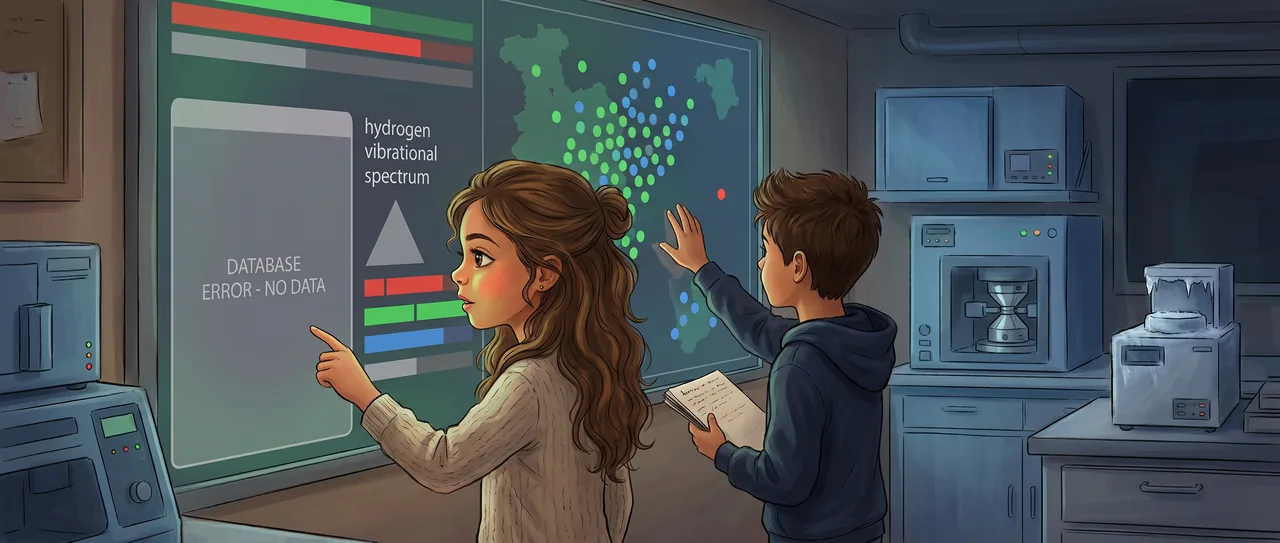
It was not a sentence. It was a forest of bars and arrows. Some bars were green. Some were red. Some had little gray triangles, which meant the companion had guessed from nearby data instead of using a measurement.
Maya liked the gray triangles at once. They looked like teeth.
“Ask why number seven is high,” she said.
Soren typed the question exactly.
The companion answered in calm blocks of text.
Predicted strong coupling between electrons and lattice vibrations.
High hydrogen vibrational frequency under compression.
Estimated stable cage-like arrangement at target pressure.
Similarity to known high-pressure hydride families.
Dr. Vega made a small, tired sound. “That is the usual song.”
“Ask it to take things away,” Soren said.
Maya turned to him.
“If it likes it for four reasons, make it forget one reason at a time,” he said. “See when it stops liking it.”
Dr. Vega’s eyebrows moved. “Counterfactual mode. That is actually a good use of five minutes.”
Soren typed.
When the companion ignored the yttrium position, the rank fell from seven to twelve.
When it ignored the cage shape, the rank fell from seven to thirty-one.
When it ignored the pressure, the rank fell off the first page entirely.
“That makes sense,” Dr. Vega said.
Maya was watching the gray triangles.
“Do the hydrogen vibration one,” she said.
Soren typed.
The wall blinked.
Rank without estimated hydrogen vibrational spectrum: not ranked in top five hundred.
For a moment the lab was very quiet.
Even the robot arm seemed to pause, though it was only waiting for its next instruction.
Soren stood up so fast his notebook slid shut. “That is the biggest drop.”
Dr. Vega frowned at the screen. “It is also estimated, not measured.”
Maya walked closer until the display colors reflected on her face. The gray triangle sat beside the words hydrogen vibrational spectrum. Under it, the database box was empty.
“No one measured the thing it likes most,” she said.
“The model inferred it,” Dr. Vega said. “From related materials.”
“Related how related?” Soren asked.
He typed before Dr. Vega answered.
The companion showed a cluster map. Dots floated in groups by structure and chemistry. Some were dense as spilled seeds. Some stood alone. Number seven was not inside a cluster. It was near three groups, not belonging to any of them.
Maya stared.
The map made the screen seem deeper than the wall. There were not just known materials and unknown materials. There were edges between them, thin places where the companion had stretched a guess across empty air.
Soren touched the glass under the lonely dot without quite touching the dot. “It is not saying this one works.”
“No,” Maya said.
“It is saying, if this guessed vibration is real, the rank changes.”
“Yes.”
Dr. Vega’s mug lowered. “We cannot measure superconductivity in that compound tonight. We may not even be able to make it cleanly.”
“Then do not measure superconductivity,” Maya said.
Dr. Vega looked at her.
Maya pointed to the blank database box. “Measure the blank.”
Soren was already searching the lab instrument list. “You have Raman spectroscopy for pressure cells.”
“For approved samples,” Dr. Vega said.
“And it sees vibrations,” Soren said. “Not all of them. But some.”
Dr. Vega opened her mouth. Closed it. Opened it again with a different expression.
“You two understand that a high vibration line would not prove superconductivity.”
“Good,” Maya said. “Then nobody can be disappointed wrong.”
Soren added, “They can only be interested in a more specific direction.”
Dr. Vega’s laugh surprised all three of them. It was short and bright and almost a cough.
“The beamline proposal form is in the shared folder,” she said. “Do not ask for a miracle. Ask for one measurement.”
Maya and Soren did not ask what words to use.
They built the request from the failure sheets.
Not: test rank seven.
Not: prove the companion right.
They wrote that the model’s ranking depended strongly on an estimated hydrogen vibrational spectrum at high pressure. They wrote that removing that estimate dropped the candidate out of the top five hundred. They wrote that existing databases had no measurement for that property in the proposed structure. They asked for a pressure-cell vibrational measurement first, before anyone wasted time chasing the shiny word superconducting.
Dr. Vega paced behind them, pretending not to read over their shoulders and failing.
“Shorter,” Maya said.
“More exact,” Soren said.
They cut three sentences. They added one number. They changed prove to test.
The companion suggested a grand title with twelve words.
Maya deleted it.
Soren typed: Measurement request for missing vibrational data in compressed yttrium nitrogen hydride.
“Ugly title,” Maya said.
“Good ugly,” Soren said.
Dr. Vega submitted the request with her adult password, but only after turning the tablet around so they could read every line first.
The queue number appeared.
Three hundred nineteen.
“That is a long queue,” Maya said.
“It is a real queue,” Dr. Vega said.
Soren gathered the failure sheets. He did not put number seven with the failed pellets. He put it in a new pile by itself.
Maya picked up the tiny pressure-cell tray from the preparation bench. It held two clear diamonds facing each other, points almost touching, with a speck-sized empty space between them.
Soren slid the printed failure strip under the diamond cell tray.
Read the interactive version, listen to the narration, and earn a gold star →
A science-verified short story for curious kids · Curiosity Land