The Backward Arrow
The first problem was the arrow.
Soren had cut it from blue paper, careful at the point, careful at the tail, and then he had not glued it down.
“It has to go around the circle,” said Mr. Ives, who taught life science and tied his shoes too tightly. “Egg, larva, polyp, adult. Around.”
Soren held the arrow above the poster board. “What if around is not enough?”
Maya, sitting cross-legged beside him on the classroom floor, looked at the empty patch in his jellyfish diagram. She had already glued all of hers except one gap. She liked gaps. Gaps were where the interesting parts hid.
Mr. Ives sighed in the exact rhythm of the classroom clock. “The aquarium asked for clear displays, not riddles.”
So Soren placed the blue arrow in his pocket.
That evening, the aquarium smelled of salt, floor wax, and cold metal. Families would arrive in an hour for Student Science Night. The big jellyfish gallery glowed purple and blue, full of moon jellies drifting like slow umbrellas. But Maya and Soren were not assigned to the big gallery. They were sent behind it, to the culture room, where the remarkable animals were kept in dishes no wider than a cookie.
Ms. Paredes met them with wet sleeves, a pencil tucked through her bun, and the expression of a person who had already solved too many emergencies before dinner.
“You two are on label duty,” she said. “No touching valves. No feeding anything. No promising immortality to visitors.”
“We weren’t going to,” Maya said.
“Everyone does,” said Ms. Paredes. “They hear immortal jellyfish and their brains fall out.”
Soren looked toward the small round dish under the microscope lamp. Its label read Turritopsis dohrnii. The immortal jellyfish.
The dish looked empty.
Ms. Paredes rubbed her forehead with the back of her wrist. “And now it is mostly a bad example. Salinity pump stuck last night. The adults are gone.”
“Gone where?” Maya asked.
“Not where visitors can see them,” said Ms. Paredes. “I have a video. We will use that. Please carry those laminated signs to the touch pool before somebody asks me if a jellyfish can make them live forever.”
She hurried away, calling to someone about shrimp.
Soren stayed by the dish.
Maya stayed because Soren stayed.
“She said adults,” Maya said.
“She said gone,” Soren said.
“She did not say dead.”
Soren bent to the dish but did not touch it. “It says they can go back. I read that. Adult medusa to polyp. But I thought...”
He stopped.
“What?” Maya asked.
“I thought it was like a sentence. A fact sentence. Not a thing sitting in a dish.”
Maya leaned so close her breath fogged the plastic lid. At first she saw scratches, salt flecks, nothing. Then the nothing had a pattern.
“There,” she said.
Soren moved beside her. “Where?”
“Not floating. On the wall.”
The inner side of the dish had tiny pale marks on it, like grains of dust that had decided to stand up. One mark forked into two. Another had a bead at its tip.
Soren took out his notebook, then stopped with the pencil just above the page. “If I write dust, I will hate myself later.”
“Get the scope camera,” Maya said.
“We are not supposed to touch equipment.”
“We are supposed to make labels. Labels require knowing what is in the dish.”
Soren considered this and nodded once.
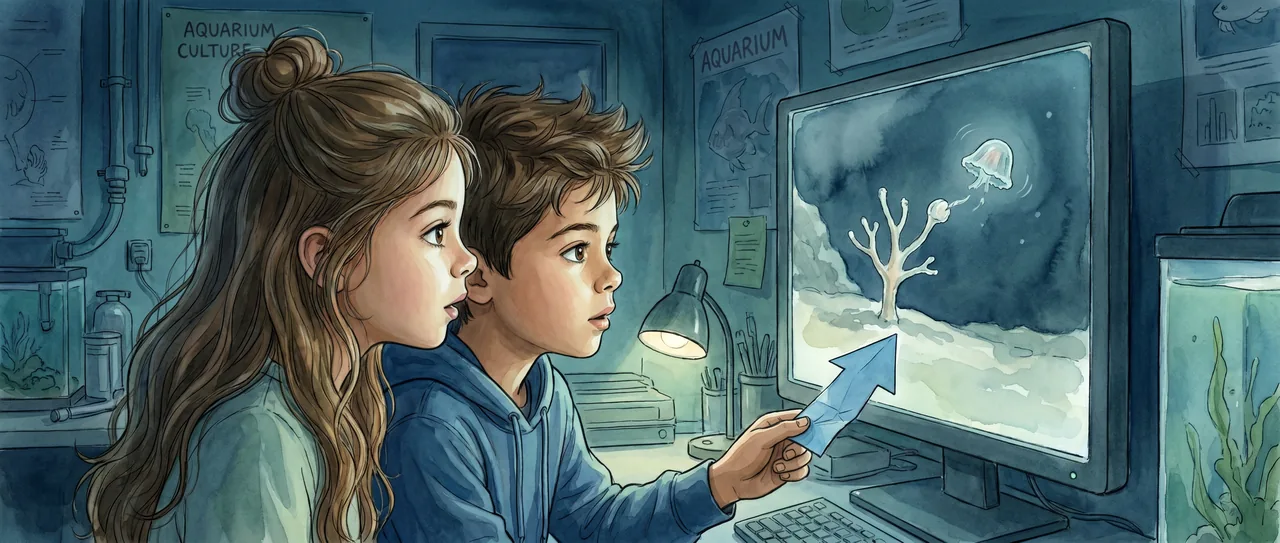
The microscope camera was already plugged into the small display screen for visitors. Soren knew how to focus because he had spent three rainy lunches in the school lab learning the old microscope nobody else used. Maya slid the dish only as far as the taped mark on the table. They did not open it.
At first the screen showed a gray blur. Soren turned the focus knob slowly. The blur became scratches. The scratches became a forest.
Tiny stalks rose from the glass. Their tops opened like white hands.
Maya forgot the clock. She forgot the signs. She forgot the purple moon jellies in the room next door, showing off with their easy glow.
One of the little hands moved.
Soren whispered, “Polyps.”
The word made the room change size.
The dish was not a dish anymore. It was a place an animal had escaped to without moving away. A grown bell-shaped swimmer had come apart from being grown and had fastened itself down as something younger, smaller, rooted. Not dead. Not exactly new. Not exactly old.
Maya tapped the side of Soren’s poster tube. “Your arrow.”
Soren pulled the blue paper arrow from his pocket. It had bent during the bus ride. He smoothed it against his shirt.
Ms. Paredes came back carrying a bucket and looking dangerous. “Why is the Turritopsis on the screen?”
Maya pointed.
Ms. Paredes did not look at Maya. She looked at the screen. Her mouth made a small shape without sound.
“Hydroids?” she said.
Soren answered carefully. “That is what polyps are in this group, right?”
“Could be contamination,” Ms. Paredes said, but her voice had changed. It had lost its hurry.
Maya said, “The salinity went wrong. The adults disappeared. Now there are polyps on the glass. In the dish with the animal that does this.”
Ms. Paredes set the bucket down very slowly. “Do not move.”
“We didn’t,” said Soren.
She went to a shelf and pulled down a binder with salt-stiff pages. Her fingers flipped past dates and feeding notes. “We had twelve medusae yesterday morning. Three were damaged from transfer. I marked them. If the colony is near the red dot...”
Maya looked at the dish. A tiny red marker dot showed on the outside of the plastic. The pale branching patch clung beside it.
“There,” Maya said.
Ms. Paredes bent close to the screen. “Well,” she said.
It was not a big word, but she said it like a door unlocking.
Visitors began to murmur in the hallway. Mr. Ives appeared with a stack of programs and a worried smile. “Are we ready?”
“No,” said Ms. Paredes.
Mr. Ives looked alarmed.
Ms. Paredes pointed at Soren. “You. The loose arrow. Did you bring it?”
Soren held it up.
“Good,” she said. “Your display goes here.”
Mr. Ives blinked. “His display was not clear.”
“It is now,” said Maya.
They set Soren’s poster under the screen. Egg to larva. Larva to polyp. Polyp to medusa. Then the blue arrow, loose no longer, pointing from medusa back to polyp.
Mr. Ives stared at it. “That is allowed?”
Ms. Paredes gave a short laugh. “Allowed is not the word I would use for biology.”
The first visitors came in, a family with a little boy holding a plush shark by the tail. Ms. Paredes began with her usual warning.
“This animal is not magic. It can be eaten. It can get sick. It can die. But when stressed or damaged, this tiny adult jellyfish can transform back into a polyp, and the polyp can make new medusae. In labs, that cycle can repeat.”
The little boy looked disappointed at the part about not magic.
Then Soren moved the blue arrow backward.
The boy stepped closer.
All evening, people came expecting something that would live forever like a superhero. They found a speck on a screen that had refused the straight road. Some frowned. Some laughed because they did not know what else to do. One woman asked if it was the same animal or its children, and Ms. Paredes said, “That question is why half the papers about it are interesting.”
Maya liked that answer best.
Between groups, Soren changed his poster. He did not add more words. He only cut a second arrow from scrap paper and left it unattached beside the first.
“For what?” Maya asked.
“In case one backward arrow is not enough.”
Maya grinned. “It won’t be.”
Near closing, when the hallway had gone quiet and the moon jellies drifted in their blue room like nothing surprising had happened anywhere, Ms. Paredes adjusted the microscope again.
“Look at this edge,” she said. Then she took both hands away.
Maya and Soren leaned in together.
On one pale stalk, a round bud had swollen. It was shaped like a bell too small for any hand to ring.
The smallest bell pinched at its base.
It let go.
On the screen, it hung in the water for one clear second, then pulsed once, twice, three times, away from the stalk.
Read the interactive version, listen to the narration, and earn a gold star →
A science-verified short story for curious kids · Curiosity Land