The Answer Was Yes
The wall drew the wrong sky.
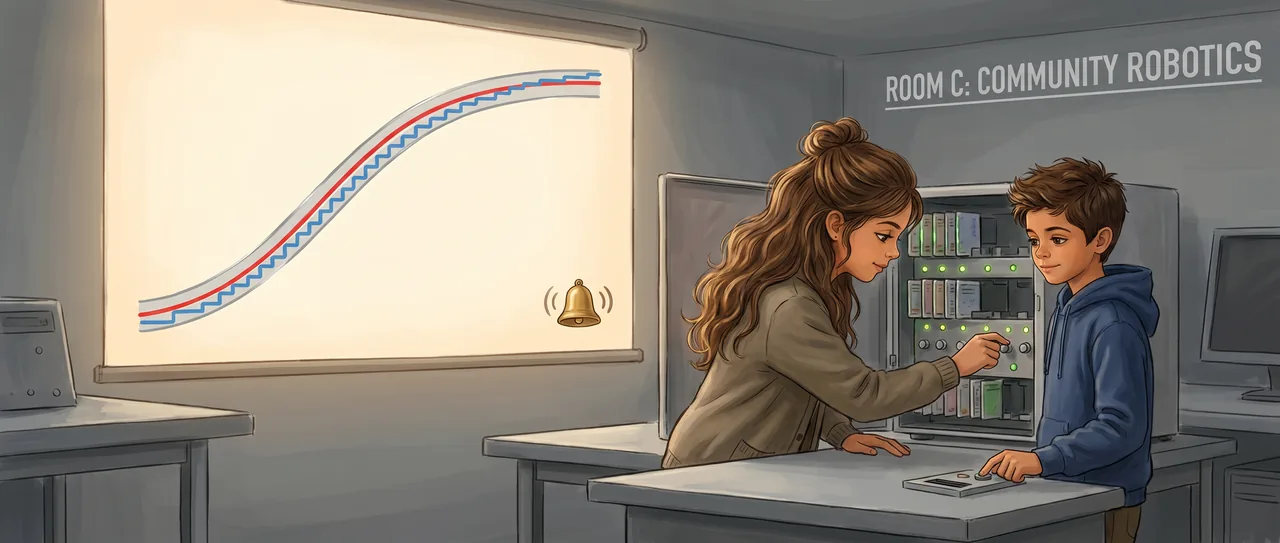
Across the front of Room C, a red line rose in a smooth hill, dipped into a valley, and curled upward again. It was the target. The blue line was what the machine made.
The blue line was a worm.
It sagged under the hill. It floated over the valley. At the end, where the red line climbed like it had remembered something important, the blue line gave up and went flat.
Dr. Orlov clapped once, too brightly.
"Warm-up run," she said. Her hair had two pencils in it and one of them still had a price sticker. "The visitors arrive in twenty minutes. Plenty of time. One hidden layer, enough little units, and the theorem says we can get as close as we want to any continuous curve. No jumps. No broken places. This red one is polite. The wall will learn it."
Maya was already at the side panel. She was not looking at the red hill. She was looking at the row of clear plastic cards behind the glass. Each card had tiny lights, two silver knobs, and a label that said hidden unit.
"How many is enough?" she asked.
Dr. Orlov had half turned toward the printer, which was making a sound like a duck trapped in a drawer.
"Enough enough," she said. "The theorem is very generous. Soren, can you press train again? Maya, please do not remove anything that is screwed in."
"What about clipped in?" Maya asked.
The printer duck honked louder.
"Use judgment," Dr. Orlov said, and hurried away with a stack of badges sliding out of her elbow.
Soren pressed train.
The wall swept from left to right. A small white dot crawled along the red curve. A blue dot tried to follow it. Numbers blinked at the bottom. Error. Step. Error. Step. The machine adjusted its knobs after each sweep, always nudging in the direction that had made the miss a little smaller.
For four runs, the blue worm became less wormy.
On the fifth, it flattened.
On the sixth, it grew a bump in the wrong place.
On the seventh, it went back to being almost the same wrong worm as before.
Soren wrote seven numbers in his notebook, then crossed out the arrow he had drawn between them.
"It is going downhill," he said. "But not toward the place we want."
Maya tapped the glass above the hidden cards. "Maybe there is a fence."
"In the error?"
"In whatever shape the error makes. A dip that is not the deepest dip."
Soren looked at the screen. The machine was not tired. It was not stubborn. It had no face. Still, the blue line seemed to be searching with its hands out, patting the dark.
"The theorem says the right knobs exist," he said. "It does not say the train button finds them."
Maya smiled without looking away from the cards.
"That is a Soren sentence," she said.
"It might be true."
"Those are your best ones."
She opened the side panel.
Nothing exploded. Nothing beeped. The row of hidden cards clicked softly as the fan moved air over them.
Each hidden unit took the same input, the left-to-right position on the wall. Each one made a soft switch. Mostly off before its chosen place. Mostly on after. Not a square corner, more like an S lying down. One knob slid the switch left or right. One knob changed how steeply it woke up. Then the output added all those little soft switches together, some pushing the blue line up, some pulling it down.
Dr. Orlov had called them neurons, but to Maya they looked like tiny decisions waiting in a row.
"If one card makes one soft step," Maya said, "then a lot of cards could make stairs."
Soren looked at the red curve. "Stairs close to the hill."
"Close enough to fit inside the silver band."
The silver band was almost invisible, two pale lines around the red curve. Dr. Orlov had set it to show the allowed error for the demonstration. If the blue line stayed inside the band, the wall would ring a small bell.
Soren did not press train.
He turned the first card’s position knob until its green light brightened near the left edge. Maya adjusted its output so the blue line lifted. Soren used the next card to lift it again. Maya added a downward step where the red curve began to dip. The blue line became a staircase with rounded corners.
It was ugly.
It was also closer.
They worked without speaking for a while. Soren chose the places, reading the red curve like a coastline on a map. Maya chose which way the steps should push. When the blue line climbed too early, she pinched the steepness knob and made the S wake more slowly. When it lagged, Soren slid the card a little left.
The hill appeared out of almost switches.
Not drawn. Assembled.
A rise made of yes, yes, yes. A valley made of yes in the other direction. The curl at the end made from three cards so close together that Soren had to hold his breath while turning them.
Maya stopped with her fingers on a knob.
On the wall, the red curve and the blue staircase were not the same. They would never be exactly the same with the cards set this way. But the space between them had become thin enough to lose.
Soren reached for the train button.
"Now?" he asked.
Maya shut one eye. "Now it knows where to start looking."
He pressed it.
The blue line twitched. It smoothed at the top of the hill. It tucked itself lower into the valley. One rounded corner slid under the silver band. Another lifted just enough.
The wall rang a small bell.
Dr. Orlov came back carrying visitor badges, a roll of tape, and the printer’s paper tray.
"Oh," she said.
The bell rang again on the next sweep.
Dr. Orlov put everything down except the tape, which remained looped around her wrist.
"You got gradient descent to behave?"
"No," Maya said.
Soren said, "We gave it a place where behaving was easier."
Dr. Orlov stepped close to the side panel. Her eyes moved over the knobs, the clustered cards, the tiny green lights.
"You built an approximation first," she said. "By hand."
"A bad one," Maya said.
"A close one," Soren said.
"A bad close one," Maya said, pleased.
The visitors’ voices gathered in the hall, a low shuffle and hum. Dr. Orlov looked at the clock. Her mouth made the shape adults made when time was attacking them.
Then she looked back at the wall.
"The theorem promises there is a way," she said softly. "It does not promise a small way. It does not promise an easy way."
"It also does not promise that the first path you try is the path," Soren said.
Maya reached for the accuracy slider. It controlled the silver band. Wider meant easier. Narrower meant closer.
Dr. Orlov saw her hand.
"For the public demo," she said, "perhaps we leave it where it is."
Maya did not move the slider yet.
Soren looked at the tray of spare hidden cards. There were twelve left. Behind the tray, on the storage shelf, there were boxes with more cards, blank labels facing out.
The hall door opened. Shoes squeaked. Someone whispered, "Is that the learning wall?"
Maya moved the accuracy slider one notch narrower.
The silver band tightened around the red curve. The bell stopped.
The blue line shivered, missed the red by a hair, and held there.
Maya lifted one more card from the tray. Soren slid open an empty slot.
Read the interactive version, listen to the narration, and earn a gold star →
A science-verified short story for curious kids · Curiosity Land