Eight Ways at Once
The octopus robot tied itself into a knot six minutes before the first visitors arrived.
Dr. Vale stared at it with the face adults make when something expensive has chosen a bad time to become noodles.
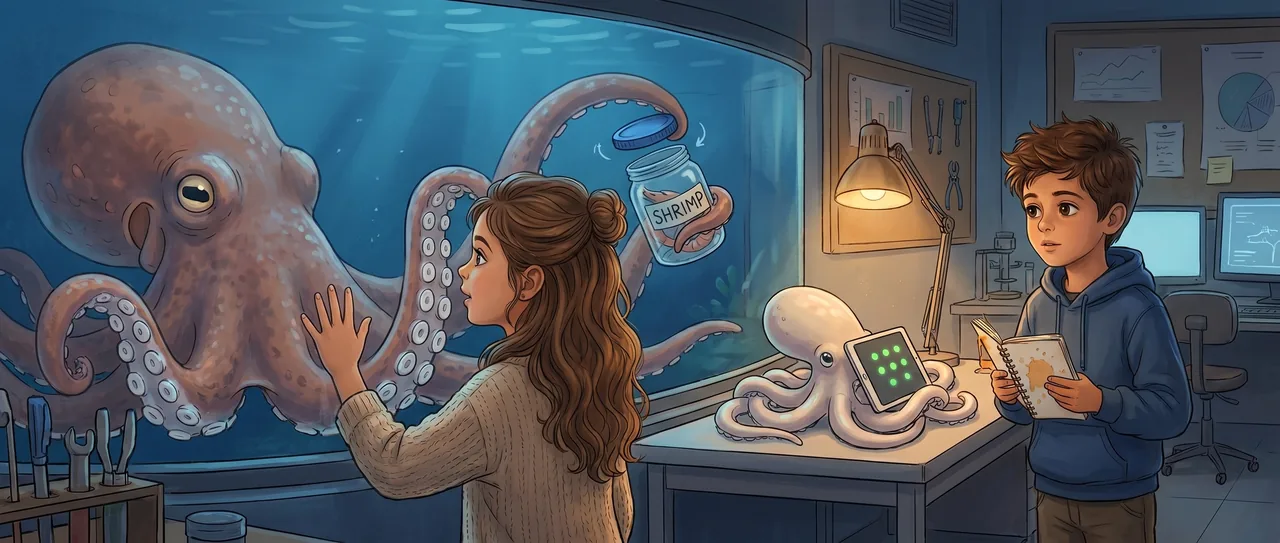
Eight pale silicone arms writhed on the demonstration table. They were supposed to reach into eight clear cylinders, lift eight foam crabs, and place them into a basket. Instead, arm three had wrapped around arm seven. Arm seven had grabbed the power cable. Arm one kept patting the table as if apologizing.
Maya leaned closer.
“It is not broken,” she said.
Soren, who had already written broken? and then crossed it out, asked, “What is it, then?”
“Bossy,” Maya said.
Dr. Vale pushed her glasses up with the back of her wrist. Her sleeves were damp to the elbows. “The word I am using is uncooperative.”
Behind her, through the curved glass wall, the real octopus spread itself over a rock ledge like spilled dusk. Its skin shifted from smooth to pebbled. One arm disappeared into a puzzle box. Another curled over a shell. A third floated in the water, suckers opening and closing against nothing at all.
A red light blinked above the lab door.
“School group,” Dr. Vale said. “Of course.”
She unplugged the robot. All eight arms sagged.
“I need two minutes with the pump in the nursery tank,” she said. “Do not touch the saltwater valves. Do not feed the octopus. Do not let the robot eat itself.”
She looked at Soren’s notebook.
“And if that paper gets wet, it will become soup.”
Soren tucked it against his chest. “Paper can survive if people respect paper.”
Dr. Vale was already gone.
Maya stepped around the table, following the arms with her eyes.
“It waits,” she said.
Soren looked at the robot. “For commands?”
“For permission.”
He checked the control tablet. The screen showed one bright blue circle labeled central pilot. Under it, eight smaller circles flashed in order. The robot had been receiving one instruction at a time. Arm one. Arm two. Arm three. Arm four. Like a teacher calling attendance.
Across the glass, the octopus had not waited for anything.
The arm inside the puzzle box twisted. The arm over the shell pressed and released. Two other arms walked the octopus sideways, sucker by sucker. Its large eye watched Maya, not the box.
Soren moved until his nose was almost touching the glass.
“That arm is opening the latch,” he said. “But the eye is not looking at it.”
Maya came beside him. “Maybe it already knows.”
“Maybe the arm knows.”
They both went quiet.
The octopus pulled a shrimp from the puzzle box with one arm while another arm kept feeling along the rock, testing every crack. Its skin flickered dark, then pale, then dark again.
Soren turned toward the wall display. It was the kind written for grown-ups in a hurry, with bright pictures and not enough pauses.
Three hearts.
Blue blood.
About two-thirds of the neurons in the arms.
Each sucker can taste and touch.
He read it twice. Then he read it out loud, slower.
Maya pressed her fingertips to her own wrist. “Three hearts.”
“Two pump blood through the gills,” Soren said, tracing a tiny diagram with his finger. “One pumps it to the body.”
“Blue blood,” Maya said.
“Copper stuff carries oxygen. Hemocyanin.”
Maya wrinkled her nose. “That is an excellent monster word.”
“It is not a monster.”
“I said excellent.”
The red light over the door blinked again.
Voices gathered in the hallway. Dr. Vale’s voice rose among them, cheerful in the stretched way adults sound when a pump is still not fixed.
“The robot is not ready,” Soren said.
Maya was staring at his notebook.
“No,” she said. “The robot is too ready for one brain.”
Soren followed her look to the table. Beside the tablet sat a tray of loose demonstration parts, suction cups, pressure pads, color cards, and little plug-in modules. A sign on the tray said local reflex kit.
He picked up one module. It had a green dot and a simple drawing of a fingertip touching a sensor.
“These make an arm curl when the pad is pressed,” he said.
“How many?” Maya asked.
Soren counted. “Eight.”
Maya smiled.
Not her school-photo smile. Her there-you-are smile, the one that meant the thing that did not make sense had finally stepped forward.
They worked fast.
Soren did not like working fast unless the fast had steps. So he made steps. He tore eight strips from the back of his notebook, only from the pages already ruined by an old juice spill. On each strip he wrote one instruction.
Touch.
Curl.
Hold.
Let go.
Maya plugged each green module into an arm port. She did not ask if she was allowed. She checked the shapes first. The plugs only fit one way.
Soren placed a pressure pad in front of each cylinder. He put one paper strip beside each pad, then moved them again because arm five would have dragged strip five into the basket.
“You are making the table think,” Maya said.
“I am making the thinking harder to drown,” Soren said.
The lab door opened.
Dr. Vale came in backward, speaking to the group beyond her. “And here we have a soft robot inspired by, well, by one of the most astonishing animals in the building, which is unfortunately having a small mechanical sulk.”
She turned around.
The robot lay in eight quiet curves around eight cylinders. The tablet no longer showed central pilot. It showed eight green dots.
Dr. Vale blinked.
“Maya,” she said. “Soren.”
“We did not touch the saltwater valves,” Soren said.
“We did not feed the octopus,” Maya said.
“The robot has not eaten itself yet,” Soren added.
Dr. Vale looked at the plugs. Then at the pads. Then at the paper strips.
“You changed it to local response.”
“It was trying to be an octopus by having eight arms,” Maya said. “But it was still acting like one person with eight sticks.”
Soren pointed to the wall display. “The arms are not just sticks.”
The visitors pressed close to the glass wall. Their shoes squeaked. Someone whispered, “Is that a real octopus?”
The real octopus flattened one arm against the glass, answering nobody.
Dr. Vale took a breath. For a moment she looked as if she might change everything back, because adults love a plan even when the plan has tied itself around the power cable.
Then she said, “Show me.”
Maya stood at one end of the table. Soren stood at the other.
They did not use the tablet.
Maya pressed the first pad. Arm one curled, gentle and slow, around a foam crab. Soren pressed the second. Arm two lifted. Maya pressed the third. Soren pressed the fourth. The robot did not look graceful. It looked busy. It looked like many small choices happening close to where the touching was.
Arm five missed the crab.
Soren did not fix it from the tablet. He moved the pad closer.
Arm five curled again and held.
The visitors leaned in.
Dr. Vale’s stretched smile loosened into a real one.
“Notice,” she said, and then stopped herself.
Maya pressed pad six.
Soren pressed pad seven.
Arm eight waited, resting in its own pale loop.
Dr. Vale did not finish her sentence. She watched the children instead.
When the last foam crab dropped into the basket, the school group clapped. The sound bounced off the tanks and the wet floor and the glass. Dr. Vale clapped too, once, then twice, then with both damp hands.
Soren looked down at the eight strips of paper. None of them said be the brain. None of them said explain yourself first. They were small, local, and necessary.
Maya had already turned away from the applause.
The octopus was moving.
It gathered itself from the rock ledge and flowed toward the front glass. One arm came first, then another, each sucker touching down and lifting, touching down and lifting. The eye followed them only sometimes.
Dr. Vale stepped beside Soren, very quietly for someone wearing rubber boots.
“We do not actually know what it is like,” she said. “To be arranged that way.”
Soren waited for her to say more.
She did not.
Behind the octopus, the shrimp jar from the feeding puzzle had drifted into a corner. Its blue lid was screwed on crookedly.
One arm reached back toward it.
Another arm spread wide on the glass in front of Maya.
Maya lifted her hand and matched it, palm to sucker, glass between them.
On the other side of the glass, one arm pressed a row of white suckers against Maya’s palm while another arm, without looking, began to unscrew the blue lid.
Read the interactive version, listen to the narration, and earn a gold star →
A science-verified short story for curious kids · Curiosity Land