The Yesterday Signal
The sign over the green button said TALK TO VOYAGER LIVE.
Maya stopped so fast Soren bumped her shoulder with his notebook.
“That word is wrong,” she said.
Dr. Kline, who wore silver shoes and carried three tablets under one arm, turned around without stopping. “Which word?”
Maya pointed.
Dr. Kline smiled the smile adults used when they were already late. “It is close enough for visitors.”
“It is not close,” said Soren.
He opened his notebook to a page where he had written LIGHT MINUTES, LIGHT HOURS, and THINGS THAT ARE FARTHER THAN FEELINGS. His pencil moved once, twice, then stopped.
“Voyager one is about twenty-two light-hours away,” he said. “If we talk now, the message gets there tomorrow. If it could answer right away, which it probably would not, the answer gets back the day after that.”
Dr. Kline glanced toward the glass wall. Beyond it, engineers sat under soft blue screens. Beyond the building, the huge white dish stood against the desert evening, tilted like an ear.
“Yes,” she said. “But TALK TO VOYAGER LIVE sounds better than CONTRIBUTE TO A SYMBOLIC UPLINK-INSPIRED OUTREACH ACTIVITY.”
Maya did not laugh. Soren almost did, because it was a little funny and also exactly the problem.
They had come because Maya had won two passes in a museum question contest by asking why old spacecraft were not allowed to retire. Soren had come because Maya had said, “You need to see the antenna. It is your sort of enormous.”
Now the visitor room was filling with families. Small children pressed their noses to the glass. A boy in a Mars sweatshirt poked the green button even though it was covered by a clear plastic lid. On the wall, a screen showed a golden spacecraft with a dish, thin arms, and a name printed beneath it.
Voyager one.
Launched in nineteen seventy-seven.
Now in interstellar space.
Still transmitting.
Maya read the lines and frowned at the animation. Little blue waves were drawn racing from the spacecraft to Earth in three seconds.
“That makes it worse,” she said.
Dr. Kline followed her eyes. “It is just a graphic.”
“It is lying quickly,” said Maya.
One of Dr. Kline’s tablets chirped. She looked down and made a small noise through her teeth. “I have a microphone that will not connect, a mayor who wants to press the button, and thirty-seven people expecting awe in twelve minutes.”
“What happens when they press it?” Soren asked.
“It records a greeting for the archive,” Dr. Kline said. “Then, at the listening window tonight, we play the real Voyager carrier tone. Everyone feels connected. Everyone goes home happy.”
“Carrier tone?” Maya asked.
Dr. Kline hesitated, then pointed through the glass. “When the antenna locks on, we know the spacecraft’s radio signal is arriving. The data are not pictures. Mostly engineering numbers. Temperatures, power levels, instrument states.”
“Power from plutonium,” Soren said.
“Heat from plutonium-two hundred thirty-eight decay,” Dr. Kline said, pleased despite herself. “Thermoelectric generators turn some heat into electricity. Less every year. That is why it has to be careful now.”
Maya turned back to the sign.
The room noise swelled behind them. Someone dropped a water bottle. A toddler began chanting, “Space button, space button.” Dr. Kline’s silver shoes tapped once against the floor.
“I cannot rebuild the exhibit,” she said.
“You do not have to,” Maya said.
Soren looked at her. “What are you thinking?”
“Two clocks,” she said. “Not one.”
He waited.
Maya pointed to the green button, then to the antenna outside. “One for us. One for the message. The problem is the room thinks now is only one thing.”
Soren’s pencil started moving.
Dr. Kline stared at them for half a second, then at the crowd, then at the dead microphone in her hand. “You have eight minutes,” she said.
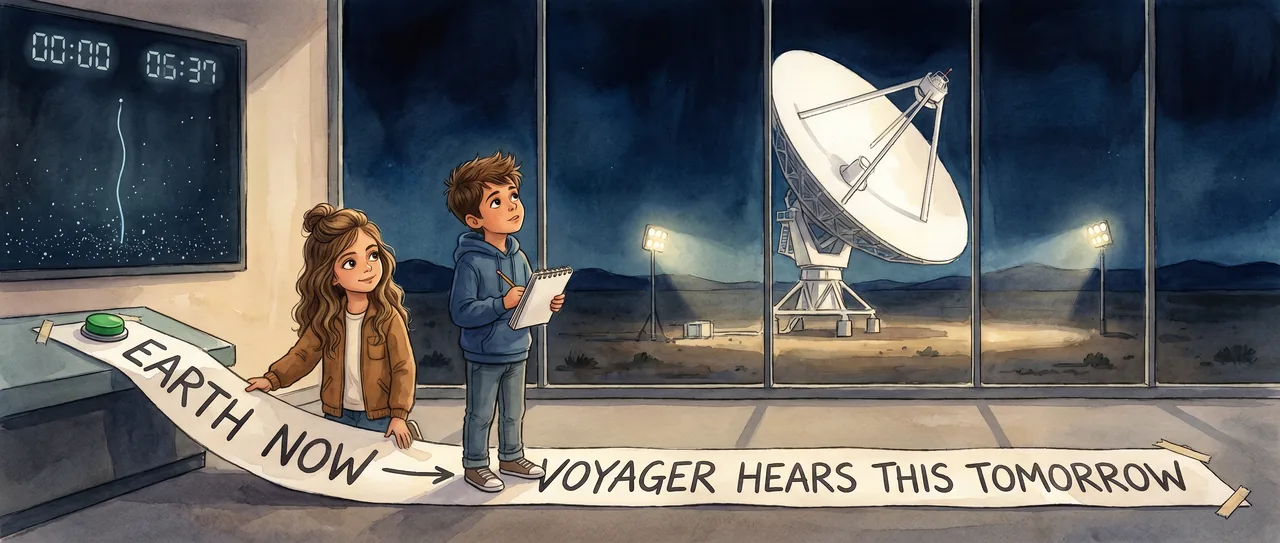
They took the paper banner that had been rolled behind the welcome table. Soren measured it with his shoes because he did not have a ruler long enough. Maya found a thick black marker and wrote EARTH NOW at one end.
At the other end, Soren wrote VOYAGER HEARS THIS TOMORROW.
“That is for sending,” Maya said. “What about receiving?”
Soren flipped the banner over. On the back he wrote VOYAGER THEN at one end and EARTH HEARS IT NOW at the other.
Maya found a roll of blue tape. Together they taped the banner across the floor, not straight, because people had feet and feet were unreasonable. It stretched from the green button to the glass wall, where the antenna could be seen whitening as the sky darkened.
Dr. Kline watched with the expression of a person deciding whether a disaster was becoming useful.
When the mayor arrived, Dr. Kline did not give him the microphone. It still did not work. She clapped her hands instead.
“Everyone,” she called, “we are changing the experiment.”
The room quieted in layers.
Dr. Kline pointed to Maya and Soren. “These two have objected to my sign on scientific grounds.”
A few adults chuckled. Maya did not.
Soren lifted the plastic lid from the green button. “If you say hello here,” he said, “Voyager one cannot hear you tonight.”
The mayor lowered his hand.
“It is not because it is ignoring us,” Soren said. “It is because light is fast, but space is bigger.”
Maya stepped onto the tape beside EARTH NOW. “Your hello goes this way.” She walked the long paper strip, heel to toe. People shifted back to make room. “It keeps going after dinner. After midnight. After breakfast. After school tomorrow.”
At the far end she touched the words VOYAGER HEARS THIS TOMORROW.
A little girl whispered, “That is so late.”
Maya nodded. “And if Voyager sends something back, it takes the same long road.”
Soren turned the banner over. The paper made a soft thunder on the floor.
“This is tonight,” he said.
The words VOYAGER THEN faced the crowd now.
“The signal the antenna is waiting for did not leave Voyager now,” he said. “It left when we were doing other things. Sleeping. Eating cereal. Losing socks.”
“Math homework,” Maya said.
“Some people,” said Soren.
This time the room laughed, but it was the right kind of laugh, the kind that made more quiet afterward.
Dr. Kline dimmed the animated blue waves. The wall screen went nearly black except for two clocks. One said EARTH RECEIVING. The other said SPACECRAFT TRANSMITTED, with yesterday’s date.
Maya stood beside Soren at the glass.
Outside, the giant dish began to move.
It did not swing like a movie telescope. It crept. Motors hummed somewhere under the floor, too low to be music. The white bowl tipped a little, paused, then tipped again, following a thing no one in the room could see.
An engineer opened the control room door. Her badge said RAO. She looked at the paper on the floor.
“Who did the light-time strip?” she asked.
“They did,” Dr. Kline said.
Ms. Rao studied Maya, then Soren. “Good. Stay off the cable covers.”
Then she went back inside.
“That was approval,” Dr. Kline whispered.
Soren grinned at his shoes.
The first tone did not sound like a greeting. It sounded like almost nothing. A thin line rose on the screen from a crowd of trembling specks.
“Carrier lock,” Ms. Rao called from behind the glass.
No one clapped.
On the wall, numbers began to appear. Slowly. Patiently. Not words. Not pictures. Temperatures. Voltages. A transmitter state. A power reading that made one adult murmur, “That little?”
Dr. Kline answered softly, for once not performing. “That little by the time it gets here. It left as a radio signal from a spacecraft running on the heat of radioactive decay. It crossed the heliopause years ago. It is outside the Sun’s wind now.”
Maya pressed her fingers to the glass.
“The Sun has weather,” she said.
Soren did not write that down. His notebook hung open at his side.
On the screen, the line shivered but held.
Maya pictured, not carefully and not like a diagram, the Sun blowing a huge invisible bubble around the planets. She pictured one human-made speck beyond that bubble, carrying a gold record, old circuitry, fading warmth, and a radio voice so small Earth had to build giant ears in three places around the planet.
Beside her, Soren touched the stub of his pencil to the paper strip with yesterday’s date.
“The old design still works,” he said.
Maya looked at him. “Because someone made Earth good at listening.”
The mayor did not press the button. No one asked him to.
Instead, people took turns standing at EARTH NOW, saying one quiet word, then walking the strip until they reached tomorrow. Some said hello. Some said thank you. One small child said banana. At the far end, they did not pretend Voyager had heard. They just stood there, looking back across the paper distance.
Near midnight, Dr. Kline replaced the sign over the button. The new one was handwritten on the back of a schedule sheet.
SAY SOMETHING. WAIT FORTY-FOUR HOURS FOR EVEN THE POSSIBILITY OF AN ANSWER.
“That is not catchy,” she said.
“It is better,” Maya said.
“It is longer,” Soren said.
Dr. Kline looked through the glass at the thin line on the screen. “Yes,” she said. “It is.”
Outside, the desert had gone cold. The public had left in sleepy clusters. Maya and Soren were allowed onto the fenced platform for one minute, with Ms. Rao watching from the door and Dr. Kline pretending not to be excited.
The antenna filled half the sky.
Maya put both hands on the cold rail. Soren’s pencil stopped above the page. The white dish kept turning, slow as a minute hand, toward a black place between stars.
Read the interactive version, listen to the narration, and earn a gold star →
A science-verified short story for curious kids · Curiosity Land