The Two Randoms
The photon from the satellite arrived as a blue tick on the screen, and Soren was already disappointed.
It was not a beam. It was not a word. It was not even a proper flash. It was only a tick in the right-hand column, beside a left-hand tick from the detector in the lab basement.
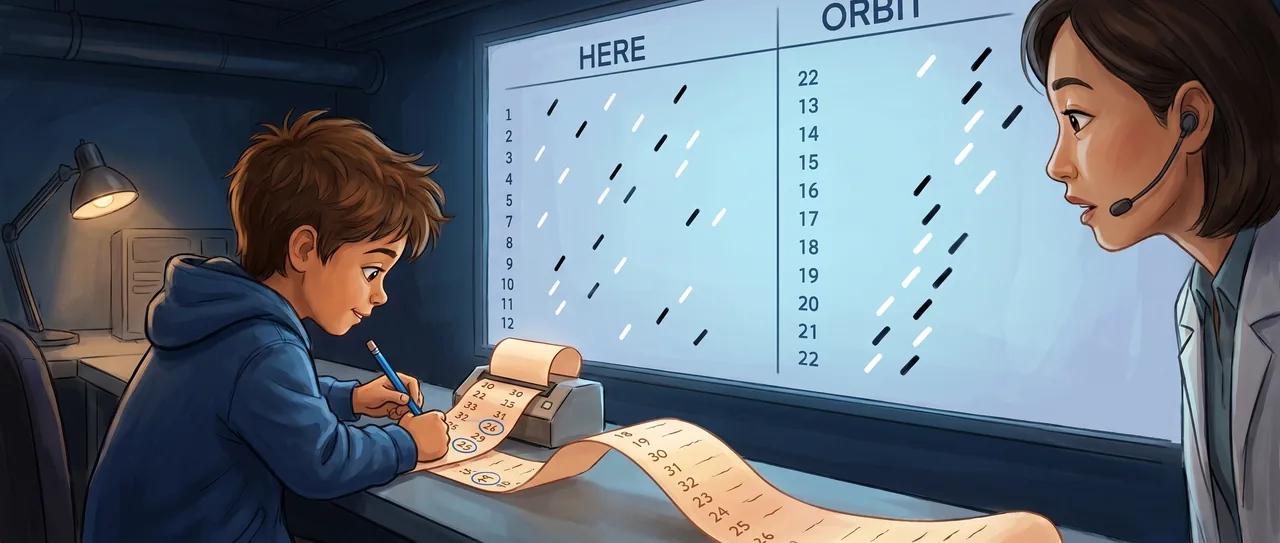
The left tick was labeled HERE.
The right tick was labeled ORBIT.
Between them, on the wall display, was a drawing of Earth with a silver speck sliding over the dark Pacific.
Soren had come with a paper notebook in his coat pocket, which made three people in line behind him whisper. Everyone else had wrist screens or phone lenses or little floating note dots that followed their shoulders. Soren had paper because paper waited without blinking.
Dr. Ikeda stood under the display with a lapel microphone and the restless smile of someone who wanted the universe to perform on schedule.
"Entangled photons are born as pairs," she said. "We keep one here. We send the other up to the satellite. Then we ask each photon a question about its polarization. If the questions match, the answers match too, even when one photon is above the ocean and one is under our shoes. No wire between them. No messenger crossing the sky. Just a pair behaving like one thing in two places."
The room made the soft sound people make when they want to clap but are not sure if science is finished yet.
Soren raised his hand.
Dr. Ikeda saw him and said, "Yes, notebook person."
"Can you use it to send a message?"
Her smile widened, but not in a mean way. More like she had been waiting for that exact trap and liked it too much.
"Come try," she said.
That was how Soren ended up at the console with the whole basement watching his hands.
There were two buttons for the detector question. One showed a tiny line standing tall. One showed a tiny line lying flat. Dr. Ikeda told him those were two ways to ask about the photon’s polarization.
"Choose any pattern," she said. "Pretend the satellite scientists are trying to read your choices from their photon results."
Soren chose tall, tall, flat, tall, flat, flat. It was not a word exactly. It was the beginning of one.
The HERE column ticked black, white, white, black, black, white.
The ORBIT column ticked white, black, black, white, white, black.
Soren looked for his tall, tall, flat, tall, flat, flat inside the satellite column. It was not there. The orbit ticks looked like spilled pepper.
"Again," he said.
Dr. Ikeda nodded to the technician behind the glass. "Again."
Soren chose flat, flat, flat, tall, tall, tall.
The orbit ticks were black, white, black, black, white, white.
Nothing.
Someone near the back laughed softly, not at Soren, but at the failed magic trick.
Dr. Ikeda took one step toward the console. "This is the part people hate," she said. "Each side alone looks random. You cannot force your result. You cannot make the far screen spell hello. Entanglement is not a faster-than-light telephone."
Soren kept his fingers on the buttons.
The screen kept ticking.
Here, orbit. Here, orbit. Black, white. White, black. White, white. Black, black.
The two columns did not look like twins. They looked like two people answering questions in different rooms without having studied.
"The timing is messy tonight," Dr. Ikeda said, turning back to the audience. "Satellite packets arrive in bursts. We’ll clean the data later and post the pretty graph."
Soren did not move.
On the screen, each tick had a tiny number beside it. The numbers were not in order in the ORBIT column. They came as one hundred twelve, one hundred fifteen, one hundred thirteen, one hundred fourteen. The satellite was late in bunches. The lab column was neat.
"Those are pair numbers," Soren said.
Dr. Ikeda stopped talking.
"Yes," she said. "Every laser pulse has a number."
"Then the rows are lying."
Now the whole basement was quiet.
Soren felt heat crawl up his neck. He did not like everyone looking at him. He liked when the thing that was wrong kept being wrong in the same way.
He pointed at the wall. "You put the next satellite tick beside the next lab tick. But they are not partners. They are just arrivals."
The technician behind the glass leaned toward his own screen.
Dr. Ikeda blinked once. Then she laughed under her breath. "Oh. I wanted a live show. I made a live mess."
She touched the console and brought up a narrow menu. "Pair sorting. Manual mode."
The display changed. The neat rows broke apart. Ticks slid away from false neighbors and snapped beside matching numbers. The room made a different sound then, a sound like chairs remembering they had legs.
Soren watched one pair number settle.
HERE, pair one hundred twelve, tall question, black answer.
ORBIT, pair one hundred twelve, tall question, black answer.
Another.
HERE, pair one hundred thirteen, flat question, white answer.
ORBIT, pair one hundred thirteen, flat question, white answer.
Another.
Same question, same answer.
Same question, same answer.
Not always, because some photons were lost and machines were not wishes. But enough that the spilled pepper gathered into lines.
Dr. Ikeda pulled a paper strip from a printer slot, which made Soren like her immediately more than before.
"Mark the pairs where both detectors asked the same question," she said.
She gave him a blue pencil.
Soren bent over the strip on the console. The paper was warm. He circled pair numbers with matching questions. His circles marched crookedly down the tape. Beside them, the answers matched so often that even the people in the back began counting aloud.
"Twenty-seven."
"Twenty-eight."
"Twenty-nine."
At pair two hundred four, the questions were not the same. One detector had asked tall-flat, a slanted question Dr. Ikeda had not put on the big buttons. The answers did not simply match or mismatch. The totals leaned in a way that made Dr. Ikeda whisper, "There you are."
Soren looked up.
"That row is the strange one?" he asked.
"That row is why ordinary hidden instructions do not work," she said. Then she caught herself, because the audience had gone glassy-eyed. "Not as a full explanation. As a doorway. The pairs act more connected than any pair of tiny prewritten answer cards should be allowed to act."
Soren touched the blue pencil to the paper but did not circle anything.
The satellite on the wall slid over the edge of South America. Its silver dot had no string behind it. No wire. No tube. No secret path where a signal could hurry through the dark.
Each column alone was nonsense. Together, after the right numbers found each other, the nonsense had seams.
Soren knew that feeling. A page of half-questions in his notebook looked ridiculous until the missing half arrived. Adults often wanted answers in straight rows. Soren trusted the crooked ones longer.
Dr. Ikeda was staring at the sorted tape as if it had done something rude and beautiful.
"We nearly blamed the satellite," she said.
"It was doing its half," Soren said.
The technician behind the glass tapped the window and held up both thumbs. Dr. Ikeda turned to the audience.
"We have six minutes before the satellite sets," she said. "Enough for a longer run, if our guest operator is willing."
Soren looked at the buttons.
He could not send hello. He could not send tall, tall, flat. The far column would never obey him that way.
But if the records met later, if the numbers lined up, something that had been split between basement and orbit would show its shape.
Dr. Ikeda lowered her voice. "There is another receiver available for the next pass. It is only a test channel. Farther away. Much farther."
On the wall display, a new gray circle appeared beyond Earth’s blue rim.
The label under it was small at first. Then the system sharpened it.
MOON RELAY.
Dr. Ikeda did not touch the console. "Your choice of questions," she said.
The basement air conditioner clicked on. The paper strip curled against Soren’s wrist.
On the screen, above TALL and FLAT, a new label blinked into being: MOON RECEIVER.
Soren reached for the green key, and the room’s lights reflected in his fingernail.
Read the interactive version, listen to the narration, and earn a gold star →
A science-verified short story for curious kids · Curiosity Land