The Streets Inside
At the Future Wayfinding Lab, the glasses insisted Soren walk straight through the River Thames.
He stopped with one shoe on a blue carpet strip meant to be water. The lenses drew a bright arrow across the floor map of London, over bridges, under labels, through a painted ferry, and into a place where no road existed.
Maya walked past him, then walked backward until she was beside him again.
“That’s wrong,” she said.
“The arrow thinks it isn’t,” Soren said.
Across the room, the exhibit engineer had both hands inside a silver charging box. He was cheerful in the way of a person who had not looked at the problem yet.
“Keep moving,” he called. “The route engine corrects itself.”
“It wants me to drown,” Soren said.
“It’s a simulation,” the engineer said.
“The river is also a simulation,” Maya said. “Still wet enough.”
The lab filled a whole gallery of the museum. The floor was London, flattened and shining. The Thames curved under their feet. Tiny stations glowed. Streets were pale threads. On the walls, old taxi meters sat beside clean white screens showing driverless buses, live traffic maps, and flying delivery drones that looked like dragonflies with parcels.
Soren liked all of it, except the glasses telling him not to look.
He pushed them up onto his forehead. The arrow vanished. The room became harder at once.
Maya grinned.
“That’s better,” she said.
The challenge was printed on a card they had been given at the door: Start at Paddington. End at the Royal Observatory in Greenwich. No trains. No boats. No sky-lanes. Street route only.
The engineer had called it a game. He had also said nobody learned cities anymore because cities could explain themselves.
Soren had opened his paper notebook then, and the engineer had blinked at it.
“Paper?” he had asked.
“It doesn’t run out,” Soren had said.
“It also doesn’t update,” the engineer had said, already turning away.
Now the update was trying to send them through the river.
Maya crouched on the map. “We’re not going straight. London never goes straight.”
“That is not a rule,” Soren said.
“It’s a London rule.”
He lowered himself beside her. From up close, the floor was crowded with names. Some were famous. Some were only curls of letters tucked between other curls. The streets bent for old walls, parks, stations, vanished fields, and the river itself. A city pretending to be a maze, or a maze pretending to be a city.
Soren drew a small compass in his notebook, then stopped. He did not copy the map. There was too much map.
“We need chunks,” he said.
Maya tapped Paddington. “Start west. Get across the middle without getting eaten. Cross the river once, not three times. Greenwich is down and right.”
“East,” Soren said.
“Down and right on the floor.”
“That is not how maps work.”
“It is how this one works.”
He looked at the blue curve of the Thames. It was not a line. It was an animal. It nosed north, sagged south, coiled back, and slid away toward Greenwich.
Soren put his finger on Paddington, then moved it along bigger roads, pausing at crossings, testing each choice before he took it. Maya kept seeing gaps before he reached them.
“Not there,” she said. “That road pinches.”
“It still connects.”
“Barely. Look at the crossings after it.”
He looked. Three tight turns. One dead end hidden by the shine of the floor.
“All right,” he said. “Not there.”
They moved slowly at first. Then the route began to hold together. Hyde Park was a green raft. The river bend near Westminster was a hook. The bridges became choices instead of stripes. Soren whispered the pieces as they walked them with two fingers.
“Paddington to the park. Park to Westminster. Cross once. Then follow south and east until the river bends us back toward Greenwich.”
“Not follows,” Maya said. “Argues with.”
“Fine. Argues with the river.”
They were halfway across the gallery when the glasses on Soren’s forehead chirped.
“Route recalculated,” they said.
Maya took them off his head and set them carefully on a model bus shelter.
“No drowning machine,” she said.
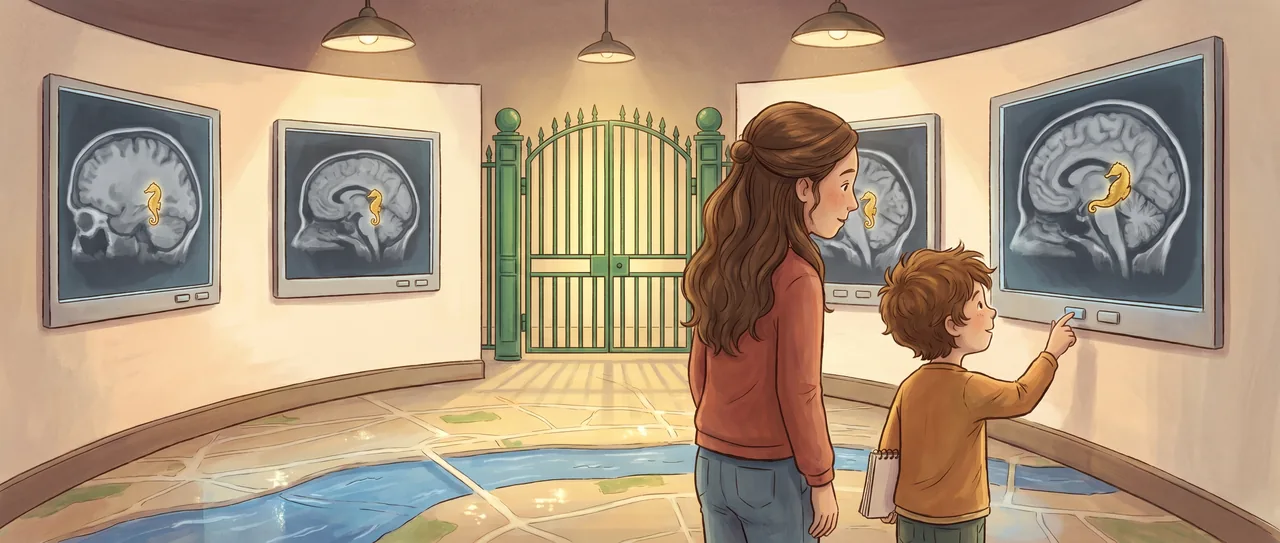
At Greenwich, a small gate lit green. Behind it stood the last station, a curved wall with three glowing brain images. Each brain looked like a storm cloud sliced open. In each one, a small seahorse-shaped region was colored gold.
A sign above the screens read: Which brain learned London?
The engineer hurried over, still carrying a cable.
“Oh, that one’s popular,” he said. “Most people pick the brightest picture. Try not to overthink it.”
Maya and Soren both looked at him.
He sighed. “Fine. Overthink it. I have to rescue a drone from a coat rack.”
He left.
Soren stepped closer to the screens. “That gold part. Hippocampus. It does memory.”
“Seahorse,” Maya said.
“That too.”
Three labels waited below the images: New driver. Experienced London taxi driver. Person who has not trained on London streets.
Maya did not read them twice. She watched the shapes. The whole brain was not bigger in any picture. The gold region was not a magic button. But in one scan, the back part of the seahorse shape was thicker, denser, as if the image had leaned its weight there.
“This one,” she said.
Soren did not touch the answer button. “Why?”
“The city has a back.”
“That is not a reason.”
“It is almost a reason.”
He bent toward the small caption, but covered the last line with his hand before reading too far.
“London taxi drivers have to learn thousands of streets and landmarks,” he said. “The Knowledge. They train for years before the exam.”
Maya nodded at the thicker gold place. “Years went there.”
Soren’s finger hovered over the button. “If it’s real, it won’t be the whole brain. It would be the part doing the route work.”
“And not from one afternoon,” Maya said.
“And not because taxi drivers are born with taxi brains,” Soren said. “Maybe training matters.”
He pressed the button below the thicker-backed seahorse.
The wall chimed. The caption brightened.
Experienced London taxi drivers in brain imaging studies had more gray matter in the posterior hippocampus, a region involved in spatial memory. The longer they had driven taxis, the greater the measured difference. Later studies of trainees found changes in those who successfully learned The Knowledge.
No confetti fell. No cartoon brain flexed its arms. The three quiet images stayed on the wall.
Maya stepped back until her heels touched the painted river.
The city was on the floor. The city was on the screen. Somewhere inside living heads, streets had left marks delicate enough that machines could measure them.
Soren touched the side of his own head with two fingers, the way he had touched Paddington.
“My notebook is outside,” he said.
Maya looked at him.
He tapped his head once. “But not only outside.”
The engineer returned with a rescued drone tucked under one arm. Its propellers hung limp.
“You got it,” he said. “Nice. The taxi one surprises people. Brains are adaptable. Very good for the future. We can make maps faster, smarter, more helpful.”
Maya was still looking at the scans.
“If maps do everything,” she said, “what gets bigger?”
The engineer opened his mouth, then closed it.
Soren picked up the glasses from the model bus shelter and turned them over. “The arrows could ask instead of tell.”
“Ask what?” the engineer asked.
“Which way is the river bending now?” Soren said.
“Where’s north if the screen goes dark?” Maya said.
“How do you get there if the bridge is closed?” Soren said.
Maya pointed at the floor. “Let people carry some of it.”
The engineer looked from the broken drone to the glasses to the glowing brains. His face changed into the expression adults got when an idea had arrived at an inconvenient time.
“That would be a different mode,” he said. “Not easiest route. Learning route.”
“Inside route,” Maya said.
The engineer set the drone down on a bench, slowly. “Would you two try a prototype if I built one?”
“No arrows through rivers,” Soren said.
“No arrows first,” Maya said.
Outside the museum, evening had made the real city blue at the edges. Buses breathed at the curb. A taxi rolled past with its yellow light on, carrying a driver whose head held streets no screen could see.
Soren unfolded his paper map under the streetlamp, and Maya put her finger on a road neither of them had taken.
Read the interactive version, listen to the narration, and earn a gold star →
A science-verified short story for curious kids · Curiosity Land