The Slowest Crash
The new exhibit was called Roof of the World, and it was lying.
Maya knew this before she knew why.
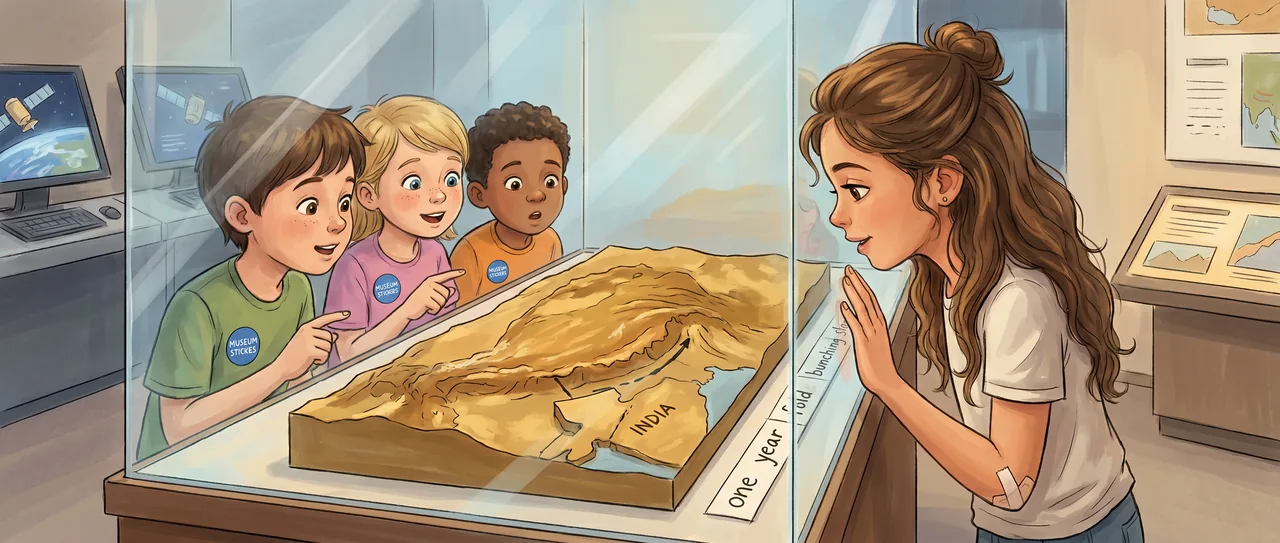
The lie sat under clean glass in the children’s science center, shining with fresh paint and tiny white mountain ridges. A plastic India waited on a track below a plastic Asia. When someone pressed the red button, India shot forward, rammed Asia, and a row of Himalayas popped up like toast.
Wham.
Done.
Aunt Leela stood beside the case with a tablet tucked under one arm and three pencils in her hair. She had designed the exhibit for the opening that afternoon. She had also designed the dinosaur stair decals, the moon-rock light box, and the bathroom sign that said Humans Are Mostly Water, Please Wash Your Hands.
‘Maya,’ she said, without looking up, ‘if you are about to say the mountains look too tidy, please save it until after the donors leave.’
‘They stopped moving,’ Maya said.
‘The donors?’
‘India.’
Aunt Leela tapped her tablet. The model reset. Plastic India slid backward with a little electric buzz.
‘It has to stop,’ Aunt Leela said. ‘Children need to see the cause and the effect.’
Maya crouched until her nose was level with the glass. The plateau was painted gold-brown, broad and high behind the jagged mountains. It looked like a table somebody had shoved a wrinkled rug against.
‘But the cause did not stop,’ Maya said.
Aunt Leela finally looked at her. One pencil slipped from her hair and clattered onto the floor.
‘Yes. Technically. India is still moving north into Asia. About as fast as your fingernails grow. But I cannot make people watch a continent move for one year.’
‘How long has it been doing that?’
‘Since before whales looked like whales,’ Aunt Leela said. ‘About fifty million years. Maya, the mayor is coming in forty minutes, and the fog machine in Oceans of Europa is making soup noises.’
She hurried away.
Maya stayed crouched.
Someone had taped a black line on the floor to keep visitors from crowding the exhibit. Her left shoe was outside the line. Her right shoe was inside it. She shifted both feet inside because the line had been placed too far from the interesting part.
On the case, a label read: India collided with Asia, lifting the Tibetan Plateau and the Himalayas.
Maya mouthed the word collided.
At school, collision meant two scooters at recess and a teacher saying, Maya, not so fast, you have to watch where everyone else is going. Collision meant noise and stopping. This exhibit had understood that part perfectly. Wham. Done.
But under the glass, the little India sat frozen against Asia, as if fifty million years had ended politely at the edge of a label.
Maya looked at her own hand. A pale crescent showed at the end of each fingernail. Her thumbnail had a tiny split from where she had picked at a glue dot that morning. She pressed the nail against the glass.
About that fast.
Her thumb covered half of India.
That was wrong too, but in the other direction.
Maya stood up and went behind the case.
The back panel was open because Aunt Leela always left one thing unfinished until the last possible minute. Inside were wires, a motor, a belt, two spare gears, and a small cardboard box labeled Future Improvements, which was mostly full of binder clips and one granola bar.
The motor had two settings written in Aunt Leela’s slanted handwriting.
Show.
Reset.
No setting said Continue.
Maya took the granola bar out and put it on the floor. Then she lifted the two spare gears. One was large. One was small. In robotics club, Mr. Chen had said gears were just arguments about speed. A small gear could make something fast. A large gear could make something stubborn.
Maya liked stubborn machines. They did not pretend to be finished.
She unplugged the motor before touching anything, because Aunt Leela had rules, and some of them were useful. Then she moved the belt from the fast gear to the large gear. The track would crawl now, if it moved at all.
She plugged it back in and pressed Show.
Plastic India shivered.
It did not slam. It leaned.
The mountains did not pop.
Maya pressed the button again.
India shivered harder. The belt made a sad clicking sound. The Himalayas stayed flat.
‘No,’ Maya said.
The problem with a slow crash was that it looked like nothing.
A group of third graders in blue museum stickers came in early because somebody had given them cookies in the lobby and lost control of them. They swarmed toward the case.
‘Press it,’ one boy said.
A girl slapped the red button.
India trembled forward. Nothing popped up.
‘Broken,’ the boy said.
‘It is not broken,’ Maya said.
The children stared at her. This happened to Maya often. People did not like being corrected by someone who had one shoe untied and tape on her elbow.
The girl pressed the button six more times. Each time, India nudged Asia with a tiny click. The mountains barely moved.
‘See?’ the boy said. ‘Nothing.’
Maya looked at their faces. They were ready to leave. Slow had failed.
Then the girl with her finger still on the red button frowned.
‘Wait,’ she said.
A wrinkle had appeared behind the mountains.
It was not much. A gold-brown fold had lifted in the plateau, thin as a breath under the glass.
The girl pressed the button again.
Click.
The fold held.
Again.
Click.
Another fold rose behind it.
The boy bent close enough to fog the glass. ‘It’s not popping. It’s bunching.’
Maya’s untied shoelace lay across the black line. She did not move.
She opened the Future Improvements box again and found a strip of blank white labels. She stuck one to the glass beside the track and drew a tiny mark with Aunt Leela’s fallen pencil. Then another mark. Then another, each no wider than the pale crescent of her thumbnail.
‘One year,’ she said, pointing to the first space. ‘About. In the real world. This model is cheating so we can see it.’
The girl pressed the button more slowly.
Click.
‘One year,’ Maya said.
Click.
‘One year.’
Click.
The children joined her, not all together at first.
‘One year.’
‘One year.’
‘One year.’
Aunt Leela came running from the Europa room with a smear of fake ocean frost on her sleeve.
‘Why is everyone chanting at my geology?’ she asked.
Nobody answered her.
The plastic India kept nudging north. The Himalayas rose in uneven ridges. The plateau behind them thickened into a rumpled height that had not been there before. It did not look like toast anymore. It looked like something huge refusing to make a quick shape.
The third graders had gone quiet except for the clicking button and their soft counting.
Aunt Leela crouched beside Maya.
‘The pop-up was better for crowds,’ she whispered.
‘No,’ Maya whispered back.
Aunt Leela watched the broad brown plateau rise one small wrinkle at a time.
‘No,’ she said. ‘It wasn’t.’
The mayor arrived during year thirty-two, which was nothing, even in a cheating model. Aunt Leela did not give her prepared speech. She handed the mayor a sticker that said Press for One Year.
The mayor laughed like she thought it was a joke, then pressed the button.
Click.
A boy near the front said, ‘You only moved it a fingernail.’
‘That is the point,’ said the girl who had first seen the fold.
Maya looked through the glass at the tiny marks marching along the label strip. A fingernail was an annoying thing. It caught on socks. It tore. It had to be clipped and clipped and clipped.
The marks kept going.
On the wall above the exhibit, a satellite image showed the Tibetan Plateau from space, enormous and brown and white, with clouds dragging shadows across it. Beside it, Aunt Leela had mounted a live map from GPS stations. The arrows were so small they looked like scratches.
Maya stepped close.
Each scratch pointed north.
A whole piece of Earth was still arriving.
The room had grown loud around her. The third graders wanted turns. The mayor wanted a photograph. Aunt Leela wanted more labels. Someone asked if the mountains were still getting higher. Someone else asked what happened underneath when a continent could not sink easily into the mantle because it was too buoyant. Aunt Leela said, ‘Excellent question,’ in a voice that meant she did not have the short answer ready.
Maya took the fallen pencil and added three words to the temporary label.
Still happening now.
Then she crossed out now because now was too small.
The girl with the museum sticker watched her. ‘What do you put instead?’
Maya held the pencil over the label.
The red button clicked again. Another year went into the case. The plateau kept its new fold and waited for the next one.
Maya set her thumbnail against the glass beside the tiny red arrow. Under the clear case, the foam India nudged the wrinkled paper by the width of a seed.
Read the interactive version, listen to the narration, and earn a gold star →
A science-verified short story for curious kids · Curiosity Land