The Shape Between
By the time Maya and Soren reached Bench Seven, their proteins were already floating in the air.
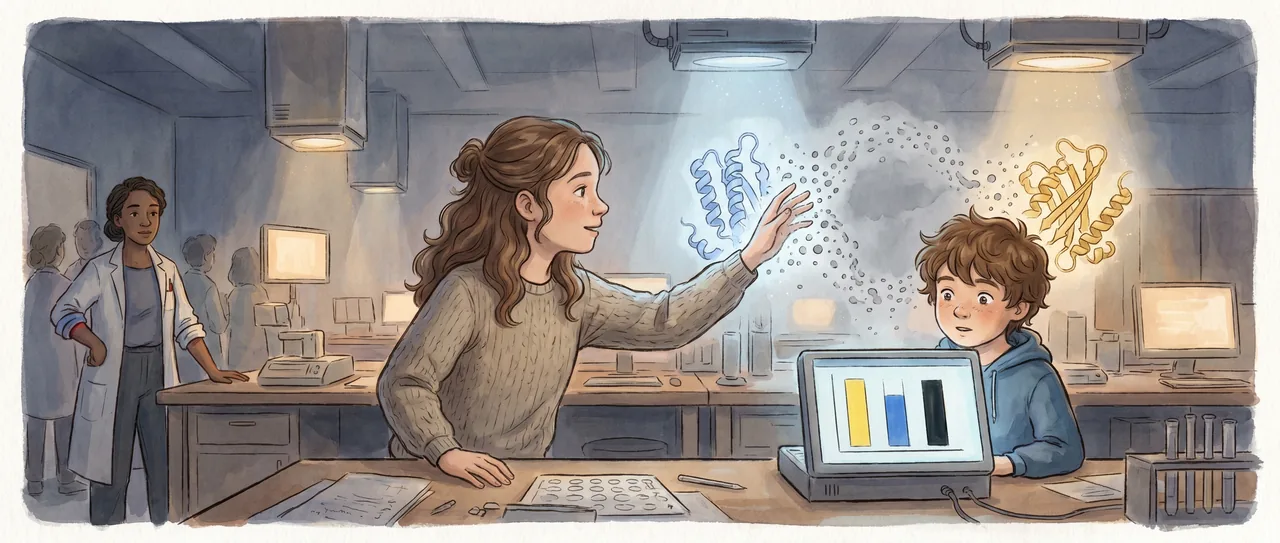
Not real proteins. Light proteins. The biofoundry's ceiling projectors drew them above the worktop, two twisted ribbons turning slowly, blue and gold, each one folded from a string of amino-acid letters that ran along the screen like beads.
Anu, their genomics AI companion, spoke from the bench speaker. "Sequence A folded. Confidence high. Sequence B folded. Confidence high. Predicted time, two point one seconds. Actual time, one point seven seconds."
"Showing off," Maya said.
"Correct," said Anu.
Soren leaned closer until the blue glow colored the bridge of his nose. "Run the pair."
The two ribbons slid toward each other. Then they stopped.
Between them, the air filled with gray mist.
Anu said, "Complex prediction unavailable. Interaction model confidence below useful range."
Across the aisle, Dr. Imani clapped twice. She wore a lab coat with one sleeve rolled up and one sleeve down because she had been called away while dressing for the visitors. "Junior team, remember, the mayor arrives in eighteen minutes. We need one clean demonstration. Single protein folding, sensor color, applause. No mysteries today, please."
"It's not a mystery," said Maya. "It's a fog."
"Fog is for poets," Dr. Imani said, already walking backward toward a hissing sterilizer. "Use the approved docking preview. It will be close enough for a demonstration."
Soren looked at the gray between the proteins. "Close enough to what?"
Maya was already opening the sample drawer.
Their assignment was supposed to be simple. Protein A came from a harmless pond microbe. Protein B came from a library of designed binders made for school labs. Both were safe. Both were ordinary. Together, according to the old docking preview, they were supposed to clasp like two hands.
Each protein had a tiny lantern attached. If the lanterns came near, the sample would shine yellow. If they stayed apart, it would shine blue. Visitors loved yellow. Yellow meant something had happened.
Maya set the clear well plate on the reader. Soren checked the labels twice because one of them said left edge and one said leftish edge, and that bothered him.
"Leftish is not a place," he said.
"It is if you are a protein," Maya said.
"Proteins do not have leftish."
"They fold. They can have anything."
Soren placed three drops of Protein A into three wells. Maya added Protein B. The reader lid whispered shut.
The screen stayed blue.
Not yellow.
Maya tapped the glass with one fingernail. "Again."
They ran it again.
Blue.
Dr. Imani passed behind them carrying a box of visitor badges in her teeth. She removed the box and said, "If it fails twice, assume contamination. Switch to the butterfly pigment protein. Very pretty. Folds beautifully."
"Both our proteins fold beautifully," Soren said.
"Then they do not like each other," Dr. Imani said. "That is allowed."
Maya did not move to the pigment tray. She was staring at the blue well.
"It is too blue," she said.
Soren looked. "Blue is blue."
"No. The alone blue is bright at the edge. This blue is flat. Like someone put a thumb over it."
Soren called up the control wells. Protein A alone, bright blue. Protein B alone, no lantern. A plus B, blue, but dull. The number under the graph had dropped.
"The donor lantern is being quenched," he said.
"Thumb," Maya said.
"Molecular thumb," Soren said.
Anu said, "Possible explanations include concentration error, lantern damage, sample impurities, unexpected local environment, conformational change upon binding."
"Last one," Maya said.
Soren did not say no. He pulled the well plate closer, though the machine had already read it. "If they are not binding, the lantern should act like A alone. If they are binding the way the preview says, it should go yellow. If it goes dull blue..."
"The lantern got buried," Maya said.
"Or bent near something that eats its light. Or farther from the other lantern than expected. Or all of that."
Maya grinned. "So it worked wrong."
"It failed informatively," Soren said.
"That is what I said."
The approved docking preview still hovered above the bench, blue and gold touching at one neat patch. It looked certain in the way school diagrams looked certain. Clean lines. Smooth surfaces. No gray mist.
Soren turned to Anu. "Show the attachment sites."
Green dots appeared on Protein A and Protein B, marking where the lanterns had been clipped.
Maya circled the hologram with her finger, not touching it. "If the thumb is here, move the lanterns."
"We have alternate tags," Soren said. "Right edge, top loop, bottom loop."
"Leftish?"
"We are not using leftish."
They worked fast. Not messy fast. Bench fast. Soren read every tube name aloud. Maya placed each drop before his voice finished. Anu adjusted the reader settings, but only after Soren told it which wavelengths to use.
From the front room came the sound of visitors arriving, shoes squeaking on polished floor, a baby laughing, Dr. Imani saying, "Welcome to the People's Biofoundry, where biology becomes something you can ask questions of."
Maya whispered, "Good. We have questions."
The second set ran.
Top loop plus top loop flashed yellow.
Bottom loop plus bottom loop stayed bright blue.
Right edge plus right edge went dark, almost black.
Soren's mouth opened, but no words came out. He ran the plate again.
Yellow. Blue. Black.
Again.
Yellow. Blue. Black.
Maya stood very still. She was not looking at the numbers. She was looking at the floating proteins, at the tidy docking preview that had no room in it for yellow, blue, and black all at once.
"They are touching," she said.
"At least one part is," Soren said.
"And one part is moving away."
"And one part is getting buried or squeezed."
The blue and gold shapes hung in the air, each one perfect alone. Between them, the gray mist thickened where Anu could not draw what happened next.
Soren said, very quietly, "The shape is not either protein."
Maya said, "It is what they do to each other."
Anu did not interrupt. The reader hummed. The visitors murmured in the next room. Dr. Imani's demonstration voice grew brighter and more hurried.
Then she appeared at their bench, smiling too widely. "There you are. I need the folding display in two minutes. Please tell me you have something simple."
Soren pointed at the plate.
Dr. Imani looked at the three wells. "That is not simple."
"No," Maya said.
"Is it broken?"
"No," said Soren.
Dr. Imani leaned in. The bright demonstration smile slipped off her face. She looked at the blue well, then the yellow, then the black. She looked up at the gray mist between the holograms.
"Oh," she said.
Maya waited for her to say contamination. She did not.
Dr. Imani set the visitor badges down on the bench, very carefully. "Can you reproduce it?"
Soren held up the second run. "We did."
"Controls?"
Maya held them up.
"Alternate tag positions?"
"Three," said Soren.
Dr. Imani looked toward the front room, where the mayor was probably standing under the banner that said FOLDING THE FUTURE. Then she looked back at Bench Seven.
"The mayor can wait," she said. "No, worse, the mayor can watch."
The visitors crowded around Bench Seven instead of the big stage. Some were adults who bent politely. Some were children who pushed between elbows. Dr. Imani began explaining single-protein folding, too fast at first, then stopped herself.
She turned to Maya and Soren. "Show them."
So Soren showed Protein A alone, folded in less than two seconds. Maya showed Protein B, folded just as quickly. The crowd made the correct impressed sound.
Then Maya asked Anu to show the pair.
The gray mist appeared.
No one made the correct sound after that.
A little kid in the front asked, "Why doesn't it know?"
Soren said, "Because knowing the shapes alone is not the same as knowing the shape they make together."
Maya added three drops to three wells. The reader lid closed. On the screen, the results appeared again.
Yellow. Blue. Black.
The little kid pressed both hands to the bench. "Which one is true?"
Maya looked at Soren.
Soren looked at the three colors.
"All of them," he said.
Anu's voice softened, though it was still only a speaker under the bench. "Would you like to submit this pair to the Open Interaction Atlas? Current atlas entries with unresolved binding-change behavior, nine million four hundred thousand and increasing."
The number rolled across the screen.
Maya touched submit.
The blue and gold proteins rose higher above the bench. Their single shapes shone clear. Between them, Anu left an empty space filled with moving gray points.
Maya lifted her hand into the blank space between the two glowing proteins, and the hologram scattered pale dots across her fingers.
Read the interactive version, listen to the narration, and earn a gold star →
A science-verified short story for curious kids · Curiosity Land