The Marks Between
The machine put Soren in the wrong century.
A blue line rose from his cheek-swab sample, crossed the glass wall, and fastened itself to a strip labeled Winter Famine Archive, one hundred and twelve years ago.
“That is not where an eleven-year-old goes,” said the exhibit builder.
She tapped the wall with two fingers. The blue line vanished, blinked, and came back, brighter than before.
Maya leaned close enough that her breath fogged the glass. “It likes him there.”
“It is a calibration error,” the builder said. She had a coil of cable over one shoulder and a mouth full of pins, which made every word sound dangerous. “This gallery opens in forty minutes. Children, step back.”
Soren did not step back. He looked at the wall.
The gallery was called The Body Remembers, which Soren had disliked from the beginning. Bodies did not remember. Brains remembered. Not always well. Bodies healed, grew, got hungry, got tired, made blood, made mistakes. He had written that on page twelve of his notebook, then crossed out the last part because bodies also fixed mistakes constantly, which seemed important.
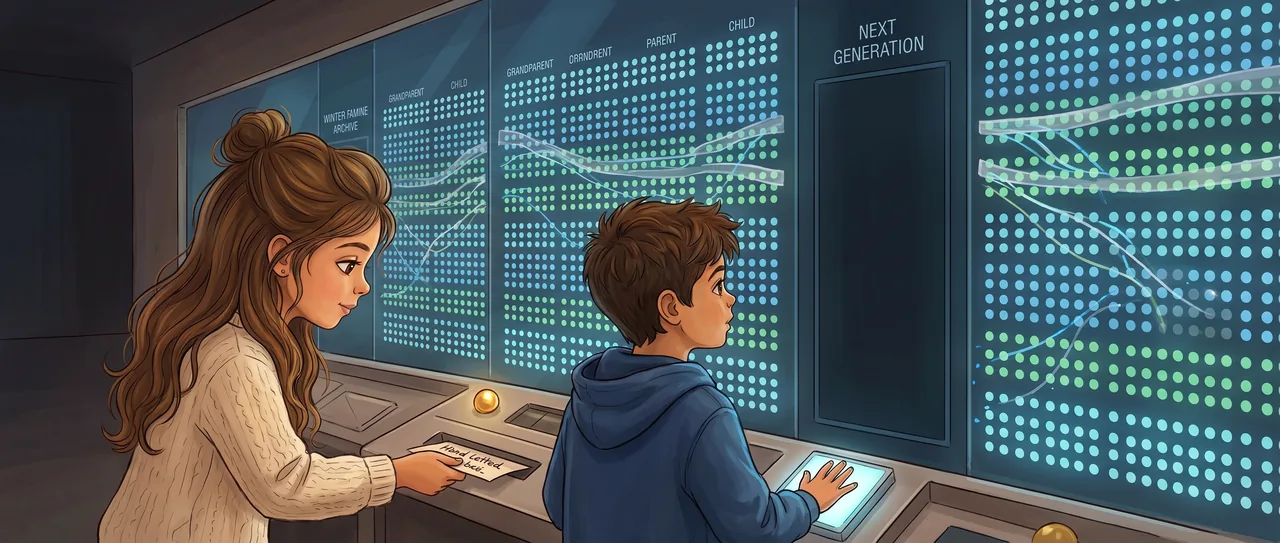
The wall showed families as threads of light. White threads were DNA letters, the long inherited code. Green and blue flecks were smaller things attached to the code, marks that helped cells decide which instructions to use more or less. The builder called them switches for visitors, although Soren had written, not exactly switches.
Maya had not written anything. She had walked past the first seven displays and stopped at the eighth because a pattern broke.
Now the broken pattern was Soren.
“My DNA cannot be from the famine archive,” he said.
“It is not,” Maya said.
The builder pulled the pins from her mouth. “Exactly. Thank you. The white DNA thread is behaving. The epigenetic overlay is confused.”
Maya pointed. “Only the blue flecks moved. Not the white.”
Soren took a half step closer. The white thread from his sample still ran straight into the Present Day Children column. The blue flecks lifted away from it like sparks and joined a cluster beside the old famine samples.
The builder sighed. “The public does not need sparks. The public needs clear.”
“Clear is wrong sometimes,” Maya said.
The builder looked at the ceiling as if asking it to lend her patience. “Clear is what keeps grandparents from thinking we are telling children they are doomed by history.”
Soren heard the word doomed and disliked it even more than remembered.
He picked up the used swab packet from the tray. His name was printed on the edge. The packet seal was intact except where he had opened it. The scanner dish was clean. The control bead beside it glowed steady gold.
“Can I test it again?” he asked.
“No time,” said the builder.
Maya had already taken a fresh packet from the drawer.
The builder made a small noise, half protest and half defeat. “One repeat. Then I shut off the overlay.”
Soren rubbed the cotton tip inside his cheek. He counted to ten because the directions said ten, not because counting helped, although it did. He set the swab into the scanner.
The machine hummed. White thread, straight to Present Day Children. Blue flecks, away across the wall to Winter Famine Archive.
Maya smiled without looking at him. “Not dirt.”
“Not random,” Soren said.
The builder frowned. She pulled a tablet from her belt and scrolled too quickly. “You are in the consent set because your family donated older medical samples. There should be a grandparent card, a parent blood spot, and your cheek swab. The display is supposed to stack them, not fling you into history.”
“Show the stack,” Maya said.
“It is hidden in visitor mode.”
“Show it anyway.”
The builder hesitated. The clock above the doorway clicked to thirty-six minutes.
“Fine,” she said, and dragged three fingers down the tablet.
The wall changed.
The pretty family threads collapsed into rows of dots. Grandparent. Parent. Child. Grandparent. Parent. Child. Hundreds of them, quiet and exact. The white DNA letters stayed mostly steady down each family row, not identical, but close in the way family faces were close. The blue and green marks shifted more, scattered more, appeared and disappeared like tiny beads of weather.
In some rows, the famine grandparent had a blue cluster. The parent had less of it. The child had a few dots in the same places.
Not all rows. Not every dot. Not a command.
But enough.
Soren stopped counting.
Maya’s hand found his sleeve and pinched it once, hard.
On the wall, one winter from before Soren was born had not stayed in the winter. It had crossed bodies. It had crossed cradles. It had arrived as small chemical marks sitting on DNA in children who had never missed a meal because the sky froze the crops.
The room seemed to gain walls behind its walls. Behind the glass were parents, and behind them grandparents, and behind them cold fields, empty cupboards, ration lines, storms, choices, bodies doing whatever they could to keep going. None of it was memory. None of it was story. It was smaller than story and stranger because it was real.
Soren looked down at his hands.
He had always packed extra food. Crackers in his left pocket. Dried apple in his bag. He did not know why. He was not afraid of lunch disappearing. It just felt better to have something saved.
The builder said softly, “We do not know what each mark does. We do not know how many last. Most marks are reset between generations. Some seem to escape. Human evidence is messy.”
“Messy is not nothing,” Soren said.
“No,” the builder said. “Messy is not nothing.”
Maya moved along the wall, following the rows. “Why did visitor mode hide the middle?”
“Because three generations are complicated.”
“That is the point.”
The builder opened her mouth, then closed it.
Soren looked at the display controls. There were buttons for DNA Only, Health Traits, Ancient Migration, and Simple Family View. At the bottom, grayed out, was a button labeled Environmental History.
“Why is that off?” he asked.
The builder rubbed both hands over her face. “Because people like inheritance to mean letters. A, C, G, T. Nice and clean. They get nervous when we say experience can leave marks too.”
“Are the marks bad?” Maya asked.
“Not bad. Not good. They can change how genes are read. Sometimes stress leaves patterns. Famine. Smoke. Fear. Care can change bodies too, but what crosses generations in humans is harder to prove.”
Maya stared at the grayed button. “So the honest display says maybe.”
“The honest display says maybe, and here is the evidence, and here is what we do not know.”
“That sounds better than simple,” Soren said.
The builder gave a short laugh. “You two are not the public I was warned about.”
Maya pressed Environmental History.
Nothing happened.
“Locked,” the builder said.
Soren checked the tablet still hanging from her hand. A small warning box read, Requires complete three-generation alignment.
He looked back at the rows. His family stack had grandparent and child, but the parent dot row was pale. Not absent. Unmatched.
“The machine thinks my middle row does not count,” he said.
“It is from a different tissue,” the builder said. “Old blood spot for the parent. Cheek cells for you. Preserved blood card for the grandparent. I told them that would be too messy.”
Maya tilted her head. “But all the rows have different tissues somewhere. It only breaks when the mark is the part that matters.”
Soren followed the columns with his finger, not touching the glass. The DNA letters aligned easily because letters were letters in almost every cell. The epigenetic marks depended on cell type, age, life, all of it. The machine was demanding a perfect match from a thing that was not supposed to be perfect.
“Lower the match threshold for the marks,” he said.
The builder blinked.
“Not for DNA,” Soren said quickly. “Only for methylation sites already flagged from the famine study. If it is looking for identical, it will fail. If it is looking for pattern overlap, it might stack us.”
Maya nodded. “The mark is a footprint, not a shoe.”
The builder stared at them for one second too long. Then she moved.
Her fingers flew over the tablet. “Pattern overlap. Study-flagged regions only. Confidence bands visible. No prediction language.”
The warning box vanished.
Soren’s blue flecks returned to his white thread. Then the wall drew a second line, thinner than the first, from the famine archive to the grandparent row, from grandparent to parent, from parent to child. Around it appeared a pale band, not solid, not certain, but there.
Other bands appeared across the gallery. Some stopped after one generation. Some faded in the second. A few reached the third like whispers that had found a way through closed doors.
The clock clicked to twenty-eight minutes.
The builder looked at the wall. Her eyes were shiny, but her voice was brisk. “I need a label.”
Maya read from the side of the glass. “We already have one.”
The old label said, Some histories are inherited.
Soren shook his head. “Too finished.”
Maya took a blank label strip from the tray. “Then ask it.”
Soren picked up the black marker. He wrote slowly because labels were not notebook pages and other people would see this.
What else can a body carry forward?
The builder took the strip from him and slid it into the holder beneath Environmental History. The gallery doors clicked. Voices gathered outside.
Maya slid the tag into the empty slot. Soren set his palm against the scanner. Behind the glass, the unlit column for the next generation stood dark.
Read the interactive version, listen to the narration, and earn a gold star →
A science-verified short story for curious kids · Curiosity Land