The Line That Would Not Behave
The forest would not balance.
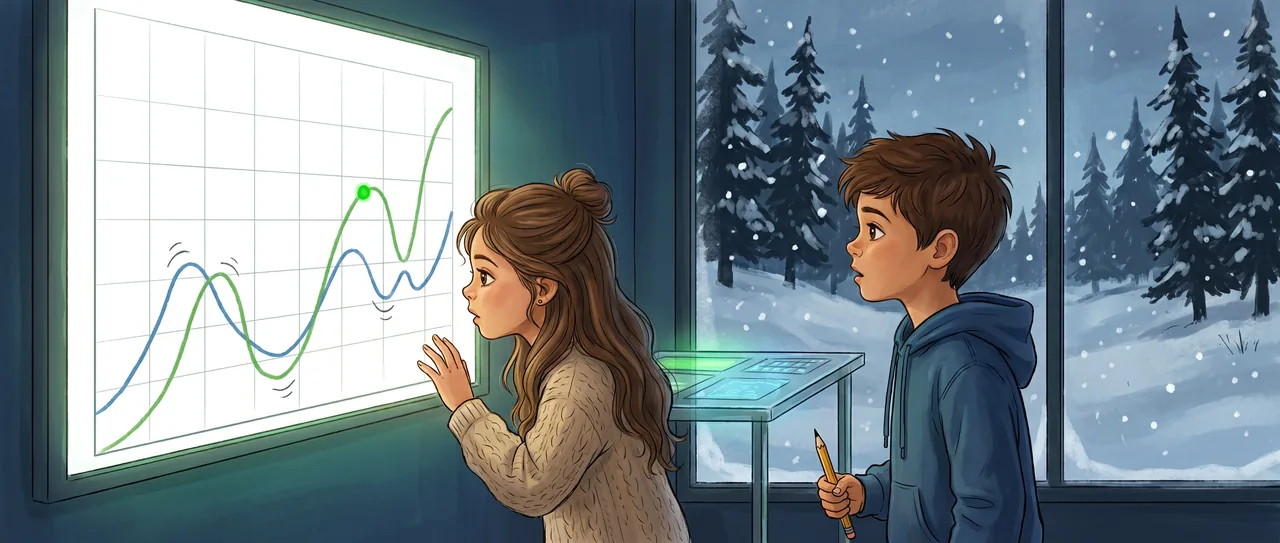
On the wall screen of the Boreal North Ecology Station, green dots for snowshoe hares jumped up and down like frightened popcorn. Blue dots for Canada lynx followed them, not at the same time, never at the same time, always late.
The title above the screen said HEALTHY FOREST, BALANCED FOREST.
Maya looked at the title, then at the lines. Her mouth made the shape it made when something had been put in the wrong drawer.
Soren stood beside the control table with a pencil behind his ear. The pencil was real wood. The table was glass and touch-lit and did not approve of pencils.
"It's not balancing," he said.
"I know," Maya said. "That's the problem. Or the title is. Probably the title."
Dr. Pell hurried past them carrying a tray of tiny spruce seedlings for the donors. Her orange scarf had pine needles stuck in it. She had been saying "wonderful" all morning in a voice that meant the opposite.
"Can you two make the exhibit presentable?" she asked. "The board comes through in twelve minutes. Tap reset if it gets messy. We need people to see stability. Conservation sounds better with stability."
"But the data," Soren said.
"Historical data is untidy," Dr. Pell said. "Live data is untidier. Smooth it if you must. Just do not let the lynx line look like a roller coaster."
She vanished through the automatic doors, still holding the seedlings like a tray of nervous cupcakes.
Maya tapped reset.
The green hare line rose. The blue lynx line rose after it. The hares fell. The lynx fell after them. Then the hares rose again.
"Again," Maya said.
Soren reset it.
The forest refused to sit still.
The station had been built at the edge of black spruce and tamarack, where winter lasted long enough to feel like a law. All week, their class had helped sort camera trap photos, paw prints in snow, and little tubes that collected hare fur for DNA counts. Most kids liked the lynx pictures best because lynx looked as if they knew secrets and disapproved of everyone.
Maya liked the gaps between pictures. Why no hares here, then too many hares there? Why did bite marks show up on willow twigs before the lynx cameras got busy? Why did the forest seem to breathe through numbers?
Soren liked the old cabinet in the back room.
The cabinet held scanned pages from fur trading posts. Year after year, people had written down how many lynx pelts and snowshoe hare pelts came in from huge stretches of Canada. The numbers were not perfect. They were records of trapping, not exact animal counts. Still, the pattern kept coming back, roughly every ten years, green then blue, hare then lynx.
Now the same pattern was marching across the wall screen, and Dr. Pell wanted it smoothed.
"Maybe the smoothing tool is broken," Soren said.
"Maybe smoothing is the broken thing," Maya said.
She dragged two fingers across the screen and opened the model drawer. The station software offered choices with tidy names. Carrying Capacity. Migration. Weather Noise. Lotka-Volterra.
Soren leaned closer.
"That's the predator-prey one," he said. "Two equations. Prey grow when predators are low. Predators grow when prey are high. Then predators eat more prey. Then predators drop because there isn't enough food."
"A chase in math," Maya said.
"A chase where both lines move each other."
She selected it.
The screen showed two empty axes and four sliders. Hare birth rate. Predation rate. Lynx death rate. Lynx growth from prey.
"We don't know the numbers," Soren said.
Maya pointed at the old-data folder. "The forest already tried them. We can ask backward."
That was not how the exhibit wanted to be used. It had a big friendly button that said DEMONSTRATE. Maya ignored it and opened ADVANCED. The screen asked for a password.
Soren looked toward the door where Dr. Pell had disappeared.
Maya tried "harelynx."
Wrong.
Soren tried "boreal."
Wrong.
Maya tried "stability."
The screen opened.
"That's embarrassing," Soren said.
"For the password," Maya said.
They loaded the old fur-return data. The green and blue points appeared in a long row of years, more than either of them had been alive by a lot, more than their parents had been alive, more than the station had existed. The hares rose and crashed. The lynx rose and crashed after them.
Soren adjusted the hare birth slider. The green curve sprang too high.
"Too much," Maya said.
He moved it back.
Maya changed the predation slider. The green curve collapsed flat.
"Dead forest," Soren said.
"Undo."
They worked without talking for a while. The equations did not care about the station's title. They did not care about donors or glass tables or whether a pencil belonged. Every wrong setting made a different kind of wrongness. Too many lynx, and the hares vanished. Too few lynx, and the hares climbed until the model stopped looking like the records. Too little predator growth, and the blue line dragged behind like a tired kite.
Then Soren lowered the lynx death rate by one small notch.
The blue curve slipped into place behind the green points.
Maya held up her hand, not touching the screen.
"Don't move," she said.
Soren did not move.
On the wall, old dots and model curves crossed, missed, found each other, missed again. Not perfectly. Not like homework. Like footsteps heard through trees.
Maya walked backward until her shoulders touched the opposite wall.
The model had been made long before the station's cameras, before their little fur tubes, before this winter's tracks. It had not seen these hares. It had not watched one lynx step over a buried log at two in the morning. It had been written as a way for one thing eating and one thing being eaten to tug on each other through time.
And now the new data, messy and cold and alive, was bending near the old math.
Soren took the pencil from behind his ear and tapped it once against his thumb.
"If it's right," he said, "the hare rise this year is not random."
"And the lynx rise comes later," Maya said.
"How much later?"
Maya looked at the blue curve. "Not now. Soon."
"Soon is not a number."
"You do numbers."
He smiled and pulled the last three years of live station counts onto the graph. Camera sightings. Track surveys. DNA estimates. Each had its own uncertainty bar, thin vertical lines like whiskers.
"We should not pretend the points are exact," he said.
"Good," Maya said. "Exact would be suspicious."
They fitted the curve again, this time using only the data from before the current winter. Soren covered the newest points with his hand.
"Predict first," he said.
Maya put her finger where she thought the uncovered hare point would be. High, but not at the top.
Soren ran the model.
The green curve rose under her fingertip.
He lifted his hand.
The new hare point sat almost on the curve.
For three seconds, neither of them said anything.
Outside the long window, snow fell between black spruce trunks. Somewhere beyond the glass were hares turning white with the season and lynx with wide paws that did not sink much in snow. None of them knew they were part of a curve. None of them had agreed to be predictable. Still, the pattern moved through them, not forcing each animal, not naming each pawstep, but shaping the crowd of them across years.
Maya pressed both palms to the cold window.
"It's bigger than catching," she said.
Soren came to stand beside her. "And bigger than being caught."
Behind them, Dr. Pell rushed in with three adults in wool coats and one man already holding a donation tablet.
"Children," she said, stopping short. "Why is the exhibit not smoothed?"
Maya turned from the window. "Because smooth is wrong."
The man with the tablet frowned at the leaping lines. "It looks unstable."
Soren picked up the control stylus. His hand shook once, then steadied.
"Watch the covered year," he said.
He reset the display to the moment before the newest data appeared. The model drew its green prediction into the blank space. Then Soren uncovered the actual hare count.
The point landed beside the line.
One of the wool-coat adults stepped closer.
"Do that again," she said.
So they did. They showed the old fur records, with all their human messiness. They showed the equations, written almost a century before the station's sensors began collecting data. They showed the hare peak coming first and the lynx answering later, not as a mistake, not as balance, but as a rhythm made by hunger, birth, snow, and time.
Dr. Pell stopped saying "wonderful" in the wrong voice.
"We cannot claim perfect prediction," Soren said quickly.
"Good," said the woman in the wool coat. "Perfect prediction would be boring."
Maya looked at her then.
The woman was not watching the smooth parts. She was watching the offsets, the lag, the places where the lines did not match and therefore said something. Her gloved finger hovered over the blue curve after the green peak.
"This delay," the woman said. "This is where the forest tells you what it is doing."
Soren's pencil was still in his hand. Maya saw the bite marks in the yellow paint, the sharpened point, the ridiculousness of carrying wood and graphite in a room full of glass screens. The graph needed the old dots. It needed the late line. It needed the thing that did not arrive when everyone expected it to.
Dr. Pell looked at the title above the screen and winced.
"We need a new heading," she said.
Maya reached up and deleted HEALTHY FOREST, BALANCED FOREST.
The cursor blinked.
Soren said, "Healthy Forest, Moving Forest."
Maya typed it.
The donors moved on slowly, pulled forward by the next exhibit but looking back at the unsmoothed lines. Dr. Pell stayed. She touched one of the uncertainty bars on the screen with the tip of her scarf.
"Can it run ahead?" she asked. "Not as a promise. As a question."
Soren opened the prediction window. Maya set the years forward. The software asked how far.
The choices were five years, ten years, twenty years.
Maya looked at Soren.
"Twenty," he said.
She tapped it.
On the screen, beyond the last black dot, the green line kept climbing into the empty white grid.
Read the interactive version, listen to the narration, and earn a gold star →
A science-verified short story for curious kids · Curiosity Land