The Honest Lopsidedness
The audit wall was pretending to be boring.
It showed rows of station payments in pale blue light. Valve seals. Seed packets. Carbon filters. Hull paint. Replacement spoons for the south cafeteria, because spoons vanished on Orbital Ring Nine the way socks vanished on Earth.
Maya stood too close to the wall. Her nose was almost in the numbers.
Soren stood farther back with a pencil behind one ear and his paper notebook open in both hands. Everyone else used wrist screens. Soren liked paper because paper did not decide, halfway through a thought, that it needed to update.
The auditor in charge had given them six anonymized ledgers and a bright yellow box of counting chips.
“One file in there is fabricated,” the auditor had said. She had three styluses in her hair and the look of a person who had eaten breakfast while walking. “Not stolen money. Not a crime. A training fake. If you can find it without using the audit software, I will be extremely impressed and also late.”
Then she had turned back to arguing with a printer that believed every page was jammed.
Soren drew nine columns in his notebook, one for each possible first digit from one to nine.
“This is easy,” he said. “If someone made up numbers badly, they used favorite digits. Seven, probably. People like seven.”
Maya did not answer. She was looking at the first amounts in Ledger Green.
One hundred twelve credits.
One thousand four hundred credits.
Nineteen credits.
Two hundred eight credits.
Seven thousand credits.
She moved to Ledger Silver.
One hundred six. One thousand nine. Eleven. Eighteen hundred.
“Huh,” she said.
Soren looked up. “Good huh or bad huh?”
“Crowded huh.”
They began counting first digits. Not the biggest digit. Not the last digit. Only the first symbol the number wore when it came into the room.
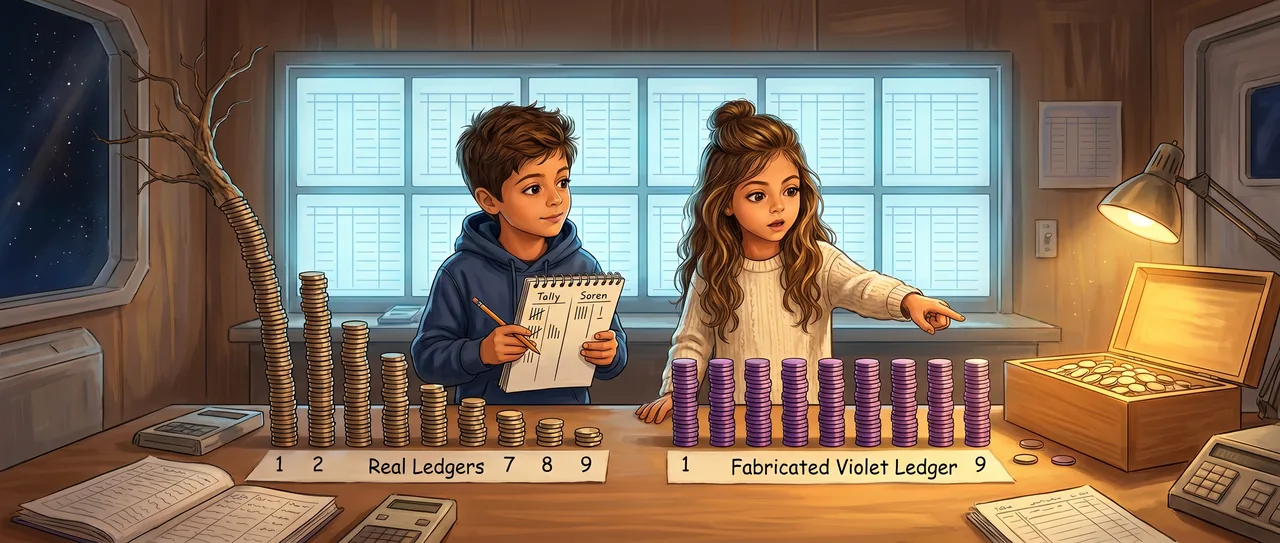
For Ledger Green, Maya dropped a chip in the one column every time an amount began with one. Soren marked the rest. Two. Five. One. Three. One. One. Eight. Six. One.
The one column grew tall.
“That can’t be right,” Soren said.
They counted again.
It was right.
Ledger Silver did the same thing. Ledger Amber did it too. Not exactly the same. The station was not tapping out a drumbeat. But each real-looking ledger leaned toward one, as if the smallest digit had the strongest gravity.
Soren frowned down at his columns. “Random should be flatter.”
Maya had gone very still.
“What?” he asked.
“That one.” She pointed at Ledger Violet.
Its chips stood almost level. Ones, twos, threes, fours, fives, sixes, sevens, eights, nines. Neat little buildings. Same height. Calm. Fair.
“It looks better,” Soren said.
“It looks combed.”
The auditor passed behind them carrying a coil of printer filament around her neck like a scarf.
“Careful,” she said. “Human eyes are great at finding dragons in clouds.”
“This dragon has nine heads,” Maya said.
The auditor blinked once, smiled because she thought that was a joke, and kept walking.
Soren tapped his pencil against his teeth, which Maya hated but did not say, because his eyes had narrowed in the way that meant the pencil was helping.
“We need to know which shape is supposed to happen,” he said.
“Not flat,” Maya said.
“Why not flat?”
Maya spread her fingers toward the wall. “Because all the messy ones match.”
“That is not a why.”
“It is a start.”
They needed a dataset that had not passed through any person who might be trying to fool them. Maya looked around the audit room. Every surface had numbers. Clock times, printer errors, seat labels, door codes.
“No,” Soren said before she asked. “Assigned numbers do not count. Door seven starts with seven because someone named it.”
Maya grinned. “You said no to the thing I hadn’t said yet.”
“I heard it arriving.”
They found the vending alcove beside the audit room. It sold things at fixed prices, which Soren rejected. It also displayed the habitat’s live maintenance queue, sorted by estimated cost. Tiny fixes, huge fixes, bolts, pumps, sealant, whole greenhouse panels, all mixed together.
“Amounts that grow across sizes,” Soren said. “Small to huge. Not phone numbers. Not labels. Not only cafeteria spoons.”
They copied the first digits of the estimated costs until Soren’s hand cramped and Maya started using two fingers to keep her place.
Again, the ones rose.
Not half. Not all. But far more than any digit that small had any right to be. Almost one out of three.
Soren stopped writing.
On the wall, the maintenance queue changed as new jobs came in. A cracked algae pipe appeared at one hundred thirty credits. The one column gained another chip.
The room did not get louder. No trumpet played. The printer still complained. Someone’s shoes squeaked in the hall.
But the rows of station costs seemed to tilt open. Valve seals, greenhouse panels, pipe patches, seed drums, oxygen filters, all those separate things, bought by different people for different reasons, were keeping the same crooked posture. The station’s ordinary money had a secret weather inside it.
Soren whispered, “It is not random like dice.”
Maya said, “It is random like growing.”
They went back to the audit wall.
Soren drew a new page, slower now. He wrote the ledger names down the side. He did not write a conclusion. He made columns for first digits, counted totals, and checked whether the ledgers covered small and large amounts. Ledger Red had purchases from ten credits to nine thousand. Good. Ledger Green, eleven to twelve thousand. Good. Ledger Silver, eight to twenty thousand. Good.
Ledger Violet had the right spread too. Tiny payments. Huge payments. It should have leaned.
It stood straight.
Maya began pulling up individual Violet entries. Her fingers moved fast enough that the wall made soft popping sounds.
“Look,” she said.
Soren leaned in.
The amounts were not repeated. They were not silly. No one had bought nine hundred ninety-nine spoons. Whoever made them had avoided obvious mistakes.
“That is careful,” Soren said.
“Too careful.”
He looked at the level chip towers. “They tried to make every first digit equally likely.”
Maya nodded. “Because that feels fair.”
Soren stared at the neat Violet columns for another breath.
Then he laughed once, very softly. “Fair is the fake part.”
The auditor came back, this time with a printer panel under one arm and a defeated expression.
“We think Violet is your fabricated ledger,” Soren said.
The auditor’s eyebrows rose. “Why?”
Maya pushed the chip trays forward.
The auditor looked from the towers to the wall. Her mouth opened, then closed. She set down the printer panel.
“You used first digits,” she said.
Soren said, “Only after we checked the data type. Not labels. Not fixed prices. Amounts spread across sizes.”
“And not proof by itself,” Maya added. “A flag.”
The auditor’s tired face changed. Not into a teacher face. Not into the face adults used when they were about to praise you for breathing. It changed into the face of someone whose workbench had just gained two more hands.
“That method is old,” she said. “Older than the ring. Accountants used it on Earth to spot made-up financial records.” She looked at Ledger Violet again. “The training generator is too tidy. I told them it was too tidy.”
Maya smiled at Soren.
Soren looked down at his paper, where the one column leaned over all the others like a tree reaching for a window.
The auditor touched the wall and opened the hidden answer key. Violet flashed gold.
Then, because the audit room was connected to everything, the wall offered more live data feeds in a side menu. Harvest masses. Repair costs. Water use by garden bed. Meteor shield patch sizes. Dust-impact masses from the outer skin.
Soren’s pencil slowly slid from behind his ear into his hand.
The auditor opened a fresh square on the wall. Its title box blinked, waiting.
Maya reached up and dragged the live file marked dust-impact masses into the empty square.
Read the interactive version, listen to the narration, and earn a gold star →
A science-verified short story for curious kids · Curiosity Land