The Gaps Between Bells
The sign above Soren’s unfinished exhibit said FIND THE PATTERN.
Soren stood under it with a screwdriver in one hand and a roll of paper in the other, frowning so hard that the museum volunteer stopped counting wristbands.
“You do not like the sign,” the volunteer said.
“It is bossy,” Soren said.
“It is math.”
“Not always.”
The volunteer had been given twelve exhibits to check before the museum opened for Numbers at Night. She wore three key cards around her neck and kept losing the pencil tucked behind her ear. Her job was to make sure each exhibit had a beginning, a middle, and something satisfying at the end.
Soren’s exhibit did not.
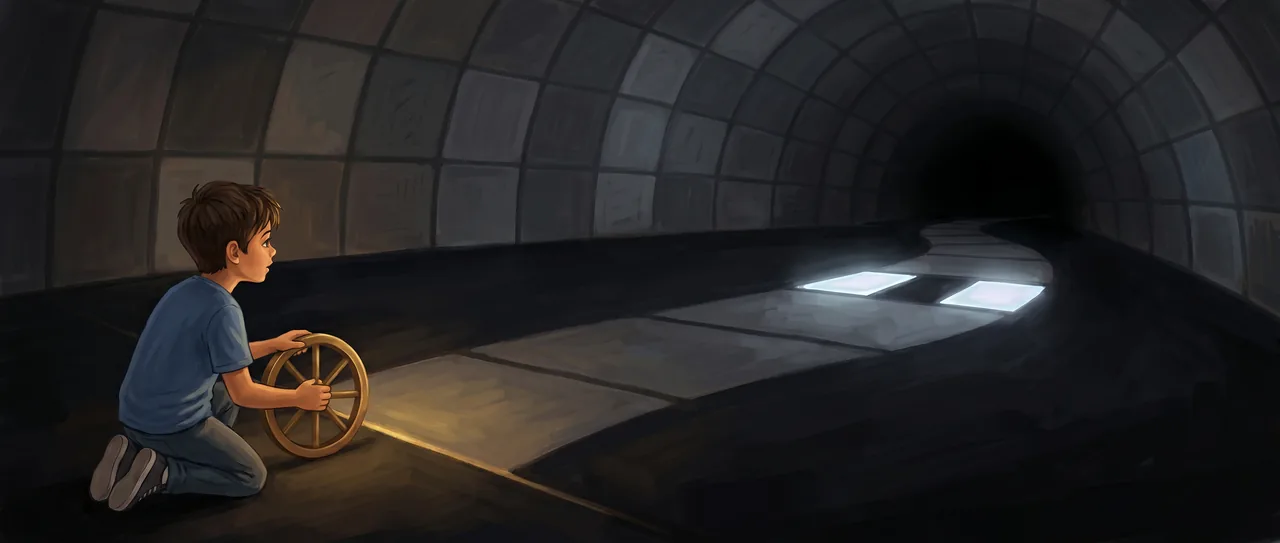
It had a long black floor made of square panels. Each square held one whole number, starting with two and running across the room, around the planetarium dome, and into a strip of digital floor that could keep counting as long as someone turned the brass wheel.
Most of the numbers slept gray.
Prime numbers rang.
Soren had built the ringing part himself. Not the floor, which belonged to the museum, and not the little speakers, which were already in the panels. But he had written the instructions that told the floor which numbers to test. Two stayed bright because only one and two divided it. Three stayed bright. Four went dark because two stepped evenly into it. Five stayed. Six went dark. Seven stayed.
The old sieve worked like footsteps. Cross out the multiples of two. Cross out the multiples of three. Cross out the multiples of five. Keep going.
Every prime made a clear white chime.
Every twin prime made two chimes close together.
Three and five.
Five and seven.
Eleven and thirteen.
Seventeen and nineteen.
The first time Soren ran the exhibit, the beginning of the floor sounded like rain on a metal roof.
Chime, chime-chime, chime, chime-chime.
Then the rain thinned.
There were longer spaces between the bright squares. Twenty-three rang, then twenty-nine and thirty-one rang together. After that came pauses large enough for Soren to take two steps without hearing anything.
That was supposed to happen. He had read it three times to be sure. Primes do not run out. There are always more. But they get farther apart, mostly, as numbers grow.
Soren liked the word mostly. It was where math kept its trapdoors.
His first plan had been simple. Visitors would walk from the noisy beginning into the quiet farther numbers. The chimes would grow rare. The twin chimes would stop. At the end, a blue panel would say THE LONELY NUMBERS WIN.
He had already painted the panel.
Then the exhibit refused to end correctly.
Past one hundred, the floor went quiet enough for the air conditioner to sound loud.
Then one hundred and one rang.
One hundred and three rang right after it.
Soren checked the code.
Past one thousand, the primes came more slowly. The twin chimes seemed finished.
Then they came back.
Past ten thousand, they came back again.
He tested the floor with his paper roll, because the museum tablets rounded things in a way he did not trust. He marked composites with little slashes, primes with dots, twins with two dots joined by a bridge. The bridges grew scarce. They did not vanish.
The volunteer came over carrying a coil of cable and the sign that said FIND THE PATTERN.
“Does it reach the answer?” she asked.
“No,” Soren said.
“Can you make it reach the answer by seven o’clock?”
“No.”
She sighed, not unkindly. “The number line is digital. Make it shorter.”
“That would be lying with carpentry.”
“It is not carpentry. It is exhibit design.”
Soren lay flat on his stomach and watched the panels blink sideways down the hall. He had already tried making it shorter. The exhibit then seemed to say the twins stopped after whatever number the museum got tired of showing. That was worse than being wrong by accident. It was being wrong with a clean font.
He turned the brass wheel again.
The floor counted faster.
Numbers streamed under the glass, too quick to read, but not too quick for the program. Gray, gray, gray, white. Then gray for a long stretch. Then white. Then, after a single dark square between them, another white.
Twin chimes.
Soren stopped turning.
The two lit panels held their brightness for five seconds before fading. Between them sat one dark even number, quiet as a closed mouth.
The hall felt suddenly too small for the counting inside it.
Soren knew what the books said. No one had proved that twin primes go on forever. No one had proved that they stop. People had known primes were endless since ancient mathematicians made arguments with pebbles and lines and impossible lists. But these paired primes, these two white knocks separated by one even door, still stood at the edge of proof.
The volunteer had crouched beside him without noticing that her key cards were dragging on the floor.
“So what is the pattern?” she asked.
Soren pushed himself up. “There are patterns that do not give you the whole thing.”
“That will not fit on the sign.”
“It should not fit.”
He took down FIND THE PATTERN.
The volunteer opened her mouth, then closed it. She checked the time. She checked the empty wall. She looked at the painted blue panel leaning against a toolbox.
“The lonely numbers win?” she read.
Soren picked it up and turned it toward the wall.
He worked quickly then. Not because he had the answer, but because he did not.
He changed the beginning. Now the first panels still rang in bright, crowded bursts, but above them the small display showed only one sentence at a time.
Some numbers cannot be made by multiplying smaller whole numbers.
Then, farther along, where the chimes thinned:
These are prime numbers. They become less crowded as counting goes on.
At the first twin pair after a long silence, he added:
Sometimes two primes stand as close as primes can stand, with one even number between.
The volunteer watched him attach a final black panel at the far end of the physical floor, just before the digital strip began.
“What goes there?” she asked.
Soren had written three versions and crossed out all of them.
TWIN PRIMES MAY GO ON FOREVER.
No. Too smooth.
NO ONE KNOWS.
True, but too small.
He wrote slowly on the black panel, large enough that a person turning the wheel would reach it breathing a little faster.
No proof has reached the end of this question.
The volunteer read it twice. “That is not an ending.”
Soren clicked the panel into place. “Yes.”
At seven o’clock the museum doors opened, and footsteps came in from the lobby. The planetarium dome filled with reflected floor light. The volunteer hurried away to find her missing pencil, then came back still without it.
Soren stood beside the brass wheel. He did not call out. He did not explain the exhibit. The first visitor could read the panels or not. The floor would do its own talking.
He turned the wheel.
At first the room filled with chimes so close together they almost became a song. Then the spaces widened. Single primes flashed like far windows. The wheel grew heavier as the count raced onward, though Soren knew that was only the museum’s flywheel, added so people would feel the numbers passing under their hands.
A long quiet opened.
The quiet kept going.
Soren’s fingers tightened on the brass.
Then two white panels flashed with one dark square between them.
The paired chimes struck the air.
Soren set both hands on the brass wheel and pushed. The floor woke in sparks: single white, single white, then two white flashes with one dark square between them, ringing together into the long hall.
Read the interactive version, listen to the narration, and earn a gold star →
A science-verified short story for curious kids · Curiosity Land