The First Rain Smelled Alive
The first rain on the Moon was scheduled for fourteen hundred hours, and Dr. Kato wanted it to smell correct.
Maya did not like the word correct.
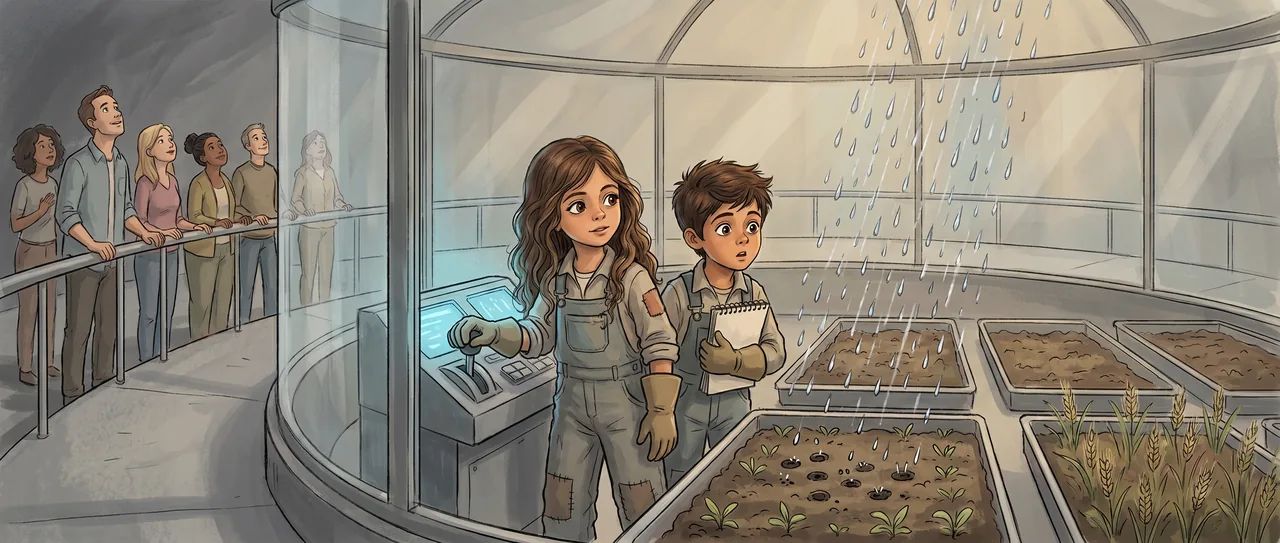
The rain room was a glass cylinder sunk under the gray skin of the Moon. Above it, the ceiling curved with pipes and mist nozzles. Below it, rows of barley stood in trays of made soil, washed moon dust mixed with compost, minerals, water, and a million invisible workers too small to see.
Soren stood beside a silver scent machine with his paper notebook tucked under one arm. The machine had a label that said PETRICHOR ASSIST.
Maya leaned close to its nozzle and pulled back fast.
“No,” she said.
Dr. Kato was on a ladder, tightening a rain pipe with one hand and answering messages on her sleeve screen with the other. Her hair floated around her head in the low Moon gravity like a black dandelion.
“No what?” she asked.
“That is not rain,” Maya said.
“It is the approved rain smell,” Dr. Kato said. “One harmless pulse when the water starts. Visitors expect it.”
Soren sniffed the nozzle more carefully. “It smells like a clean spoon pretending to be dirt.”
Dr. Kato climbed down two rungs. “It smells like geosmin. That is the molecule people smell after rain. We do not have time for poetry.”
Maya was already walking away.
“Maya,” Dr. Kato said.
“She found something,” Soren said, and followed.
Maya stopped beside tray twelve.
Tray twelve did not look special. It had barley no taller than Maya’s thumb. Its soil was dark in some places and pale in others. A little maintenance robot crouched beside it, asleep on its charging pad.
Maya pointed at the corner nearest the glass wall. “Here.”
Soren bent down. He smelled plastic, wet leaves, metal, and under all of it, something that made the back of his mouth remember sidewalks in July, even though he had not stood on an Earth sidewalk for three years.
“Rain,” he said.
“It has not rained,” Dr. Kato said from behind them.
“That is the interesting part,” Maya said.
Dr. Kato checked her sleeve. “Tray twelve was watered by root wick at oh six hundred. No overhead droplets. The air sniffers show no geosmin.”
Soren looked up at the nearest sensor, a white puck in the ceiling. “What do they count down to?”
Dr. Kato blinked. “For general organics? One part per billion. Sometimes lower, if I ask them nicely and recalibrate.”
Soren opened his notebook, then shut it again without writing. “People can smell geosmin at five parts per trillion.”
Dr. Kato’s mouth opened, then closed.
Maya smiled at Soren. “That is smaller.”
“A lot smaller,” Soren said.
Dr. Kato looked toward the glass wall, where guests would soon gather in clean white socks to watch the first scheduled rain fall on crops grown in Moon-made soil. “I know the number. I also know ceremony schedules. The soil system is young. It may not release enough smell for a room full of people. The assist makes sure the moment works.”
“It makes sure the wrong moment works,” Maya said.
The doctor sighed. She was not angry. She was worse than angry. She was busy. “You have twenty minutes. If you can make real petrichor reach the nose rail before countdown, I will turn off the assist. If not, I am using the machine.”
“Done,” Maya said.
Soren said, “We need cups.”
The lab wall unfolded drawers for them. Future drawers were very polite. They offered sterile cups, droppers, sample spoons, seal lids, gloves, and labels.
Maya grabbed three cups.
Soren grabbed four. “One blank.”
They moved to the side bench. Maya scooped a pinch from tray twelve. Soren took a pinch from a tray of plain washed moon dust. Maya took one from the compost mix waiting for the next planting. Soren took one from beneath the thickest barley roots, where the soil clung together in soft crumbs.
Dr. Kato pretended not to watch while watching completely.
Soren lined the cups up. “Dry smell first.”
Plain moon dust smelled like a cold stone in a sealed bag.
Compost smelled green and sour.
Root soil smelled alive, but not like rain.
Tray twelve smelled like almost-rain, the way a song sounds when someone is about to open a door.
Maya tapped the cup. “It is waiting.”
“For drops,” Soren said.
He put one drop of water into each cup and snapped on the lids. Maya shook them once, then stopped him from shaking harder.
“Rain does not stir,” she said. “Rain hits.”
Soren thought about that, then held the tray twelve cup under the bench light and tapped its bottom with one finger. Tiny beads jumped inside. A few droplets struck the soil, bounced, and left specks on the clear lid.
Maya lifted the lid a crack.
The smell came out so suddenly that Soren stepped back.
It was not the scent machine. It was not a clean spoon. It was dark and round and old. It was the smell of Earth hiding in a teaspoon of Moon dirt.
Maya did not move. The room around her seemed to grow crowded, though no one had entered. The cup held dust, water, roots, and bacteria with thread-thin bodies. The bacteria had made a molecule too small to see. A falling drop had thrown it into the air. Her nose had caught it at five parts per trillion.
Soren was staring into the cup as if the bottom had fallen out of it.
“Streptomyces,” he said.
Dr. Kato came down from the ladder the rest of the way. “Possibly.”
“Not possibly,” Maya said. “Look.”
She slid a smear from tray twelve under the small bench microscope. The screen bloomed with pale branching threads, tangled around grains of mineral and crumbs of compost. They looked like frost, or roots, or a city drawn by someone who never used straight lines.
Soren put the root-soil sample beside it. More threads. Fewer, but there.
Dr. Kato leaned close. Her sleeve chimed three times. She ignored it.
“The inoculation took,” she said softly.
Maya had already moved to the rain controls.
“Not all trays,” Soren said. “Twelve and the root tray are strongest. If the first drops hit there, the air moves to the nose rail.”
He pointed through the glass. The ventilation stream showed as faint blue lines on the control panel, sliding low across the barley and rising where visitors would stand.
Dr. Kato frowned. “The ceremony pattern begins at the center.”
“Change the pattern,” Maya said.
“It will make the rain uneven.”
“For six seconds,” Soren said. “Then switch to center.”
Maya touched the screen and waited. She did not press the button. Dr. Kato looked at the scent machine. She looked at the barley. She looked at the two children, both wearing gloves too large at the fingers, both watching her hand instead of her face.
Dr. Kato unplugged PETRICHOR ASSIST.
At fourteen hundred hours, the guests pressed their noses near the rail and whispered because people whisper in rooms where something has never happened before.
Maya stood at the manual control with Soren beside her. Through the glass, tray twelve waited under its little patch of ceiling.
Dr. Kato nodded once.
Maya pressed the rain key.
For six seconds, the Moon’s first rain fell crooked.
Drops struck tray twelve. Tiny dark circles opened in the soil. The barley shivered. The ventilation line on the panel bent blue across the floor and climbed the glass.
On the other side, the first guest lifted her head.
Then another.
Then all along the rail, people breathed in at the same time.
Soren laughed once, by accident.
Maya switched the rain to the center pattern. Water whispered down over every tray, bead after bead, until the barley leaves carried bright trembling dots from tip to stem.
Dr. Kato set the silent scent machine on the floor.
On the workbench beside Maya, a sealed red tray waited under a paper tag that said MARS BASALT TRIAL ONE.
Read the interactive version, listen to the narration, and earn a gold star →
A science-verified short story for curious kids · Curiosity Land