The Blue Parts
The printer refused to make the protein.
It had made hemoglobin without complaining. It had made insulin, small and neat, like a knot tied by someone with careful fingers. It had made a green fluorescent protein that looked like a tiny barrel with a secret inside.
Then Maya loaded their protein.
The model printer clicked twice, shivered, and wrote on the glass: unsupported region.
Soren leaned closer. His breath fogged the corner of the panel. “It says the shape falls apart there.”
“It does not fall apart,” Maya said. “Proteins do not just give up halfway through being proteins.”
“Some parts wiggle.”
“Not helpful.”
“It is if the wiggly part is the part the printer hates.”
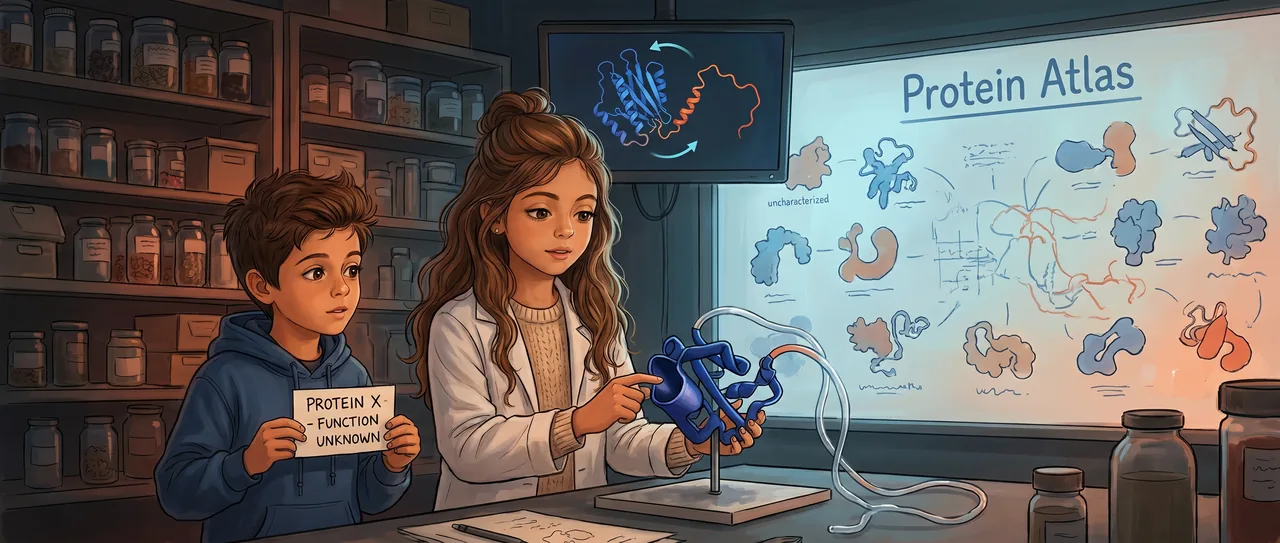
Maya put both hands flat on the lab table and stared at the floating ribbon above it. Most of the protein was blue, folded into loops and spirals like a small sleeping animal. One end trailed away in orange and red, a string with no manners.
The public lab beneath the city seed bank was supposed to open in forty minutes. Upstairs, families were already lining up to see the new Protein Atlas, a wall of touchable shapes that would be copied for the first school classroom on the Moon. The lunar greenhouse students would not have a pond, a forest, or a compost heap. They would have seedlings, recycled water, and this wall, so they could put their hands on the invisible machines that made living things work.
Dr. Ren hurried past carrying a box of labels in his teeth and another under one arm. He had silver dust on his sleeves from the model printer and the wild eyes of someone who had promised too much to too many people.
“Trouble?” he asked around the labels.
“The printer does not like our protein,” Soren said.
Dr. Ren looked at the red tail and made a face. “Choose lysozyme. Everyone likes lysozyme. Nice enzyme. Historic. Good shape.”
“Our slot says uncharacterized,” Maya said.
“That slot can say uncharacterized tomorrow.” Dr. Ren shifted the boxes. “Tonight it needs to not look like noodles.”
He rushed away before Maya could argue.
Soren tapped the sequence file. It was only letters, rows and rows of them, A, L, G, K, V, letters that did not look like they should become anything.
The protein came from a bacterium found in the seed bank’s oldest soil sample, tucked in a drawer before either of them had been born. Nobody in the lab had grown the bacterium. Nobody had coaxed this protein into crystals. Nobody had frozen it for cryo-electron microscopy. There was no photograph from an experiment, no famous paper, no tidy museum story.
But it had a sequence.
Maya had picked it because the name beside it was not a name at all. It was a code, then the words hypothetical protein.
“That is a terrible label,” she had said.
Soren had said, “It is honest.”
Now the honest protein was refusing to become touchable.
On the wall screen, the AlphaFold model slowly turned. The lab software colored confidence like weather. Deep blue meant the prediction was strong. Pale blue meant probably. Yellow meant careful. Orange and red meant the computer was not pretending.
Maya stepped around the table, following the model with her whole body. “The blue part is a thing.”
Soren pinched the air to zoom. “The red part is attached to the thing.”
“Attached does not mean folded.”
He looked at her. She grinned.
“That was your sentence,” she said.
He tried not to smile and failed.
Soren opened the old view, the one Dr. Ren said nobody used because it was ugly. It showed numbers for every piece of the protein, confidence scores running under the letters like a second alphabet. He copied the sequence into strips, blue region first, red tail after.
Maya watched the ribbon turn. “If we print only the blue part, we are lying.”
“If we print the red part stiff, we are lying more.”
The lab hummed around them. Refrigerators clicked. The model printer warmed its bed with a soft electric purr. Upstairs, someone tested the welcome music, stopped it, then tested it again at twice the volume.
Maya picked up a length of clear flexible filament from the scrap tray. She bent it around her finger. It sprang loose.
“Blue plastic for the part AlphaFold is sure about,” she said. “Clear cord for the part it will not pin down.”
Soren checked the model again. “We need the cut point.”
Maya pointed before he finished speaking. “There. The blue stops all at once.”
“That is not a reason.”
“It is where the pattern changes.”
He counted residues, checked the confidence plot, then checked the predicted aligned error view because the name sounded boring but the picture did not. Blocks of trust sat along the folded region. The tail floated apart from it, uncertain from every angle.
He set the cut.
The printer accepted the file.
Maya whispered, “Ha.”
The first blue loop rose from the print bed. Then a coil. Then a sheet folded against another sheet. It did not look like a machine built by people. It looked like a machine that had become itself by obeying rules too small to see.
Soren threaded the clear cord through the last printed ring and let it hang loose.
When Dr. Ren came back, the model was sitting on the table beside its label. He stopped so fast one label slid off his box.
“That is not lysozyme,” he said.
“No,” Maya said.
“It has a tail.”
“Yes.”
“A floppy tail.”
“Yes.”
Soren held up the label. He had changed it from hypothetical protein to predicted folded domain with uncertain flexible region. Under that, in smaller print, he had added: sequence known, structure predicted.
Dr. Ren read it twice. “That is a lot of words for a wall.”
“It is a lot of truth for one protein,” Soren said.
Dr. Ren looked at the blue fold, then the clear tail, then the opening doors upstairs. He sighed like a balloon losing an argument.
“Mount it between insulin and the moon radish enzyme,” he said. “If anyone asks, tell them quickly.”
But when the doors opened, people did not ask quickly.
They came down the ramp into the Atlas room and stopped.
The wall was not one wall anymore. It woke in sections, thousands of small lights blooming into ribbons, barrels, cages, hooks, knots, and spirals. Search windows opened over wheat, whales, molds, mosquitoes, yeast, moss, seaweed, skin bacteria, hot spring microbes, and things from deep ocean mud that had never seen the sun.
Soren had read the number before. More than two hundred million predicted structures had been placed in public databases after AlphaFold’s breakthrough. He had written it down because his head had no shelf large enough for it.
The number had been flat when it was ink.
Here, it became rooms behind rooms behind rooms.
Maya stood very still. A toddler pressed both palms to a giant protein from a potato. An old man traced a viral enzyme with one finger. A girl in a wheelchair turned a model from a heat-loving archaeon and laughed when the spiral fit exactly under her thumb.
On their small tile, the blue fold caught the light. The clear tail trembled whenever someone walked past.
A boy about their age stopped in front of it. He had been skipping the famous proteins. Hemoglobin had not slowed him. Insulin had not slowed him. He leaned toward the strange label.
“What does it do?” he asked.
“We do not know,” Soren said.
The boy looked up sharply, as if that should not have been allowed in a museum.
Maya turned the model so the folded pocket faced him. “But it has this.”
The pocket was small and deep. Not proof. Not an answer. A place where something might fit.
The boy touched the clear tail first, then the blue pocket. “It got on the wall anyway?”
“Yes,” Maya said.
Behind them, the Atlas search screen refreshed. Their protein’s fold had been compared to others, not by name, not by fame, but by shape. A column of distant cousins appeared. Soil bacteria. Leaf bacteria. A microbe from a ship’s ballast tank. One from a cave wall. One from a sealed Antarctic lake sample.
Soren read down the list. Most were also uncharacterized.
Maya said, very quietly, “There are lots of them.”
The boy’s finger stayed in the pocket of the blue model.
Upstairs, the welcome music started again, softer this time. Dr. Ren was talking too loudly near the entrance, telling someone that in twenty twenty an artificial intelligence system had done what biologists had been trying to do for fifty years, and after that the work of decades had begun arriving in months.
He made it sound like a finished thing.
Soren looked at the search results spilling down the screen. So many shapes had no job written beside them. So many folded machines were waiting with no verb attached.
Maya touched the next gray name. On the printer bed, a blue curve lifted out of the dark.
Read the interactive version, listen to the narration, and earn a gold star →
A science-verified short story for curious kids · Curiosity Land