The Bell That Moved
Soren had the wrong answer before the table even woke up.
Addiction, he thought, meant wanting one thing too much.
The glass table in the clinic lobby disagreed with him almost immediately.
His mother was under the scent projector with a screwdriver between her teeth. The projector was supposed to make the open house smell like warm bread when visitors pressed the bread tile. Instead it had been making everything smell faintly like burnt socks.
“Soren,” she said around the screwdriver, “keep the reward model running. If it freezes, tap the corner twice. If anyone asks a medical question, do not answer it. If anyone asks why the bread smells haunted, say we are improving the experience.”
Soren put his notebook on his knee, because the inside of his head already felt crowded.
The table brightened.
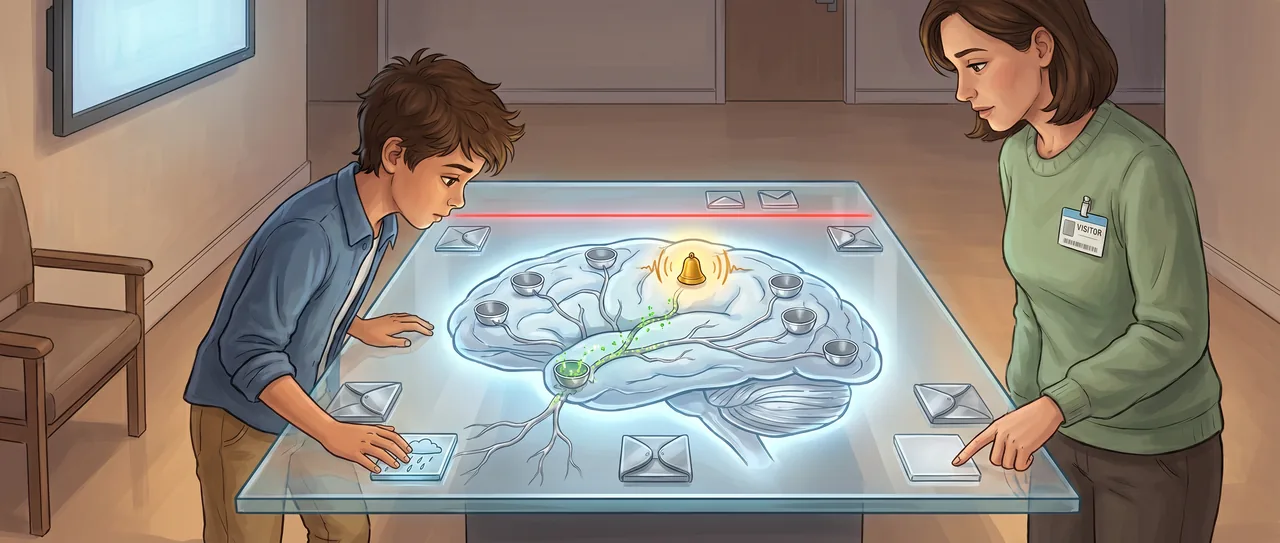
A glass brain rose inside it, not a real brain, a map made of light. Silver paths ran through it like roots. At the center sat a small golden bell. Around the edge of the table were tiles with pictures on them: bread, rain, a dog’s nose, music, sunlight, a hand squeezing another hand. One tile was plain blue and labeled substance.
Soren frowned at that one.
A clinic worker hurried past carrying a crate of clean cups. “Public version,” she said. “No drug names for open house. It is about the circuit, not the label.”
Then she was gone.
Soren pressed bread.
The scent projector coughed. A warm, yeasty smell drifted up, only a little haunted. On the glass brain, tiny green sparks moved along the silver roots. They reached the golden bell. It rang once, clear and small.
He pressed rain. The table made a soft pattering sound. The bell rang.
He pressed music. Three notes rose into the air. The bell rang.
He pressed the blue tile.
The whole brain flashed.
The bell did not ring. It crashed.
Gold light burst through the roots. The sound filled the lobby so loudly that Soren’s mother hit her head on the underside of the projector.
“Volume,” she said.
“I did not make it do that,” Soren said.
“Tap the corner twice.”
Soren did not tap the corner. The display had changed.
All along the silver roots, little cup-shaped dots had opened after the first few tiles. The green sparks had slipped into them on the way to the bell. Now some of the cups were folding shut. A thin red line had appeared above the bell, higher than before.
He pressed bread again.
Warm smell. Green sparks. No bell.
He pressed music.
Three notes. No bell.
He pressed sunlight. A pale square of warmth crossed his hands. The sparks climbed, touched the red line from underneath, and faded.
Soren wrote: line moved.
Then he crossed it out and wrote: bell moved.
His mother slid out from under the projector. Her hair was full of dust. “Did it break?”
“No,” Soren said.
“It is not ringing.”
“That is the break.”
She leaned over the table. “The open house starts in twenty minutes. Families are coming to feel hopeful, not to watch a depressing table refuse bread.”
Soren pressed the blue tile again.
The folded cups became fewer. The red line rose. The bell crashed so hard the glass trembled.
His mother’s face changed, not into an answer, but into a problem she did not have time for.
“The public setting must be too dramatic,” she said. “Reset it. We can keep the cheerful version.”
Soren looked at the bread tile. He looked at the bell.
“If I reset it, it lies.”
His mother closed her eyes for one second. “I am not asking you to lie. I am asking you to keep the table from frightening people while I fix the smell of socks.”
She went back under the projector.
Soren pressed bread six times.
The first time, nothing.
The second time, the sparks climbed a little less far.
The third time, the scent of bread seemed too big for the silence that followed it.
By the sixth time, Soren was not thinking about wanting too much. He was thinking about wanting and getting no answer. About knocking on a door that used to open. About everyone outside the door saying, Why do you only care about the blue tile?
A woman in a green sweater had stopped beside the table. She had a visitor badge clipped to her sleeve. She watched the bread tile as if it might do something painful.
“Is this the children’s model?” she asked.
“Yes,” Soren said. “But it is not finished.”
“It looks finished.”
“It lets the blue tile win.”
The woman smiled without showing her teeth. “That part is accurate.”
Soren kept his hand above the tiles. “I thought the problem would be the big crash. But the worse part is after. Bread still smells like bread. The table still makes music. The circuit just does not treat them like they matter enough.”
The woman looked at him then, really looked.
“My brother brought his dog to visit me,” she said. “I loved that dog. I knew I loved that dog. But when she put her head in my lap, it was like hearing someone call my name from underwater.”
Soren did not write that down.
The clinic worker came back with more cups and saw the table. “Oh, no. It is in tolerance cascade. We do not show that mode first.”
“We should,” Soren said.
The worker blinked. “People will think it means there is no way back.”
Soren pointed at the lower corner of the table, where a small menu was hiding behind the glow of the brain. “Then why does it have a months slider?”
The worker shifted the crate against her hip. “For clinicians.”
“Does it use real recovery data?”
“Anonymized averages. Messy ones.”
“Messy is better than cheerful.”
The worker opened her mouth, then looked at the woman in the green sweater, then at Soren’s mother’s shoes sticking out from under the projector.
“You have ten minutes,” she said.
Soren pulled the menu open.
The table offered choices: receptor availability, dopamine response, threshold, cue strength, time without substance. The words were too large and too small at the same time. He did not know enough to be in charge of them. He knew enough not to pretend the bell had stayed in the same place.
He set the model back to the moment after the blue tile had crashed the bell.
Then he changed the visitor path.
First, bread.
No bell.
Then music.
No bell.
Then dog’s nose.
No bell.
Only after the missing bells did the table allow the blue tile to appear again. When it did, Soren made the red line visible and the folded cups large enough for a person at the back of the lobby to see.
His mother crawled out. “Why is the dog nose enormous?”
“Because it matters when it does not work,” Soren said.
The woman in the green sweater laughed once. It sounded surprised to be there.
Soren slid the months control forward.
One week. The red line stayed high.
Two weeks. A few cups flickered and vanished.
Four weeks. Bread sent sparks almost halfway.
Eight weeks. Music touched the line and failed.
The worker set down the crate. His mother stayed still, dust on her cheek, screwdriver in her hand.
Twelve weeks.
One small cup opened on a silver root.
Soren pressed rain.
The table made a soft pattering sound. Green sparks moved through the glass brain. They climbed slowly, not like fireworks, not like rescue, not like a lesson with a clean ending.
The golden bell rang once.
No one spoke for a moment.
The woman in the green sweater reached into the tray of unused visitor tiles. She picked up a blank one, the kind families could program with their own ordinary thing, and placed it beside bread, rain, music, sunlight, dog’s nose, and hand.
“What does that one do?” Soren asked.
She put her fingertip on the blank tile.
On the glass brain, one tiny receiver opened, and the next square stayed dark.
Read the interactive version, listen to the narration, and earn a gold star →
A science-verified short story for curious kids · Curiosity Land