No Line
The machine was supposed to make three things happen before lunch.
It was supposed to pull caffeine out of green coffee beans for the sleep cafe downstairs. It was supposed to lift an oil stain from a silver jacket without soap or water. It was supposed to collect a medicine scent from crushed leaves in a little steel basket, so the pharmacy students could test it later.
Instead, at ten seventeen, the machine made one damp jacket, one batch of extremely awake coffee, and one tiny tube with nothing in it.
Maya liked failures that arrived all at once. They saved time.
Soren stood with his nose almost touching the safety rail, reading the numbers on the glowing panel. He had already written down the first set. He wrote down the second set too, because the first set had been rude.
Dr. Ren clapped twice, too brightly.
"A dramatic pause," he said to the visitors behind them. "Science enjoys those. Please try the carbonated pears while we reset. They are very crisp. Not explosive. I have been asked to say that."
The visitors drifted toward the snack table.
Maya did not move.
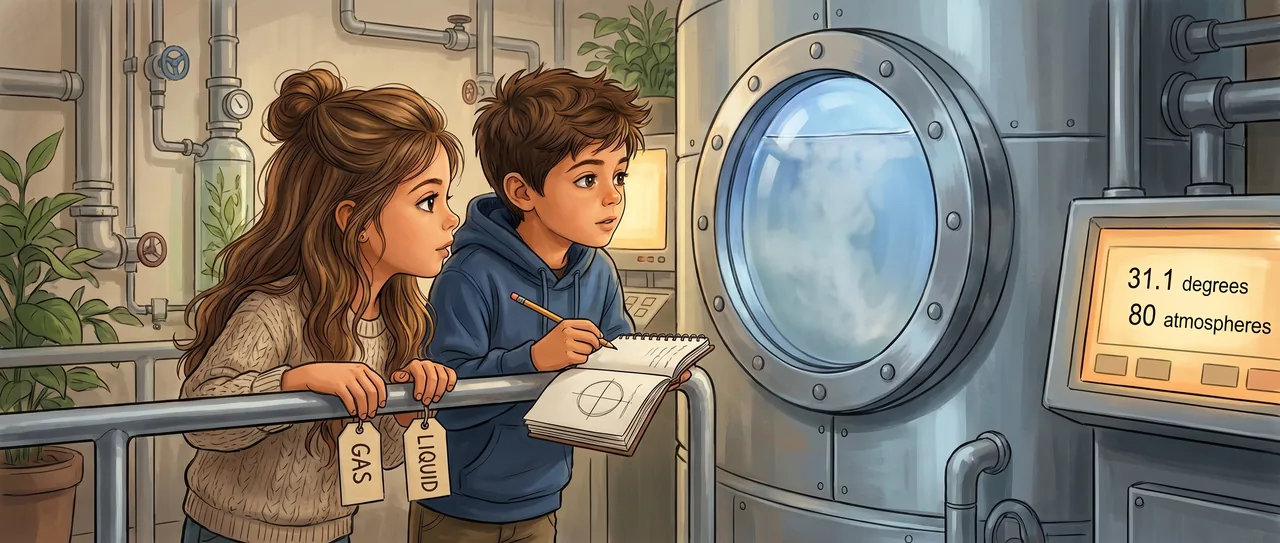
The machine took up half the room. It was all polished steel loops and bolted doors and thick pipes, with a small round window made of sapphire near the middle. A sign above it said LOOPLAB COMMUNITY EXTRACTOR. Under that, in smaller letters, it said CO2 IN, CO2 OUT, ALMOST NOTHING WASTED.
On the wall, three empty hooks waited for exhibit tags.
GAS.
LIQUID.
SOLID.
Dr. Ren had given Maya and Soren the tags when they arrived.
"You two are our deciding committee," he had said. "When the demonstration is done, you tell me where carbon dioxide belongs. Simple. Very simple. Good for investors."
It had not been simple for nine minutes.
At the beginning, white carbon dioxide had rushed cold through a clear tube and vanished into the steel body. Maya had picked up GAS. Soren had picked up LIQUID. They had looked at each other and not apologized.
"It fills the whole space," Maya had said.
"It carries things away," Soren had said.
"Smoke fills space."
"Water carries things."
"Smoke can smell like things."
"Water can get through cloth."
Dr. Ren had laughed then. Now he was not laughing. He was talking to a woman with orange glasses who kept checking the time.
"It worked yesterday," Dr. Ren said. "Very clean extraction. Beautiful separation. The pump is behaving. Pressure is fine. Flow is fine. We are merely experiencing personality."
"Machines do not have personality," Soren said quietly.
"They have habits," Maya said.
She went closer to the rail. The sapphire window showed a small chamber inside the machine. In it, there was a curved shiny line. Above the line, a clear space. Below the line, a heavier clear space. The line trembled whenever the pump hummed.
"That line," Maya said.
Soren looked up from the numbers. "Meniscus. Maybe. Boundary."
"It was there the whole time."
"I drew it," Soren said.
He turned his notebook so she could see. The little circle he had sketched had a line across it, like a tiny horizon trapped in a porthole.
Maya tapped the safety rail once. "Should it be there?"
Soren looked at the panel again.
Pressure, eighty atmospheres.
Temperature, twenty-nine degrees Celsius.
On the side of the machine, under a sticker shaped like a coffee bean, someone had printed: ABOVE THIRTY-ONE DEGREES C AND ABOUT SEVENTY-FOUR ATMOSPHERES, CO2 STOPS CHOOSING.
Soren read it twice.
"Pressure is above," he said.
"Temperature is below," Maya said.
The two statements stood there, touching nothing.
Dr. Ren came over with the orange-glasses woman.
"Good news," he said. "We have narrowed the problem to today."
"It is not over thirty-one," Soren said.
Dr. Ren blinked. "What is not?"
Maya pointed at the display.
Dr. Ren looked at it, then at the sticker, then at the sapphire window.
"The heater jacket is set to demo-safe," he said. "Twenty-nine degrees keeps the outside pleasant to touch. The pressure should still be enough for a basic run."
"But it did not run," Maya said.
The woman with orange glasses leaned toward the window. "I thought carbon dioxide was a gas."
"Usually," Dr. Ren said.
"Or liquid in tanks," Soren said.
"Sometimes," Dr. Ren said.
Maya held up both tags. GAS in one hand, LIQUID in the other. "It is doing both badly."
Dr. Ren opened his mouth, then closed it. That made Maya trust him more.
Soren flipped to a clean bit of page. "If it has a line, part is liquid and part is gas. If it is supposed to wash like a liquid and spread like a gas at the same time, maybe the line is the problem."
Maya said, "Make it stop choosing."
The orange-glasses woman checked her time again. "Can children make suggestions to pressure equipment?"
"Children may suggest," Dr. Ren said. "Only adults may touch valves. That is how civilization continues."
He crouched by the console and changed one setting. The number beside temperature began to climb.
Twenty-nine point two.
Twenty-nine point eight.
Thirty point four.
The pump kept its deep, patient hum.
Maya watched the line in the window. It shivered harder. The clear top and the clear bottom began to blur into each other, not mixing like cream in tea, not bubbling, not boiling, just losing the argument about where one ended.
Thirty-one point one.
For half a breath, the little chamber turned cloudy, as if a ghost had breathed on the sapphire from the inside.
Then the cloud thinned.
The line was gone.
No top. No bottom.
The same clear nothing filled the whole round window.
Soren did not write. His pencil stayed above the page.
Maya had seen empty space before. This was not empty the same way. Behind that glass, carbon dioxide was packed close enough to pull at molecules, loose enough to slide through tiny places, neither smoke nor water and not waiting for permission from either word.
The machine changed sound. Not louder. Smoother.
Dr. Ren loaded the jacket square first, behind its round door. The visitors came back from the pears, chewing quietly. On the screen, green lights moved along a diagram. Carbon dioxide flowed through the cloth. In a second chamber, the pressure dropped. A bead of pale oil appeared at the bottom of a glass collector.
Dr. Ren opened the cleaning basket when the panel chimed. The silver jacket square came out dry. The dark smear was gone.
The orange-glasses woman stopped checking the time.
Next came the coffee. The beans had gone into the extractor green and hard. The machine hummed, crossed its invisible country, and returned them looking almost the same. A sensor strip from the sleep cafe turned pale blue instead of purple.
"Low caffeine," said the cafe robot from the doorway. "Acceptable for bedtime humans."
"Thank you, Kettle," Dr. Ren said.
Kettle rolled away, satisfied with bedtime as a category.
Last came the crushed leaves. Their basket was no bigger than Soren's fist. The collector tube waited below the separator, clean and blank.
Maya pressed her fingers into her palms. She did not know why this one mattered more. Maybe because the leaves looked like yard waste, and the machine was treating them like they might be hiding something exact.
The tube stayed empty.
Then one clear drop appeared.
Then another.
The room filled with a sharp green smell, rain on stems, pepper, something almost like oranges but not oranges.
Dr. Ren whispered, "There you are."
Soren finally wrote down one line, but he did it without looking at the page.
The woman with orange glasses walked to the wall and studied the three hooks.
"So where does the tag go?" she asked.
Dr. Ren looked at Maya. Maya looked at Soren.
Soren tore a blank rectangle from the edge of a handout. He did not use his notebook. Maya took the thick exhibit marker from Dr. Ren's pocket before he could offer it.
On the rectangle, she wrote OTHER.
Soren added, in smaller letters underneath, USEFUL HERE.
Dr. Ren slid a fourth hook from a drawer, but Maya shook her head.
"No," she said. "Between."
Together, they set the third tag on the rail between GAS and LIQUID, directly under the window where the line had disappeared.
Read the interactive version, listen to the narration, and earn a gold star →
A science-verified short story for curious kids · Curiosity Land