Eighteen Percent Sideways
Everyone in the materials lab knew what the final table should say.
DIAMOND WINS.
The sign was already printed in glossy black letters. A real diamond chip sat under a glass dome beside it, no bigger than a grain of salt and somehow more important than a crown. Visitors would press a handle, watch a screen show atoms squeezing together, and then the sign would light up.
DIAMOND WINS.
Soren stood in front of it with his paper notebook tucked under one arm. He had written diamond at the top of a page and underlined it twice, because sometimes the obvious answer deserved a fair trial too.
Maya did not look at the diamond first. She looked at the tray of rejected sample cards.
There were cards for steel, quartz, tungsten carbide, cubic boron nitride, and one card turned facedown as if it had been bad at something.
Maya flipped it over.
WURTZITE BORON NITRIDE, it said. SYNTHETIC. CALCULATED HARDNESS UNDER COMPRESSION, ABOUT EIGHTEEN PERCENT ABOVE DIAMOND.
Maya held it up.
“That is not allowed,” Soren said.
“It’s on the card.”
“Diamond is the hardest natural material.”
“This one says synthetic.”
“That feels like cheating.”
Maya smiled at the card. “Good.”
The lab tech came past carrying a coil of fiber cable over one shoulder and three rolls of tape on his wrist.
“Please tell me the children are not reorganizing the hardness exhibit,” he said.
“We are reorganizing the hardness exhibit,” Maya said.
The lab tech looked at the card in her hand and winced.
“Not that one. The public likes diamond. Diamond is clean. Diamond is famous. Wurtzite boron nitride needs three sentences before breakfast.”
Soren turned the card toward him. “Is the eighteen percent true?”
“Calculated,” the lab tech said. “Under compression. In that crystal form. Tiny synthetic samples, not a jewelry-counter rock. The simulations suggest the bonds rotate instead of snapping the way diamond’s network can under certain stresses. Wonderful material. Terrible sign.”
Maya tapped the printed words DIAMOND WINS.
“This sign is wrong.”
“This sign is simple,” the lab tech said. “Simple keeps people moving. I have seven minutes to make the levitating droplet fountain stop spitting on the dean, so please do not break my crowd flow.”
He hurried away, trailing cable.
Soren watched him vanish behind a stack of vacuum pumps.
“Crowd flow,” he said.
Maya had already picked up the control tablet for the atom sandbox.
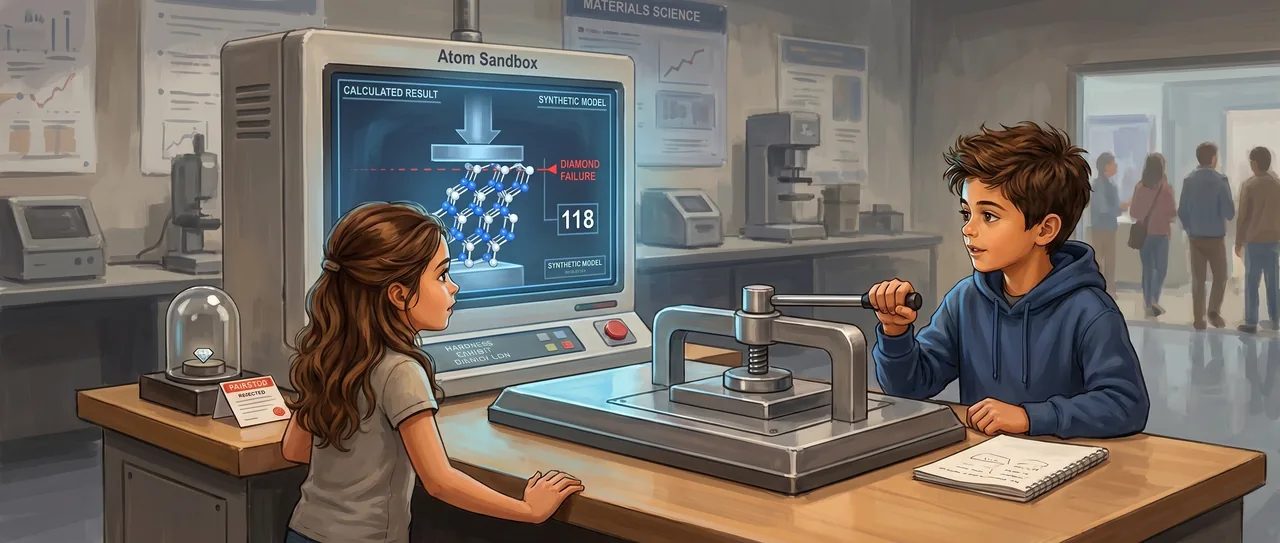
The sandbox was not sand. It was a clear box with a metal handle, a flat press inside, and a screen behind it. When someone chose a material, the screen filled with atoms joined by glowing bonds. The handle squeezed the model. The program translated the motion into force, strain, stress, and colors that made sense even before the numbers did.
Soren liked it immediately because it did not pretend squeezing was simple.
Maya chose diamond.
Carbon atoms appeared on the screen in a neat, repeating cage. The pattern looked calm, almost smug.
“Test one,” Soren said.
Maya pulled the handle down.
The top plate descended. On the screen, the diamond lattice pressed flatter. The bonds glowed pale yellow, then orange. The counter climbed.
Fifty.
Seventy.
Ninety.
At one hundred, a bond flashed red. A tiny line vanished. Then three more vanished beside it, quick as popping threads.
The screen chimed politely.
DIAMOND, FAILURE THRESHOLD REACHED.
Soren wrote one hundred in his notebook. “Again.”
Maya let the handle rise. The lattice reset.
They did it six times.
The breaking did not happen in exactly the same little place every time, but the moment always looked sharp. The diamond bonds held and held and held, and then they did not.
Soren drew a square around the numbers.
“Diamond is still extremely diamond,” he said.
Maya had already selected wurtzite boron nitride.
The screen changed.
The new lattice was blue and white, boron and nitrogen alternating in a pattern similar enough to diamond to make Soren lean closer, but not the same. It had a slant to it. A direction. The atoms stacked in a wurtzite arrangement, like a tiny crystal roof repeated forever.
“It looks like it’s already leaning,” Maya said.
Soren put his pencil down. “Careful. Looking like something is how mistakes get in.”
“So run it.”
He took the handle this time.
The press came down.
At first the wurtzite boron nitride lattice glowed yellow just like diamond. Then something strange happened.
The bonds did not simply shorten. They tilted.
Not a lot. Not like a door swinging wide. More like a shoulder turning in a crowded hallway. The blue and white atoms kept their neighbors, but the angles shifted. The whole pattern took the squeeze and passed part of it sideways.
Soren stopped pulling.
On the screen, the lattice held its new shape.
Maya whispered, “It moved.”
Soren did not answer. He raised the handle and lowered it again, slower.
The bonds tilted again.
He tried a third time, then a fourth, watching the same tiny turn happen under the descending plate.
The counter climbed past diamond’s red mark.
One hundred five.
One hundred twelve.
One hundred eighteen.
The screen did not chime.
The world got bigger inside the clear box. Hardness had been a word like a locked door. Now it had hinges. The strongest thing in the room was not the thing that refused to change at all. It was the thing whose smallest parts knew how to turn without letting go.
Maya’s fingers were tight on the edge of the table.
“Again,” she said.
Soren ran it again.
The same turn. The same holding.
He looked at the rejected card, then at the sign.
“The sign is answering the wrong question,” he said.
Maya grabbed the tablet. “So we change the question.”
They did not erase diamond. Soren would not allow it, and Maya did not want to. Diamond was still the hardest natural material, still astonishing, still the reason the whole room had gathered around a grain under glass.
They changed the title instead.
NOT WHAT IS HARDEST FOREVER.
WHAT HAPPENS WHEN ATOMS ARE SQUEEZED?
Soren added NATURAL beside diamond and SYNTHETIC beside wurtzite boron nitride. Maya added CALCULATED RESULT in letters large enough that nobody could miss them. Under the handle she made two buttons.
HOLD STILL.
TURN AND HOLD.
Soren frowned at the second one.
“Too dramatic?” Maya asked.
“It is not wrong,” he said.
From the other side of the lab came a splash, a buzz, and the lab tech shouting, “That was much better than last time.”
Visitors were beginning to gather at the entrance. Their shoes squeaked on the polished floor. Someone laughed near the robot arm. Someone else said, “Where’s the diamond?”
The lab tech hurried back, damp on one sleeve, and stopped in front of the exhibit.
His eyes moved from the old sign on the floor to the new title on the screen.
“Oh no,” he said softly. Then he read the buttons.
Maya held out the wurtzite boron nitride card.
“It needs three sentences,” she said. “We gave it a handle.”
The lab tech looked as if he wanted to argue with time itself. Then he looked through the glass at the press, at the diamond chip under its dome, at the blue-and-white lattice waiting on the screen.
“Calculated,” he said.
“In big letters,” Soren said.
“Not natural.”
“Also in big letters.”
“Under compression, not every possible kind of hardness.”
Maya pointed to the title.
The lab tech let out a breath that was almost a laugh.
“The public is going to ask questions.”
Soren picked up the handle. “Good.”
The first group reached the table. Maya touched the button for diamond, and the carbon lattice appeared, bright and perfect. Soren pressed until the red lines flashed and the polite chime sounded.
Then Maya touched the second button.
The rejected card lay faceup beside the glass.
“Again?” Soren asked.
Maya turned the handle one more notch. On the screen, the blue-and-white lattice bent sideways under the press and held.
Read the interactive version, listen to the narration, and earn a gold star →
A science-verified short story for curious kids · Curiosity Land