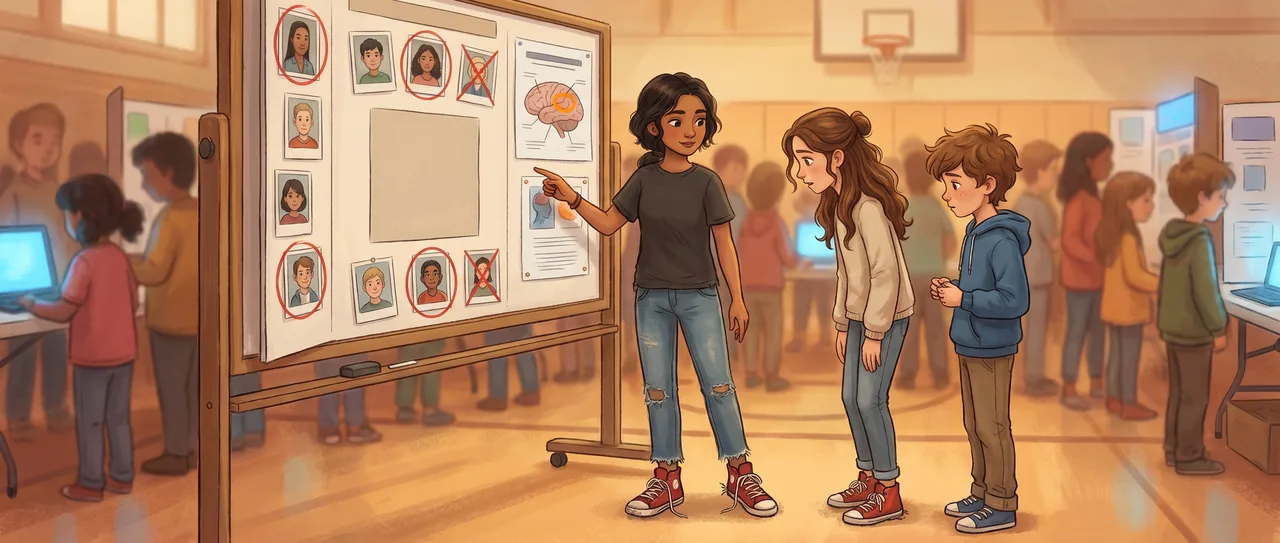
The Wrong Face
Soren had been standing near the hydrology table for four minutes before he admitted to himself that he had already walked past Maya three times without recognizing her.
He knew this because Maya found him first. She tapped his shoulder and said his name and he turned around and felt, for the fourth time that morning, a small lurch of wrongness.
He knew it was Maya. He just couldn't hold her face together.
The gymnasium was loud and bright and full of two hundred kids from twelve different schools, and every time he looked away from her and looked back, her face seemed to rearrange itself into something unfamiliar. Eyes, nose, mouth. Correct. But the whole of it kept failing to add up.
"You walked past me twice," Maya said. She was not offended. She was already tilting her head.
"I know," Soren said. "Something's wrong with me today."
"What kind of wrong?"
"I can see your face. I just can't." He stopped. He didn't have the word for it. "I can't hold it."
Maya looked at him for a long moment. Then she looked out at the gymnasium, at the rows of display boards and the crowd moving between them. "You know," she said, "I noticed something earlier. There's a girl two tables down who called someone the wrong name. Someone she clearly knew. And the person she called it to wasn't even upset. Like it happens all the time."
Soren knew better than to ask how that was connected. He just followed her.
The girl's name was Priya. Her project board was covered in photographs of faces, some circled in red, some crossed out, and a title that read: "What Your Brain Throws Away."
Priya was sixteen, older than both of them, one of the high school entrants. She was explaining something to a judge who looked politely confused. When the judge moved on, Maya walked straight up to her.
"Your project," Maya said. "Is it about you?"
Priya looked at Maya, then at Soren, then at Maya again. Not rudely. Carefully. "My voice or my shoes?" she asked.
"Excuse me?" Maya said.
"How did you know I was the same person you saw two tables over? My voice, or my shoes?"
Maya blinked. She actually looked down at Priya's shoes. Red canvas, very worn at the left heel. Then back up. "Shoes," she said slowly. "I didn't know I was doing that."
Priya smiled. It was a smile Soren could not read, and he was beginning to understand why. "Neither do most people," she said. "Until they have to."
Her project was about prosopagnosia. Face blindness, she called it, though she said that name was slightly wrong and she used it anyway because it was the name people knew. Her brain had never learned to recognize faces as faces. Not as a disease. Not from an injury. Just, she said, the way some people are born without perfect pitch. She had normal eyes. She had normal intelligence. Faces just didn't stick.
"But you recognize people," Soren said. "You just did it to us."
"I recognized her shoes," Priya said. "I recognized your voice from when you said something's wrong with me today near the hydrology table. I was one table over."
Soren felt something shift in the back of his head. He had a word for it: calibration. The feeling of a measurement being adjusted.
"So everyone's brain is doing face recognition," he said, slowly, "as a separate thing. Not just part of seeing."
"Yes," Priya said. She pointed to her board. There was a diagram of the brain, a region highlighted in orange near the back and bottom. "There's a piece of your brain that does almost nothing else. It's why you can tell two sheep apart from a photograph if you train it. It runs faces through that specific part. Specialized hardware, basically."
"And yours just doesn't run," Maya said.
"Mine runs," Priya said. "It just doesn't produce output. Or doesn't produce the right output. Nobody actually knows which."
Soren said, "Nobody knows?"
"It's a very active question," Priya said, in a tone that suggested she had read every paper written on it and found most of them inadequate.
Maya was very quiet. Soren recognized this. It meant she was running hard in some direction he couldn't yet see.
"If it's separate," Maya said finally, "then there could be other separates."
Priya looked at her with something new in her expression. "What do you mean?"
"Other things everyone thinks are just seeing or just hearing or just knowing. But they're actually their own little machines inside your head. And some people have them and some people don't. And the people who don't have them work it out some other way and everyone else doesn't even notice there was a different way to do it because they never had to find one."
Soren thought about the four times he had walked past Maya and not known her. He thought about how he had known her the moment she said his name.
Priya was still looking at Maya. "That is exactly the question," she said. "Researchers think face recognition might just be the easiest one to find because faces are so important. But there could be dozens of these. Little dedicated modules. And we might be walking around assuming everyone's brain works the same way because nobody had a reason to look until someone's module went quiet."
"And when it goes quiet," Soren said, "they have to solve the problem a completely different way."
"And they get very good at it," Priya said. She said it without any particular emphasis, but the sentence landed anyway.
Soren looked at his own hands for a moment, which he always did when he needed to make sure he was still where he was. He thought about the sixteen years Priya had spent learning to read a world that kept rearranging its face at her, learning to hear what shoes sounded like on different floors, learning that voices have signatures the way fingerprints do. He thought about the researchers who found her module and went quiet, and had not yet found the others.
The gymnasium was the same gymnasium it had been ten minutes ago.
He looked back up at Priya's board, at the orange region, at the photographs with their red circles, and then at the long blank space on the board where more photographs should have been but weren't.
Read the interactive version, listen to the narration, and earn a gold star →
A science-verified short story for curious kids · Curiosity Land