The Thread That Wouldn't Tear
The door said AUTHORIZED PERSONNEL but it was open, so Maya walked in.
Soren followed her, which he always did, while also writing down the number stenciled above the door in case they needed to find their way back.
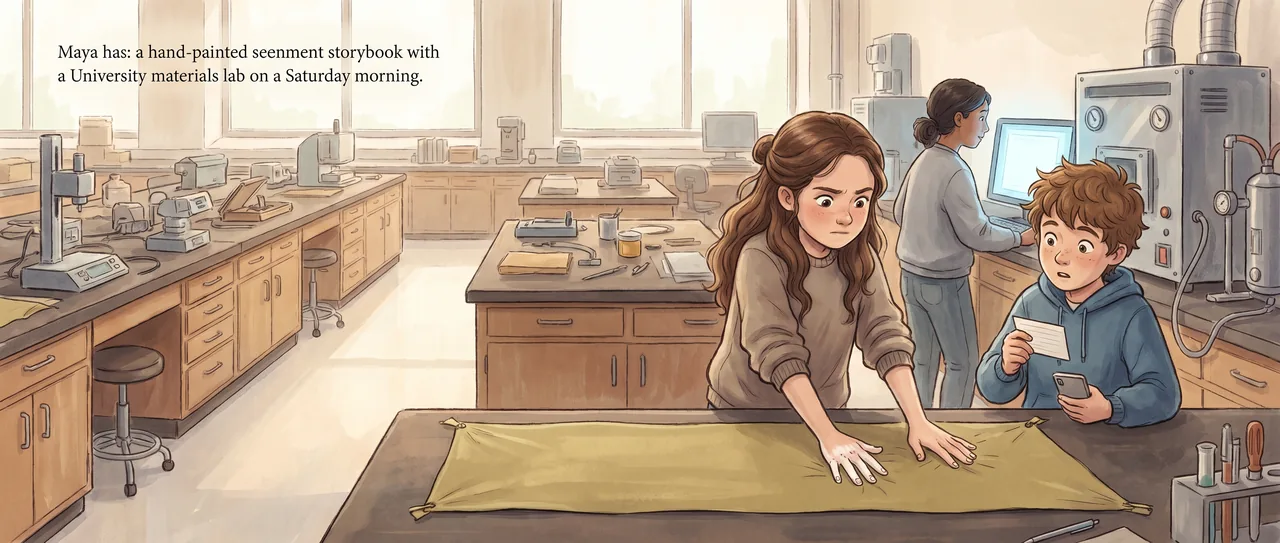
The lab smelled like something between a swimming pool and a hardware store. Long benches ran the length of the room, covered in equipment Maya had no names for. At the far end, a graduate student in a gray sweatshirt sat hunched over a machine the size of a dishwasher, pressing the same button repeatedly with the focus of someone who hated that button.
"Excuse me," Soren said.
The student didn't look up. "If you're here about the broken centrifuge, I already filed the report."
"We're not," Maya said. "We're looking for the demonstration. The strong-fiber thing. Our school group was supposed to see it."
Now the student looked up.
Maya looked at Soren. Soren looked at his phone. He confirmed, with his expression, that Maya had read the date wrong and that he was not going to say so out loud.
"Can we see anyway?" Maya asked.
The student stared at them for three full seconds, then pointed at a cabinet. "Samples are in there. Don't touch the tensile tester. Don't touch anything that's plugged in. I have to figure out why my polymer solution keeps crystallizing wrong and I cannot also manage two children."
She turned back to her machine.
The cabinet held clear plastic bags, each with a label. Maya found the one marked DEMONSTRATION and opened it on the bench. Inside were four samples: a piece of steel mesh, a scrap of denim, a ceramic tile with a crack across one corner, and something that looked like fabric but the wrong color, a muted gold, stiff in a particular way that was hard to describe. Stiff but not rigid. It didn't crinkle. It resisted.
Soren picked it up. He folded it once. The fold pushed back.
"That's lighter than it should be," he said.
Maya took it and tried to pull it apart at the fold. Her hands went white. The fabric didn't move.
She looked at the label. It said KEVLAR WEAVE and below that a number she didn't understand.
"How," she said. Not a question, exactly. More like a placeholder.
Soren read the small card that had been in the bag with the samples. He read it twice, which meant he was deciding how much of it he believed.
"It's the chains," he said. "The molecules. They line up when they make it. They spin the liquid and the chains go parallel, and then they bond to each other sideways at the same time. So when you pull on it, you're not just pulling one chain. You're pulling all of them, all at once, and they're all holding onto their neighbors."
Maya held the fabric flat and tried to imagine that. Chains too small to see, running parallel like lanes on a highway, and across every lane, at every point, tiny handholds.
"How many?" she asked.
"It doesn't say."
She pressed her thumbnail into the weave as hard as she could. The weave didn't indent.
From down the bench, without looking up, the graduate student said: "Billions. Per square centimeter, roughly."
Maya looked up. "And spinning does that? Just spinning the liquid?"
"The chains want to align. They're shaped like rods, not coils. Spinning gives them room to find each other. Then the hydrogen bonds lock them in place when it solidifies." The student hit her button again. "The hard part isn't making one layer of that. It's making it consistent. Same alignment. Same bond density. Every time. My solution keeps crystallizing in patches and I can't figure out why the temperature distribution is uneven in this particular vessel and honestly if you have ideas I'm listening."
She said the last part as a joke. Her eyes were already back on the machine.
But Soren had gone still, which was a thing he did when he was about to ask the question that mattered.
"Your vessel," he said. "Is it the same shape as the one you usually use?"
The student turned around completely. "We had to switch to a narrower vessel because the other one's in for maintenance. Why."
"The spinning," Soren said. He wasn't certain yet. Maya could tell because his voice was half a step quieter. "If the vessel is narrower, the solution near the wall is moving faster than the solution in the center. Different speeds. The chains near the wall might be aligning at a different rate than the ones in the middle."
The student didn't say anything for a moment.
"That's," she started. She stopped. She looked at the machine. "That would show up as patches. Inconsistent crystallization at the boundary layer versus the bulk."
"I don't know if that's right," Soren said. "That's just what it made me think of."
"No, that's." The student was already pulling up something on her screen. "The boundary layer. I didn't check whether my rotation model accounted for the new radius. I've been checking temperature for two days."
Maya was still holding the Kevlar.
She held it flat between her palms. She pressed in from both sides and felt nothing give, nothing compress, nothing yield. Something in there was pushing back at her from every direction at once, billions of invisible handholds all saying no, all saying not here, all saying we have each other.
She thought about the way it worked. How the strength wasn't one big thing. It was billions of small things agreeing.
Across the lab, the graduate student was nodding, and typing quickly, and had entirely forgotten they existed.
Maya turned the fabric over in her hands. She found the edge where it had been cut, where the chains were interrupted, where it was almost possible to pick apart a single thread.
Almost.
Read the interactive version, listen to the narration, and earn a gold star →
A science-verified short story for curious kids · Curiosity Land