The Thing That Is Mostly Nothing
The graduate student's name was Priya, and she had made one rule: don't touch the blue cabinet.
She had said this while already walking toward the hallway, phone pressed to her ear, so neither Maya nor Soren was entirely sure the rule counted.
Soren looked at the blue cabinet. Maya was already opening it.
"She said," Soren started.
"She said don't touch it," Maya agreed. "I'm just looking."
The cabinet held rows of small labeled trays. Most contained things that looked like things: white powder, dark crystals, coiled wire. One tray held a single bluish chunk about the size of a sandwich, and the label on the tray said AEROGEL MONOLITH SAMPLE 7 and under that, in smaller letters, HANDLE WITH CARE, EXTREMELY FRAGILE.
The chunk looked like frozen smoke. It looked like someone had taught fog to hold still. It was faintly blue the way distant mountains are faintly blue, not because of any color in the thing itself but because of something happening with the light passing through it.
Maya picked it up.
She actually made a sound. A small, involuntary sound.
"What," Soren said.
She held it out. He took it. He made the same sound.
It weighed almost nothing. Less than nothing. His hand expected weight and the expectation was so thoroughly disappointed that his brain briefly flagged it as a mistake and asked him to try again. He bounced it gently. He turned it over. It was solid. It was absolutely, genuinely solid. He pressed his thumbnail into it and felt resistance.
"It's real," he said.
"It's real," she agreed.
He held it up toward the fluorescent light. The bluish color deepened slightly, the way the sky deepens when you look toward the edge of it rather than straight up. He brought it back down and looked at the edge of the chunk, which was slightly crumbled, as if it had been cut from something larger with a tool that was not quite careful enough.
"The label said fragile," Soren said.
"I was careful."
"You were not careful. You just picked it up."
"And it's fine."
This was true. It was fine. Soren set it on the counter and pressed two fingers down on the top surface, increasing pressure gradually, the way you test ice. It didn't flex. It pushed back.
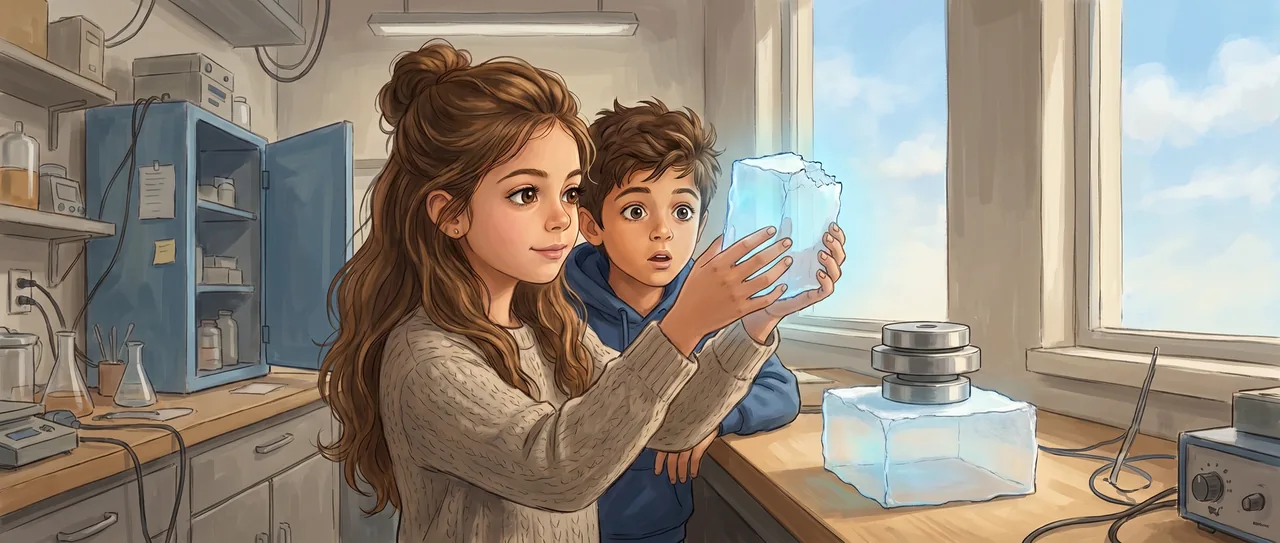
He took his fingers off. He thought for a moment. Then he went looking on Priya's workbench for something with known weight, found a stack of three metal calibration discs in a labeled case, checked the case, and read aloud: "Each disc: two hundred grams."
Maya was already nodding.
He stacked all three discs on top of the aerogel chunk. Six hundred grams. The chunk did not compress. Did not crack. Sat there holding six hundred grams of metal the way a sidewalk holds a bicycle.
"Okay," Maya said. "Okay. How."
Soren picked up the chunk again, turned it in his hands. He was looking at the broken edge. Tiny, tiny structures at the break, too small to really see, but you could tell from the texture that there was structure there, something organized, not just random solid material.
"It has to be the inside," he said. "The structure inside. It has to be built like something."
"Like what."
"Like." He stopped. "Like a building, maybe? Buildings hold weight but buildings are mostly air. Most of a building is just space."
Maya took the chunk back. She held it with both hands, tilted it toward the light again. The blue quality in it shifted. She had seen that quality before, she realized. She had seen it in the sky every day of her life and never thought about why the sky was that color, specifically that color, and not some other.
"Soren," she said. "Why is the sky blue."
He looked at her. "Scattering. Light bouncing off air molecules. Short wavelengths, blue wavelengths, they scatter more, so when you look at the sky you're seeing scattered blue light."
"This is almost entirely air," Maya said. She held the chunk up. "This is almost entirely air and it's doing the same thing."
Soren went very still.
She was right. The blueness was not a pigment. It was not a coating. It was the same effect, the same physics, happening inside a solid object, because the solid object was ninety-nine point eight percent air, structured air, air held in place by a scaffolding so thin it barely existed, and the light passing through was scattering exactly the way it scattered through the atmosphere, producing sky-blue in your hand, producing a piece of portable sky.
"Portable sky," Maya said quietly.
"You're doing the thing where you say what I'm thinking."
"You were taking too long."
He almost laughed. He took the chunk back and held it next to the fluorescent light and watched the blueness move across its surface. A solid that was almost nothing. A nothing that held weight. A chunk of material that contained, in the arrangement of its almost-invisible skeleton, the same reason the sky was blue, the same physics operating at a completely different scale, the same trick the whole atmosphere was pulling every single day, shrunk down to something you could hold in one hand.
Priya came back into the room still talking, looked at them, looked at the aerogel chunk, looked at the calibration discs still stacked on the tray, and stopped walking.
She lowered the phone.
"I said don't touch the blue cabinet."
"We know," Soren said. "We're sorry. But can we ask you something."
Priya looked at the calibration discs. She looked at the two of them. Her expression moved through irritated and arrived somewhere more complicated.
"One question," she said.
Maya held the chunk up toward the window, where actual sky was visible behind actual clouds, and the chunk caught the light and went quietly, unmistakably blue.
"How small does the structure go," Maya asked.
Read the interactive version, listen to the narration, and earn a gold star →
A science-verified short story for curious kids · Curiosity Land