The Shape of the Lock
The screen was still on.
Maya noticed it from the hallway because the colors were wrong for a screensaver. Too specific. A slow-spinning shape, blue and orange and pale yellow, like a ribbon someone had crumpled and then frozen mid-crumple.
"We're not supposed to be in here," Soren said.
"The door's open," Maya said, already inside.
The room smelled like cold air and something chemical she couldn't name. Tall shelves of equipment, most of it labeled with tape and marker. A half-eaten granola bar on the desk next to the keyboard. The researcher, whoever she was, had left in a hurry.
On the screen: the spinning shape, and under it, a name. SPIKE GLYCOPROTEIN. And a number Maya didn't understand. A confidence score, the label said. Ninety-three point four.
"What is that thing?" Soren asked. He was beside her now. He'd given up on the doorway.
"I think it's a protein," Maya said. "My mom talks about these. They're in your cells. They do things."
"That's very specific."
"I know, right?"
Soren leaned closer to the screen. He read slowly, which Maya sometimes misread as not reading. He was always reading. "It says predicted structure. Why predicted? Don't they just, I don't know. Look at it?"
Maya pulled her phone out. She had a rule about this: if something seems impossible, check whether it's actually impossible before deciding it's cool. "You can't look at a protein," she said, scrolling. "They're way too small. Like, not just too small for your eyes. Too small for most microscopes."
"So how do you know what shape it is?"
"That's exactly it," Maya said. "You can figure out which amino acids are in it from the DNA. That part's been solved for a while. But the string of amino acids folds into a shape, and the shape is the whole point, the shape is what makes it work or not work, and figuring out the shape from the string took fifty years."
She showed him her phone screen. He read it, and she watched his face do the thing it did when he hit something he couldn't immediately file away.
"Fifty years," he said.
"Fifty years of biochemists working on it and they couldn't crack it. Then this AI looked at basically every protein structure ever recorded, found the patterns, and started predicting the shapes from the sequence alone."
Soren straightened up. He looked at the spinning shape on the screen. "So that thing. That ribbon. That's a prediction."
"Of the actual physical shape. Of an actual thing inside actual cells right now."
Soren walked to the side of the desk. There was a mouse. He touched it, glanced at the door, then looked at Maya.
"If we click somewhere, will we break anything?"
"Probably not," Maya said.
He clicked the search bar. A cursor blinked. He typed: HEMOGLOBIN.
A different shape appeared. This one was four ribbons wound together, a dense knot, red and gold. Confidence: ninety-six point one.
Maya typed next: INSULIN.
Smaller. Simpler.
"Try one that causes a disease," Maya said.
Soren typed slowly: HUNTINGTIN.
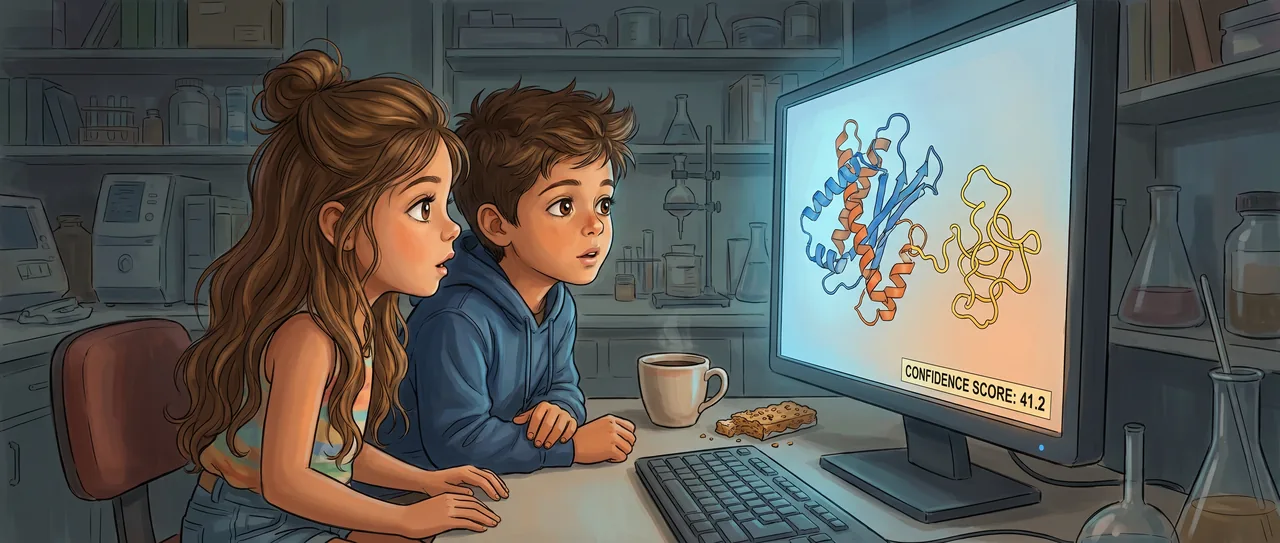
The shape that loaded was longer, tangled at one end, a long tail that curled back on itself in a way that looked almost wrong. Below it, the program had added a note in small text: regions of high structural variability. Confidence in those sections: forty-one point two.
"What does that mean?" Soren said. "The low confidence part?"
"It doesn't know."
"The AI doesn't know?"
"The AI doesn't know."
Soren stared at the tangled yellow section. "Is that where the disease comes from?"
"I think," Maya said, and then stopped.
Because she didn't know either. And she realized what she was actually looking at: the shape of something that made people very sick, and there was a portion of it that even the most powerful protein-prediction system ever built marked with a number under fifty, meaning it was not confident, meaning the shape there was genuinely uncertain, meaning the disease lived partly inside a mystery.
She looked at Soren.
He said: "Someone's trying to design a molecule that fits against that exact shape. Like a key. So it blocks it."
"How do you know?"
"That's how drugs work. My dad has a book." He paused. "But if they don't know the shape of that part, how do they design the key?"
Neither of them said anything for a moment.
"They guess," Maya said. "And test. And guess again."
"For how long?"
She checked her phone again. "Huntingtin. There's no approved treatment. They've been trying since the nineties."
The spinning shape rotated on the screen. The tangled yellow section turned in and out of view. Confident. Not confident. Confident. Not confident.
Behind them, a voice: "Oh, you found Minerva."
A woman in a lanyard stood in the doorway, not quite out of breath but close. She had a coffee cup and a name tag and the look of someone who had been giving the same talk for three hours.
"Minerva?" Maya said.
"My name for the program," the woman said. She was already walking to the desk, not annoyed, just moving. "It's a public-facing demo, so you're fine. What were you looking at?"
"Huntingtin," Soren said. "The low-confidence region."
The woman stopped moving.
She set her coffee down and looked at the screen, and her face did something that Maya could not entirely read, except that it was not the face of someone about to explain something for a crowd of strangers. It was the face of someone who worked on this.
"That region," the woman said, "is what our lab is actually looking at. The part Minerva isn't sure about." She pulled up a stool. "How much do you know about intrinsically disordered proteins?"
"Nothing," Soren said.
"Good," the woman said. "That means we start from the interesting part."
She typed something, and a new shape loaded, one that had no fixed shape at all, a cloud of possible positions, a molecule that existed in multiple configurations at once, shifting, and she started talking, and Maya leaned forward until her nose was almost at the screen, watching a thing that was never the same shape twice.
Read the interactive version, listen to the narration, and earn a gold star →
A science-verified short story for curious kids · Curiosity Land