The Shape of Everything
The tour group had moved on without Soren noticing.
This happened to him sometimes. Someone would say something interesting and he would stop walking to think about it, and by the time he looked up, the group was a distant murmur around a corner. He was not worried. He was thinking about voids.
The graduate student had mentioned them in passing, the way adults mention things they assume everyone already knows. Enormous empty bubbles in space, she had said. Between the filaments. And then she had moved on to something about redshift.
But Soren had stopped.
He found the workstation by following the light. A single monitor at the end of a long room full of dark equipment, throwing blue across a cluttered desk. The graduate student was there, hunched over a keyboard, a cold cup of coffee at her elbow. She did not look up when he came in.
"The tour is that way," she said.
"I know," Soren said. "What is that?"
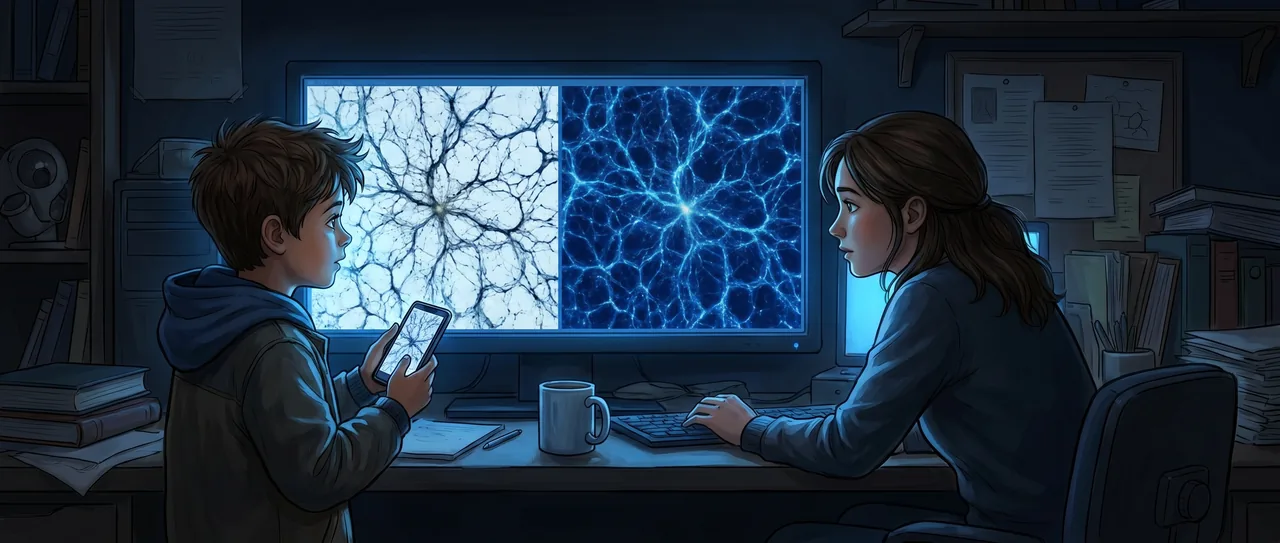
On the monitor was a three-dimensional map. It looked like someone had stretched silver thread through black water and let it dry into a tangle of filaments and loops, with dark holes of nothing yawning between them.
"Simulation of the cosmic web," she said, still not looking up. "Large-scale structure of the universe. Those bright threads are filaments where the dark matter clusters. Galaxies string along them like beads. The dark parts are the voids."
"How big are the voids?"
"Some of them, three hundred million light-years across."
Soren looked at the number from several angles the way he looked at numbers that wouldn't fit into anything he already knew. He wrote it in his notebook. Three hundred million light-years. The diameter of the void.
"Can I ask you something?" he said.
"I'm working."
"It looks like something," Soren said. "The filaments. The pattern."
She hit a key, and the simulation rotated slowly. Soren watched a void yawn open at the center, the filaments curling around it like the fingers of an open hand.
"Looks like a lot of things," she said. "Soap bubbles, if you look at the voids. Spider webs, if you look at the threads. People see what they want to see."
"I was going to say neurons," Soren said.
She stopped typing.
Soren pointed at the screen. "The filaments connecting at nodes. The empty space between. I did a project on the brain last year. The way neurons branch and connect and have these gaps between them. It looks like this."
She turned around for the first time. She was maybe twenty-five, with the specific expression of someone who has just heard a thing they were not expecting from a direction they were not watching.
"You're not wrong," she said slowly. "Researchers have actually compared them. The cosmic web and the neural network. Similar number of nodes. Similar clustering patterns. Similar ratio of active filaments to empty space."
"Why?"
She picked up her coffee and then put it down again. "Nobody knows."
Soren wrote that down too.
"What do you mean, nobody knows?"
"I mean the scales are completely different. A neuron is about one hundred micrometers. The cosmic web spans billions of light-years. Nothing about physics should make them look the same. But a team of researchers did a proper comparison in twenty-twenty, and the numbers lined up. Node distribution, filament connectivity, clustering coefficients. Inside the margin of error."
Soren looked at the simulation. He looked at it for a long time.
"Could it be the physics?" he asked. "Like, could the same rules make the same shape at different sizes?"
"That's one hypothesis. Gravity and fluid dynamics might produce similar branching patterns at different scales. The way a river delta looks like a tree looks like a lung."
"But you don't know."
"Nobody knows," she said again. She said it differently the second time. Not like a failure. Like a door.
Soren pulled up the image he had taken with his phone at school last spring, when they had done the unit on neuroscience. A microscope image of neurons in a petri dish, silver-stained, the branches reaching toward each other across dark gaps. He held the phone next to the monitor.
The graduate student leaned forward.
Neither of them said anything.
The filaments on the screen reached across billions of light-years of cold dark space. The filaments in the photograph reached across the width of a human thought. The shapes were not exactly the same. But the logic of them was. The way they branched. The way they connected at nodes. The way the empty spaces were as important as the threads themselves.
"The void is part of it," Soren said. "The empty space. It's not just nothing. It's the shape between the connections."
"Yes," she said.
"And we don't know if that's physics or coincidence or something else."
"No," she said. "We don't."
Soren thought about that word, coincidence. He had never trusted it. It was a word that meant we stopped asking. He had written that down once after his father used it to explain why two things happened on the same day, and he had looked at the sentence afterward for a long time, unconvinced.
He looked at his phone and at the monitor.
"Can I take a picture of the simulation?"
"Sure."
He photographed the screen. Then he put his phone and notebook in his jacket pocket and stood there in the blue light.
The universe on the monitor rotated slowly, the filaments sweeping around the void, the void as dark and necessary as silence in the middle of a word.
He put his finger on the screen, very gently, where two filaments met at a bright node three hundred million light-years from the nearest empty space.
Then he took his phone back out and held the neuron photograph beside it, and stood there holding both of them up in the cold blue light.
Read the interactive version, listen to the narration, and earn a gold star →
A science-verified short story for curious kids · Curiosity Land