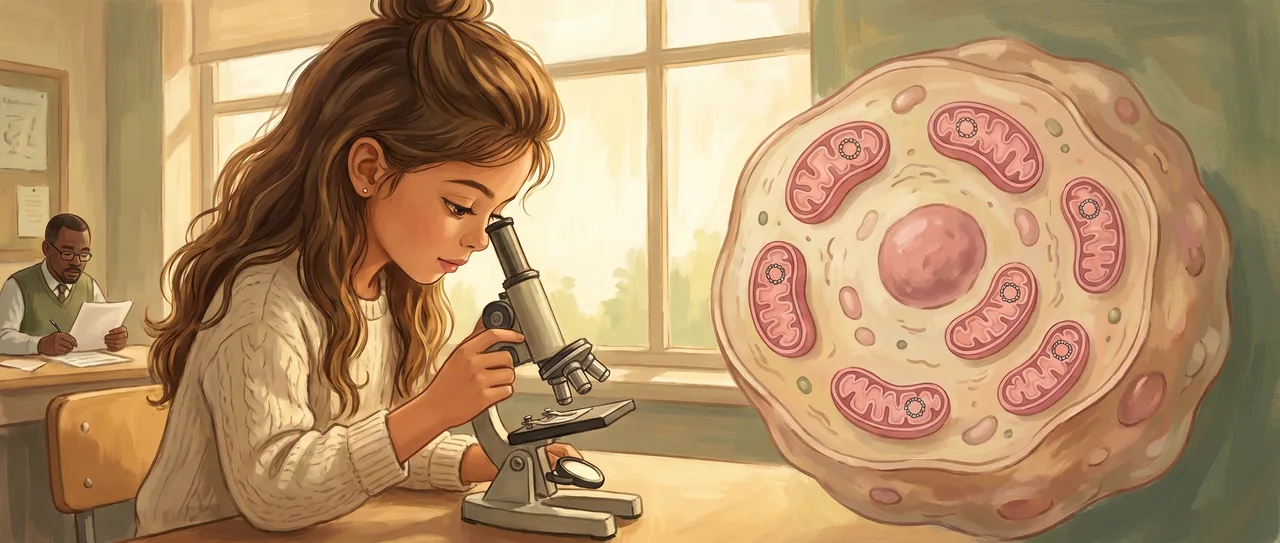
The Passenger
The slide was supposed to be boring.
Maya had already labeled her diagram. Nucleus, cell membrane, cytoplasm. The usual words. Her teacher, Mr. Okafor, had said the stained slides would help them visualize cell structure, and then he had gone back to his stack of quizzes and mostly forgotten about her.
Maya moved the slide a little to the left. Then a little more.
Something in the cytoplasm was wrong. Not wrong like a mistake. Wrong like a thing that did not match the story she had been told.
The mitochondria were supposed to be small oval blobs. She knew this. She had drawn them in her diagram three minutes ago. But under the scope, stained faintly pink, they looked less like blobs and more like commas. Like beans. Like something that had once moved on its own and still remembered how.
She pressed her eye harder against the eyepiece.
They had their own outline. Not ragged, the way cytoplasm looked, with its lumpy indefiniteness. These had a clean edge. Their own wall.
She wrote a single word in the margin of her worksheet: separate.
Then she looked up.
"Mr. Okafor."
He made a sound without raising his head.
"Do mitochondria have their own membrane?"
"Double membrane, actually," he said. Still reading.
"Two?"
"Inner and outer. It's in chapter six."
Maya looked back through the eyepiece. Two membranes. Like something that had come from somewhere else and needed to stay wrapped up inside its own skin while it lived somewhere new.
Like a tenant, she thought. Long-term.
She flipped to chapter six. Most of it was about ATP and energy conversion and she had read it twice without anything sticking. But near the bottom of the page, in the kind of small italic font that textbooks used when they wanted you to think a fact was a minor detail, she found a sentence that made her sit completely still.
Mitochondria contain their own DNA, separate from the nuclear DNA of the cell.
She read it again.
Their own DNA.
Not the cell's DNA. Their own.
She flipped ahead two pages, looking for the explanation, the part where it said why. There was a paragraph about energy production and a diagram of the electron transport chain and nothing else. The textbook had dropped the most astonishing sentence she had ever read and then walked away from it.
"Mr. Okafor."
This time he did look up, but he had the expression of a person who had been interrupted mid-thought and was not completely back yet.
"Mitochondria have their own DNA," Maya said. "Why?"
"Endosymbiosis," he said. Then he looked at her face and seemed to decide this was not enough. "It's a theory. A well-supported one. The idea is that a long time ago, a large cell absorbed a small bacterium. Instead of digesting it, the cell and the bacterium just. Kept living together. The bacterium gave the cell energy. The cell gave the bacterium protection. Over time they became inseparable."
"How long ago?"
"Billion and a half years, roughly."
Maya stared at him.
"So the mitochondria in my cells," she said slowly, "are descended from bacteria that were alive before animals existed."
"Before most complex life existed, yes."
"And they still have their own DNA. Like bacteria do."
"Circular genome, same basic shape as modern bacteria. Yes."
Mr. Okafor was watching her now with the particular attention of a person who had realized mid-conversation that it had become interesting.
"The cell never took over their DNA?" Maya asked. "In a billion and a half years?"
"Most of it transferred to the nucleus over time. But not all of it. Thirty-seven genes, in humans. Still sitting in there. Still theirs."
Maya put her eye back to the microscope.
She was looking at a human cheek cell. Donated by whoever had prepared this slide, some adult she would never meet. And inside that human cell, inside the cytoplasm, the mitochondria sat in their double membranes with their own ancient DNA, descended from bacteria that had made an arrangement with another cell before the first fish, before the first worm, before anything with a spine had taken a single breath.
The arrangement had worked so well that neither side ever left.
She thought about the word separate. She had written it in her margin without knowing why, just because something looked different, just because the outline of the mitochondria felt too clean, too self-contained. And she had been right, but she had not known how right, had not known that she was looking at something that had come from somewhere else and kept a record of that in a coil of DNA that no cell nucleus had ever claimed.
There was a question forming that she could not quite shape yet. It sat at the back of her mind and pressed.
If the mitochondria still had their own DNA, separate, after all that time, did they still make decisions? Not like thinking. But like bacteria did. Their own rhythms, their own signals.
Were they cooperating because they had to? Or because it still, somehow, worked?
She did not ask Mr. Okafor this. She could tell by the way he had gone back to his quizzes that he thought the conversation was finished. Maybe he had never thought about it that way. Maybe no one had asked him.
Maya looked around the classroom. Twenty-two other students. All of them carrying around cells full of ancient passengers who had checked in one and a half billion years ago and simply never left. The passengers kept the lights on. The cell kept the walls up. Neither one was in charge.
She looked back through the eyepiece.
The mitochondrion sat in its double membrane, pink and comma-shaped and self-contained, and somewhere inside its tiny coiled loop of DNA were the instructions it had carried across more time than Maya could hold in her head.
She pressed her eye against the scope until everything else went dark.
Read the interactive version, listen to the narration, and earn a gold star →
A science-verified short story for curious kids · Curiosity Land