The Noise That Was Everything
The noise wouldn't stop.
Maya had been sitting inside the equipment shed for forty minutes, listening through the headphones to what Dr. Vasquez's team called the auxiliary feed. It sounded like an old television between channels. Like static that had nowhere to go. Like something breathing very slowly in a language with no words.
She had found the headphone jack by accident, looking for a power strip. She had plugged in because the jack was there and the switch was labeled and she had learned that switches labeled ON were usually worth investigating. That was twenty minutes before she told herself she would stop.
She had not stopped.
The whole research team was in the main building, forty meters away, arguing about whether the new firmware had corrupted the pointing calibration or whether Dr. Vasquez had simply entered the wrong coordinates on Thursday. Maya's mother was in that argument. Maya had been in it too, briefly, until she understood that neither side needed a third person, only more volume.
So she was here, in the shed, listening to static.
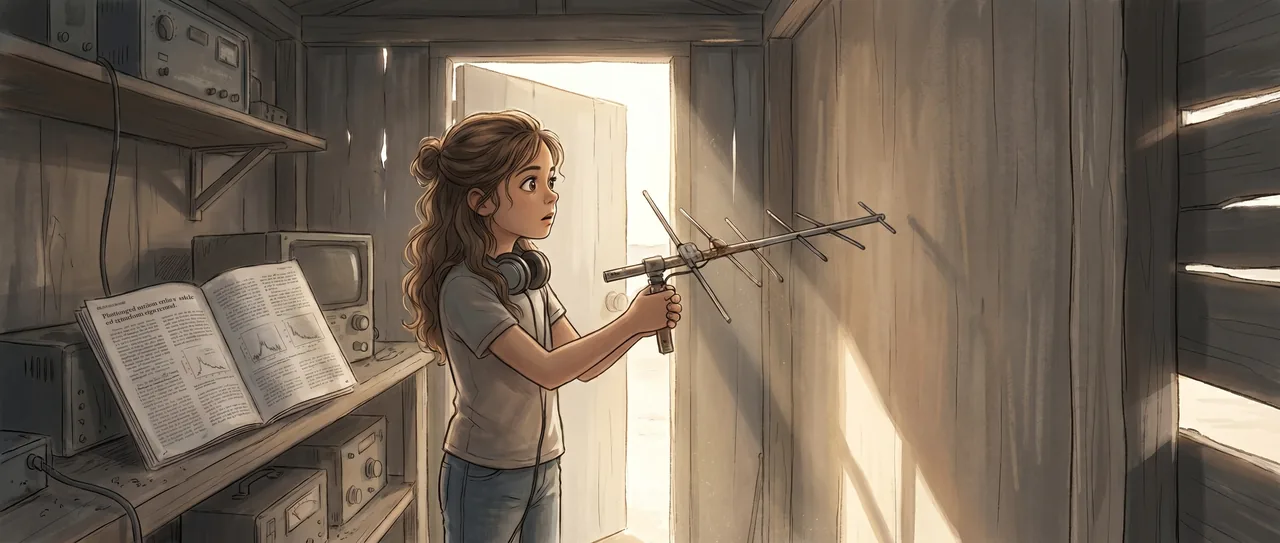
She turned the antenna by hand, slowly, because it was small enough to move that way. She pointed it north. The static stayed. She pointed it at the ground, which felt wrong but she did it anyway. Still there. She pointed it straight up, at the midday sky, white and hard and full of nothing visible.
Still there.
The same sound. Same texture. Same slow, even breathing.
She took off the headphones and pressed her fingers against the antenna housing, which was warm from the sun, and she thought: something is in the signal that isn't supposed to be there. Or the signal is the something.
She had been treating the noise as interference. As the thing you subtract to get to the real data. But she had pointed the antenna in every direction she could manage and the noise had not changed by one degree. It was exactly as loud north as south. Exactly as loud at the ground as at the sky.
Maya's running list of things that didn't make sense had about forty items on it at any given time. This went straight to number one.
She put the headphones back on.
The shed had a single shelf of binders, the kind nobody opened except during inspections. She opened the third one because it was thicker than the others and thickness sometimes meant argument, and argument sometimes meant something interesting had happened. Inside, behind the maintenance logs, she found a photocopied article from a journal, the pages soft with age. Someone had highlighted two paragraphs in yellow that had long since faded to nothing.
She read it standing up.
Two engineers. New Jersey, nineteen sixty-five. A very large antenna. A noise they could not locate and could not remove. They had cleaned the antenna. They had checked every connection. They had found pigeons nesting in the horn and removed the pigeons and cleaned up what the pigeons had left behind, and the noise had still been there. They had assumed, for months, that the problem was the pigeons. That something so vast and strange could be mistaken for something so ordinary struck Maya not as funny but as the most important thing she had read in a long time.
The noise was not interference. The noise was a signal. It was the oldest light in the universe, stretched by thirteen point eight billion years of travel until it wasn't light anymore, until it was radio waves so cold they were barely above nothing. It filled every direction equally because it came from every direction equally. From before galaxies. From before stars. From a moment so early in the universe that the universe itself was the source.
The static in the headphones was the afterglow of the beginning.
Maya stood very still.
The antenna in her hands had been built last decade, out of aluminum and carbon fiber and some kind of polymer housing she didn't know the name of, and it was receiving a signal sent thirteen point eight billion years ago by an event no human had seen and no human word had been invented to describe. The engineers in nineteen sixty-five had spent months thinking the problem was birds. Ordinary, cooing, irrelevant birds.
She did not feel superior to the engineers. She felt the opposite. She felt like everyone, always, was probably standing next to something they hadn't understood yet, calling it noise, trying to clean it up, getting frustrated because it wouldn't go away.
The signal wouldn't go away because it was everywhere. All at once. In every direction. The universe had not stopped sending it.
She put her hand on the antenna and pointed it slowly at the shed wall, at the wooden boards that were definitely not space, and the static continued exactly as before, the ancient signal passing through the wall and through her hand and through the mountain behind the shed and through the planet itself, because what could stop something that had been traveling since before the sun existed.
She heard the door of the main building open and her mother's voice calling her name, the tone that meant the firmware argument had resolved or stalled and it was time to eat.
Maya did not move for three more seconds.
She was thinking about the pigeons. She was thinking about how the engineers must have felt, scraping out the pigeon droppings, certain they had finally found the answer. Working carefully and correctly on entirely the wrong problem. The signal sitting there the whole time, patient, waiting in every direction at once.
There were probably a hundred things on her list like that. Things she'd been treating as noise. Things she'd been trying to subtract.
She set the headphones down on the shelf next to the open binder.
The antenna was still pointed at the shed wall, still receiving, the old television static filling the empty air of the shed in every direction, from every wall, through the floor and the ceiling and her own body, the first light of the first moment, and Maya walked out into the white desert afternoon with her hands in her pockets and the sound still in her ears.
Read the interactive version, listen to the narration, and earn a gold star →
A science-verified short story for curious kids · Curiosity Land