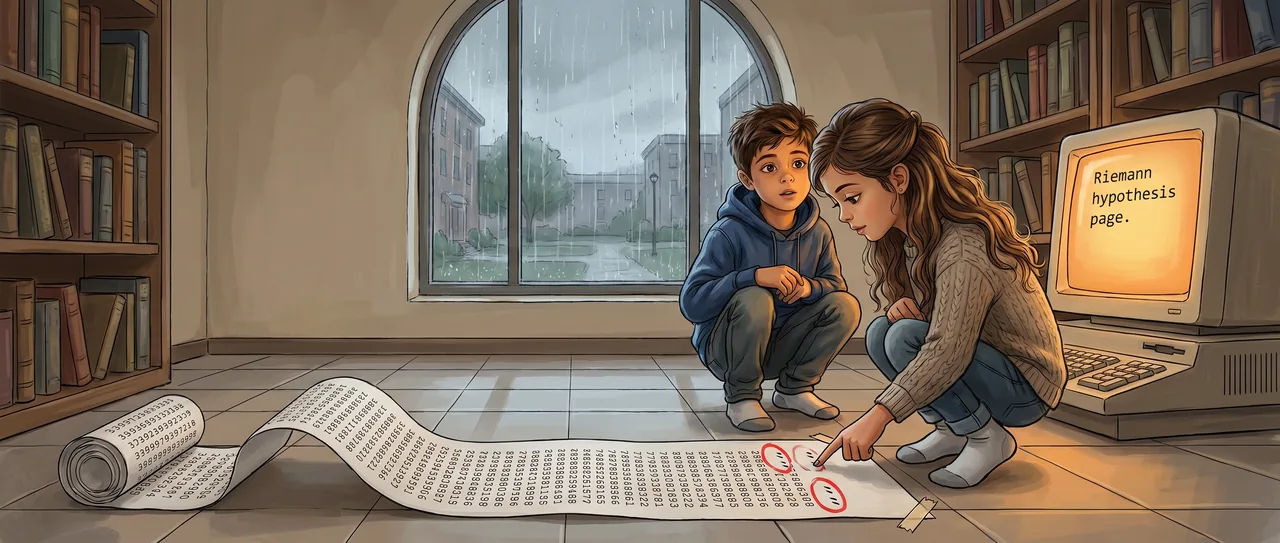
The Gap That Shouldn't Be There
The printout was three meters long.
Soren's cousin Petra had taped it to the floor of the study room before she got called upstairs to explain something to her professor. The paper ran from the doorway to the far wall and curled up against the baseboard, and on it were numbers printed in tiny columns, thousands of them, and some were circled in red marker.
"Prime numbers," Soren said. He knew what they were. Numbers divisible only by themselves and one. Two, three, five, seven, eleven. He had learned them in fourth grade.
"She circled some and not others," Maya said. She was already walking the length of the paper, stepping over it carefully, her socks making no sound on the tile floor.
"The ones that aren't circled are composite. They have factors."
"I know what composite means," Maya said, but she wasn't annoyed. She had stopped near the middle of the printout and was crouching down. "Soren. Come look at this."
He walked over. She was pointing at a stretch of numbers in the high thousands. The circled ones, the primes, were getting farther apart. That made sense to him. The higher you went, the more possible factors a number had. Primes should get rarer.
"They're spread out up here," he said.
"Right. But look at this gap." She pointed to a long run of uncircled numbers. Then, three centimeters of paper later, two circled numbers very close together. "Two primes almost touching. After all that empty space."
Soren crouched beside her. She was right. The gap before them was enormous, and then suddenly, two primes nearly neighbors. He counted the uncircled numbers in the gap. Fourteen composite numbers in a row. Then a prime. Then another prime just two apart from the first.
"Twin primes," he said.
"How does that happen? The primes are supposed to thin out."
"They do thin out. On average."
"On average," Maya repeated, and her voice had that particular flatness it got when she was about to pull on a thread. "What does that mean, on average, for primes? They're not random. They're exactly what they are."
Soren sat down on the floor next to the paper. She was onto something. Prime numbers weren't like weather. They weren't statistical. Every prime was prime for a hard, permanent reason, not a probabilistic one. Two was prime because nothing divided it. Full stop. No averaging about it.
And yet.
And yet when you looked at all of them together, from a distance, they behaved like something you could describe with probability. They thinned out. They clustered. They followed a curve that mathematicians could write down.
"I want to look something up," Soren said.
Petra's computer was still logged in. He typed carefully: distribution of prime numbers pattern.
The first result was about something called the Riemann hypothesis.
He read for a while. Maya leaned over his shoulder and read faster than he did, which he had long since stopped finding surprising.
"One hundred and sixty-five years," she said.
"Nobody's solved it."
"A million dollars if you do."
"Not the money," Soren said. "Look at what it says underneath."
Maya leaned closer. He watched her read the part he meant: that if the hypothesis were proven, it would mean the primes were not truly chaotic, that their apparent randomness across the infinite number line followed a deep and precise regularity, that they were distributed according to a pattern so exact it had a name, and that name was connected to something called the Riemann zeta function, and that no one had been able to prove it, but no one had been able to disprove it either, and it had been tested for ten trillion cases and held every single time.
"Ten trillion cases," Maya said quietly.
"And still not proven."
She straightened up and looked back at the paper on the floor. Soren looked too. Three meters of circled and uncircled numbers, and somewhere underneath all of them, maybe, a pattern so deep that one hundred and sixty-five years of the best mathematical minds in the world hadn't been able to describe it completely.
"So the primes act random," Maya said, "but they might not be."
"They're definitely not random. Every prime is prime for an exact reason."
"But the reasons add up to something that looks like randomness."
"Unless Riemann was right. Then the reasons add up to something that only looks like randomness until you find the pattern underneath."
Maya was quiet for a moment. Soren had learned to let those moments run.
"That gap," she said. She pointed back to the long run of composite numbers on the printout. "Fourteen composites in a row. That gap had a reason. Every single one of those composites had a factor, a specific one, not a random one. The gap happened because of something real. And then two primes showed up almost next to each other because of something real."
"Yes."
"But we don't know what that something is."
"Nobody does. Not completely."
The rain was loud against the library windows. Somewhere upstairs, Petra was explaining something to her professor, something with partial answers and incomplete proofs, the ordinary business of people trying to think at the edge of what was known.
Soren looked at the ten trillion tested cases and thought about what it meant to test something ten trillion times and still not know. He thought about how that wasn't failure. That was the exact shape of a question nobody had answered yet. Someone had decided the question was worth following for one hundred and sixty-five years. Other someones had agreed. The question was still open, sitting there like the gap on the printout, waiting.
Maya crouched back down. She put her finger on the gap between the cluster of composites and the twin primes at the end.
"What made this gap exactly this wide," she said, "and not one number wider or narrower."
She wasn't asking Soren.
She pressed her fingertip flat against the paper, right in the middle of the gap, where nothing was circled, where fourteen composites sat between her and the answer.
Read the interactive version, listen to the narration, and earn a gold star →
A science-verified short story for curious kids · Curiosity Land