The Floor of the Impossible Sea
The core sample smelled like nothing Maya had ever encountered. Not like mud. Not like salt water. Like something that had been waiting a very long time to be opened.
She was standing at the lab bench in the lower deck of the Ariadne, which was not where she was supposed to be. She was supposed to be in the observation lounge with the other children of the scientists attending the conference. But the observation lounge had a television and the lab had core samples, and that was not a difficult decision.
Soren came in two minutes later, notebook tucked under his arm, because he had noticed her leave.
"Dr. Vasquez said not to touch those," he said.
"I haven't touched it," Maya said. "I'm smelling it."
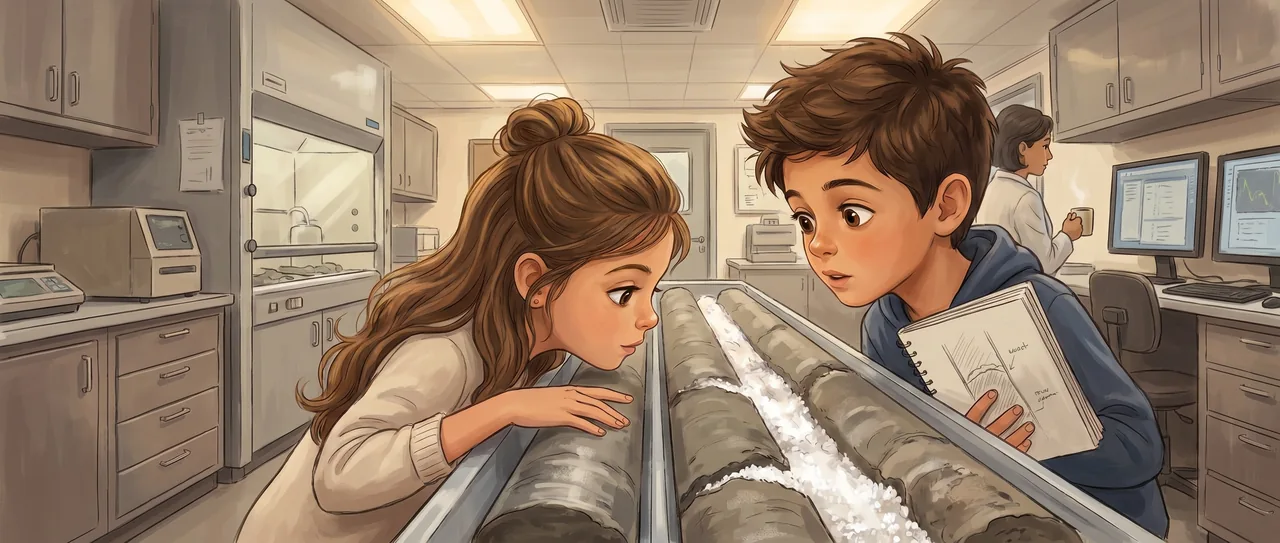
Soren came to stand beside her. The core was laid out in a plastic tray, a cylinder of compressed material about a meter long, pulled up from the seafloor six hundred meters below their feet. Most of it was grey-brown sediment, the ordinary mud of the deep ocean. But near one end, maybe thirty centimeters of it, the color changed completely. White. Dense. Crystalline.
"Salt," Soren said.
"Obviously salt. But look where it is in the column." Maya pointed without touching. "Everything above it is ocean sediment. Everything below it is ocean sediment. But that section is solid salt crystal. How does a layer of pure salt end up in the middle of seafloor mud?"
Soren leaned closer. He could see the boundary where the grey-brown material ended and the white began. It was sharp. Not a gradual fade, not a mixing zone. A hard line, like someone had made a decision.
"The salt has to have formed without water," he said slowly. "Or with very little. Evaporation."
"In the middle of the ocean."
"In what is now the middle of the ocean."
Maya looked at him. He was working something out and she could see him working it, the way his eyes went slightly distant and his hand opened and closed against his notebook.
"Say it," she said.
"I need to check something first."
He opened the notebook to a blank page and drew a rough cross-section. The seafloor. The layers of sediment. The salt band sitting inside them like a secret.
"How deep is the seafloor here?" he asked.
"Six hundred meters of water. But the core itself went down another three hundred into the seabed."
"And the Mediterranean basin, at its deepest, is about five thousand meters below sea level." He wrote the number. "That's five kilometers."
The door to the lab opened and Dr. Vasquez came in carrying a coffee, already talking to someone behind her on her headset, not looking at them. She went to the far end of the lab, pulled open a drawer, and kept talking. She had the specific blindness of someone doing four things at once.
Maya and Soren did not move.
"The Messinian thing," Soren said quietly. He said it like he was reading it off the inside of his own head.
"What?"
"I read about it once. I didn't fully believe it." He tapped the salt layer with his pen, not touching the sample. "About six million years ago, the Atlantic connection closed. Whatever was happening with the tectonic plates, the Strait of Gibraltar sealed up. And the Mediterranean, because it loses more water to evaporation than it gains from rivers, started shrinking."
Maya said nothing. She was watching his face.
"It took about a thousand years. Maybe less. And then it was just. Gone."
The lab hummed around them. The ship moved slightly on its anchor chain.
"Gone," Maya repeated. The word didn't sound right. An ocean was not a thing that went away.
"A desert," Soren said. "Three to five kilometers below where sea level was. Below where sea level is now. The deepest, hottest, saltiest desert that has ever existed. Salt flats going on for thousands of kilometers. The Alps would have been cliffs above it. Rivers would have cut canyons into the basin, canyons deeper than the Grand Canyon, just trying to reach the bottom."
He stopped.
Maya pressed two fingers flat on the edge of the tray, not on the sample, just on the plastic beside it.
"And then Gibraltar opened again," she said.
"Yes."
"How?"
"Nobody completely knows. The rock wore down, or shifted, or both. But once it started, it couldn't stop. The Atlantic was higher than the basin floor. The water came in." He looked at what he had written and then stopped writing. "Models suggest it may have taken less than a thousand years to refill. Some models say much less. A waterfall, eventually, bigger than anything that exists now. Coming over the edge. Filling a five-kilometer-deep basin."
Maya stared at the white section of the core.
She thought about standing at the bottom of a salt desert so deep that the sky above would look like a pale stripe between walls of rock. The silence of it. The heat. The absolute impossible depth. And then the sound, starting somewhere to the west, starting small and building into something that had no name.
"We're floating," she said, "above where that happened."
Soren looked up at the lab ceiling, which was also the bottom of the deck above them, above which was the sea, above which was the sky.
"The salt in this core," he said, "was sitting at the bottom of that desert. Then the water came. Then more sediment covered it. Then we drilled down and pulled it up." He turned the page in his notebook to a fresh one. "It was dry, and then it wasn't, and it's been wet ever since, and we're floating on top of all of that not knowing."
Dr. Vasquez finished her call and turned around and saw them.
"I said the observation lounge," she said, but she didn't actually sound angry. She sounded like someone who had said words without thinking about them.
"What made Gibraltar open back up?" Maya asked.
Dr. Vasquez looked at the core. She looked at them. Something shifted in her expression that was not quite a smile and not quite something else.
"We're still working on that," she said.
Maya put her nose back down toward the white section of the core and breathed in the smell of something that had last been open to the air five million years before any human had existed to smell anything at all.
Read the interactive version, listen to the narration, and earn a gold star →
A science-verified short story for curious kids · Curiosity Land