What the Stone Remembers
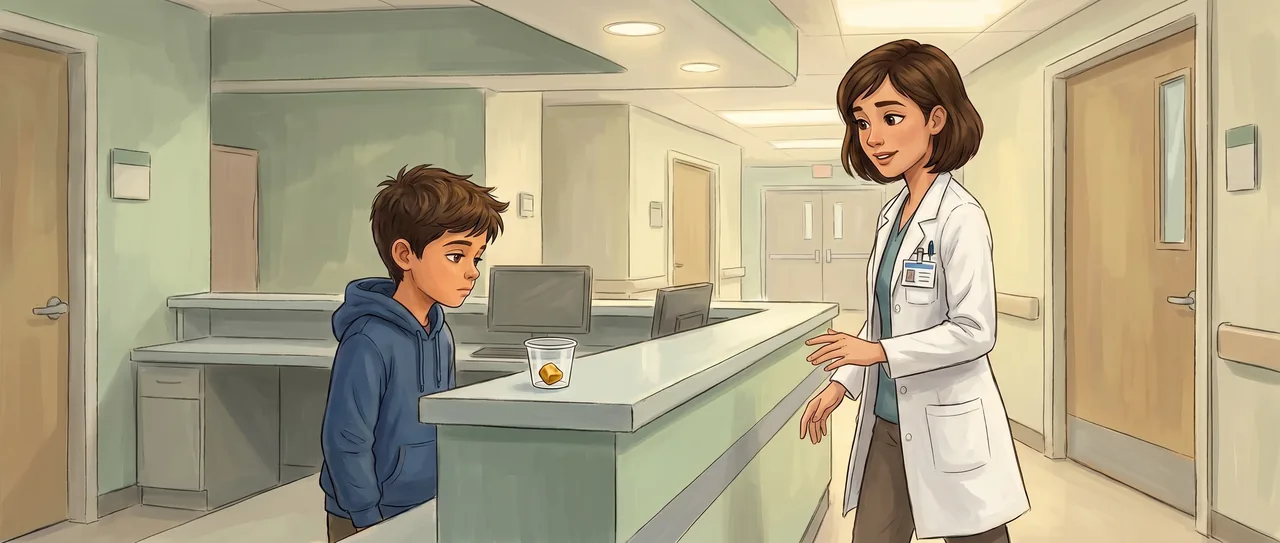
The stone was sitting in a small plastic cup on the counter of the nurses' station, and nobody was paying attention to it.
Soren had been waiting for four hours. His mother was still in recovery. His aunt was filling out paperwork at the far end of the corridor, and the television in the waiting room was playing a cooking competition with the sound turned low. Soren had read every poster twice. He had counted the ceiling tiles in two directions. He had done the math to confirm they were not a perfect rectangle.
Then he had walked to the water fountain, and on the way back he had seen the cup.
The stone inside it was smaller than he expected. The size of a marble, maybe, but not round. It had angles. It was pale yellow at the edges and darker in the center, almost the color of old honey. He stood very still and looked at it through the plastic.
A nurse passed behind the desk without glancing at it.
Soren did not touch it. He looked at it for a long time.
His mother had told him, the week before the surgery, that the pain was sudden and enormous. Like something was squeezing. The doctors had shown her an image on a screen, a small pale shape, and she had said it almost felt personal. Like her own body had made something against her.
Soren thought about that.
A doctor came out of a side room, moving fast, and Soren almost let him go. But the shape of the thing in the cup was still sharp in his mind, all those angles, and he said: excuse me.
The doctor stopped. He was younger than Soren expected doctors to be, with a badge that said Dr. Reyes, and he looked at Soren the way adults do when they are busy but trying not to show it.
Soren pointed at the cup. Is that a gallstone?
Dr. Reyes glanced at it. His expression did something complicated. Yes, he said. From a procedure this morning. Normally we don't leave those out.
How does it form, Soren asked.
The doctor paused. He looked at Soren for a moment. Then he said: your gallbladder concentrates bile. Bile is a fluid that helps you digest fat. The gallbladder's entire job is to pull water out of the bile and make it stronger, more potent, so it's ready when you need it. It does this extremely well. It can make the bile five times more concentrated than when it arrived.
Five times, Soren said.
Five times. But sometimes the bile gets too concentrated. The components in it start to crystallize. Like when you dissolve too much sugar in water and the crystals come back out. Those crystals clump together. They grow. Over months, sometimes years. Until they're this.
He gestured at the cup without touching it.
Soren looked at the stone. He thought about the word crystallize. He thought about sugar water and the way crystals formed in his science kit, slow and inevitable, one layer building on the next.
He said: so it's not really something that went wrong. It's something that worked too well.
Dr. Reyes opened his mouth, then closed it. He looked at Soren differently now. He said: that is actually a reasonable way to put it.
He was already moving again, but he stopped once more at the door and said: the gallbladder is trying to do its job. It just doesn't know when to stop.
Soren stood at the counter after he left.
He thought about the months. He thought about his mother going about her life while the stone was quietly forming, crystal by crystal, in the dark. She had been grocery shopping and making dinner and complaining about traffic, and the whole time something was building itself inside her that she couldn't see or feel, patient as a mineral deposit, layer by layer.
He thought about all the processes running right now that nobody could feel. His own gallbladder, pulling water out of bile, concentrating, adjusting, doing its careful work. A hundred things happening at once, all without asking.
The thought should have been ordinary. It was biology. It was just the body doing what the body does.
But something about the word crystallize would not let him go.
He had grown crystals before. He knew that a crystal was not random. It had structure. A lattice. Each piece finding its place based on the shape of what came before. Given the right conditions, the same substance always made the same angles, always.
The stone had angles.
He looked at it again. Pale yellow at the edges. Darker in the center where it had started, years ago, as something almost too small to see.
He thought: someone could look at that stone and tell you something about the concentration of bile in my mother's gallbladder. About the chemistry. About what was out of balance and for how long.
He thought: the stone is a record.
He didn't know how to read it. He didn't know if anyone could read it, not yet, not with what they knew now. Maybe the tools for that didn't exist. Maybe they would.
His aunt came around the corner and said his name and told him his mother was awake and asking for him.
Soren looked at the stone one more time.
It sat in the plastic cup, pale and angled and entirely unremarkable to everyone who walked past it, holding everything it knew in its lattice, in its layers, in the specific arrangement of crystals that had grown, one by one, in the dark.
He followed his aunt down the corridor.
Read the interactive version, listen to the narration, and earn a gold star →
A science-verified short story for curious kids · Curiosity Land