What the Ground Keeps
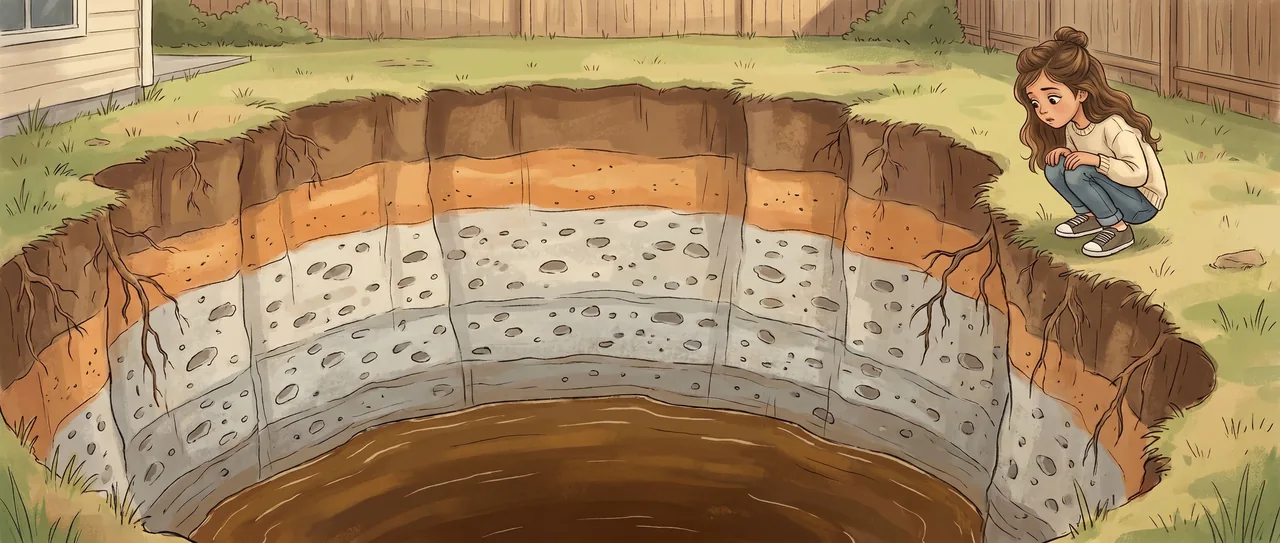
The hole was the size of a swimming pool by the time Maya got close enough to see the bottom.
Officially, she was not allowed this close. The orange plastic fencing the county had stapled to wooden stakes said so. But the stakes were pushed into sandy soil, and the soil was not exactly arguing back, and Maya had spent the last forty minutes watching Mrs. Okafor from three houses down cry on the sidewalk while workers in yellow vests stood at the edge of the hole looking at their phones, so she ducked under the fencing and walked to where the ground ended.
Below her, the earth had simply stopped pretending.
The walls of the hole were layered. Brown topsoil. Then orange sand. Then something gray and crumbled and wet that didn't look solid at all, more like soaked cardboard that had given up. At the bottom, maybe twelve feet down, water was collecting. Dark water, the color of old tea.
Maya crouched and studied the walls.
She had seen pictures. Every kid in Florida had heard the stories, the cars parked over nothing, the bedroom floors that became holes in the night. She had always imagined a sinkhole as an event, something dramatic, a crack and a roar. But Mrs. Okafor said she'd heard nothing. She'd gone to sleep, and in the morning the back corner of her yard was gone.
Silent. That was the part Maya kept snagging on. Silent.
She looked at the gray layer in the wall. It was the widest layer, thicker than her arm was long. She knew limestone when she saw it. Her teacher Mr. Farris had a chunk of it on his desk, pale and pocked, with tiny shell shapes pressed into it. He called it Florida's foundation, which Maya had always thought was a funny thing to say about something that turned into nothing when water touched it.
Because that was the thing. Limestone dissolved. Not fast, not all at once, but water seeped through the soil and found the rock, and the rock was old ocean floor from millions of years ago, full of calcium that water wanted, and year by year and decade by decade the water took what it wanted and left a little less rock behind.
The gray layer in the wall had holes in it. Not one big hole. Dozens of small ones. Like the rock had become a sponge and then the sponge had become a question mark.
Maya looked at those holes for a long time.
Her street was three hundred meters from here. Her house was on that street. The ground under her house was the same ground as this ground. The same sand, the same orange sediment, the same gray limestone below it all, and below the limestone the same water, always moving, always finding calcium, always making the rock slightly less than it was.
She pressed the toe of her sneaker against the edge of the hole, where the grass simply ended in a clean curve like a bite taken from a cookie. The soil was dry and crumbly here. She could see roots dangling in the air, surprised by their sudden exposure to nothing.
One of the workers in yellow vests appeared at the orange fencing. "Hey. Hey, kid, you can't be in there."
Maya pointed down. "What's the gray layer?"
The worker, a man with sunburned arms and a clipboard he was not writing on, looked at her like she had asked him something in another language. "Come out of there right now."
"Limestone?"
"I'm not, I don't. Yeah, probably. Come on."
She stepped back over the fencing. The man walked away, already done with her. Maya looked at the clipboard in his hand. It was blank.
She went home.
Her house had a crawl space. She had never been in it. There was a small wooden door in the back of the utility closet that her father had told her contained spiders and nothing useful, which she now understood to be two descriptions that did not actually address what she wanted to know.
She found a flashlight.
The crawl space was shallow and smelled like cool dirt and old pipes. She belly-crawled in and turned the flashlight down.
Dirt. Pipes. A concrete footing where the wall met the earth.
She pressed her hand flat against the soil.
It was damp. Not wet, but present. Water moved through here, she knew that now in a way she hadn't before, not just knew-it-for-a-test but felt as a fact inside her chest. Water moved through here the way it moved through Mrs. Okafor's yard and the yard two houses over and every yard on this street and every street in this city, slowly dissolving the ocean floor that Florida was built on, making caves where no caves should be, making a honeycomb out of a foundation, making rooms in the rock that no one had mapped and no one would see until the ceiling of one finally came down.
The whole state was a ceiling.
Maya lay there in the dark under her house with her palm on the damp soil and the flashlight aimed at nothing, listening.
She didn't know how big the caves were. She didn't know where they went. She didn't know which ceiling would hold and which one was already halfway to done. Nobody knew that. The workers with their clipboards didn't know. Mr. Farris with his chunk of limestone on his desk probably didn't know either.
The water knew. The water was the only one keeping track.
Somewhere beneath her hand, past the soil and past the roots and past the crumbled gray layer, water was moving through a passage that had been getting slightly wider since before this neighborhood existed, before this city existed, before anyone who had ever told her to come inside and stop asking questions was born.
Maya pressed her ear against the soil.
She held her breath and listened to the ground.
Read the interactive version, listen to the narration, and earn a gold star →
A science-verified short story for curious kids · Curiosity Land