The Wrong Shelf
The terminal was supposed to be for looking up lunch menus.
Soren had figured out in about four minutes that it was not just for lunch menus.
His mother had said: do not run queries on the research partition. She had said this while walking backwards out the door, already thinking about something else, her badge lanyard swinging. She had not said: do not ask the lab's AI assistant anything at all. Soren appreciated the difference. He wrote things down precisely for moments like this.
Maya was reading the ingredient list on a jar of preserved apricots she'd found in the break room. She did this with everything she could pick up. Soren had stopped asking why.
"Soren," she said. "What makes something a superconductor?"
He looked up from the terminal. "Electrons move through it with no resistance. Zero. None."
"And they only do that when they're freezing cold."
"Most of them. You need liquid nitrogen, or liquid helium. Colder than anywhere on Earth."
"Most of them," she repeated. Not a question. The way she said things when she was following a thread.
"There are some that work at higher temperatures," he said. "Scientists have been trying to find one that works at room temperature for like fifty years. That would change everything. Power lines, computers, trains. Everything."
Maya set the apricot jar down on the counter. She held it there with one finger for a second, not letting go.
"What does the molecule have to look like?"
"I don't know exactly. There's a profile, I think. Certain structures."
She looked at the jar. Then she looked at him.
He was already turning back to the terminal.
The AI assistant the lab used was called MIRA. It was not the AI you got for free. It had access to sixty years of materials science literature, chemistry databases, and a feature Soren had noticed in the help file: cross-domain anomaly flagging. He had read the help file. He was the kind of person who read help files.
"MIRA," he said, "can you run a structural match query? I want to find compounds that were developed for non-materials purposes but whose molecular properties overlap with room-temperature superconductor candidate profiles."
MIRA's response bar moved steadily for a moment.
"Query complete. There are several partial matches in the literature. One candidate shows a strong structural overlap. It appears in a nineteen-ninety-four food science paper. The compound was developed as a preservative to inhibit oxidation in canned and jarred fruit products. It was studied for approximately three years, found to be less cost-effective than existing preservatives, and abandoned. There is no record of it being tested for electrical conductivity properties."
Soren read it twice.
He read it a third time.
"Maya."
She was already behind him, reading over his shoulder.
"The molecular geometry," MIRA continued, because Soren had not told it to stop, "shows layered lattice structures and specific electron-orbital overlaps that several recent theoretical models identify as necessary, though not sufficient, conditions for room-temperature superconductance. This does not mean the compound is a superconductor. It means this question has not been asked about it."
The lab was very quiet. Outside, a cart went past in the hallway, wheels squeaking.
"It's in that jar," Maya said.
"We don't know that."
"Soren. It's a fruit preservative. From the nineties. We are in a room full of preserved fruit."
He looked at the apricot jar. He looked at Maya. He turned back to the terminal.
"MIRA, what's the compound name?"
MIRA gave it. It was long and had numbers in it. Soren copied it carefully into his paper notebook.
Maya had already picked the apricot jar back up and was reading the label with the focused expression she got when the world was not moving fast enough for her.
"It's not on here," she said. "There are three preservatives listed. Can MIRA tell us the other names this compound might go by?"
Soren asked. MIRA listed four alternative names. One of them was on the label. It was the third preservative. It had been sitting in the university break room for an unknown period of time, next to a coffee machine and a basket of sugar packets.
Neither of them said anything for a moment.
"This is probably nothing," Soren said.
"Yes," Maya agreed.
"The theoretical models say necessary but not sufficient. There could be a hundred other things it needs to do that it can't do."
"Absolutely."
"We should write down exactly what MIRA found and why it flagged it, and what the match quality was, and which papers the profile came from."
"Your mother is a battery researcher," Maya said. "Not a superconductor person."
"No. But she knows who is."
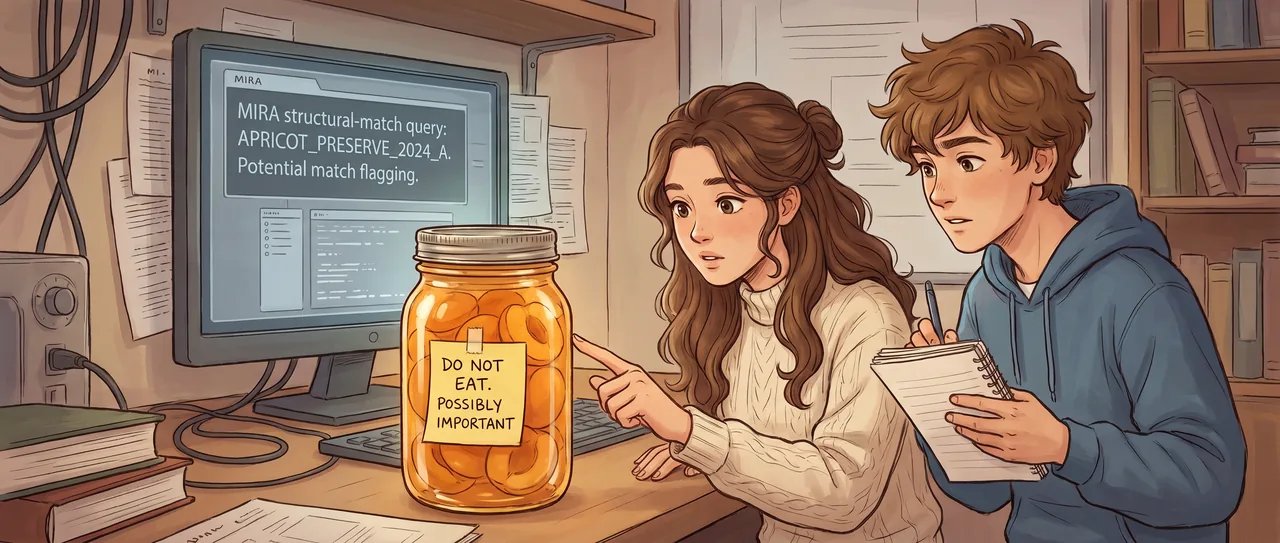
Soren's mother came back an hour and a half later with coffee and the distracted expression of someone who had been thinking hard about something completely different. She found them at the terminal with three pages of notes, a printout of the MIRA query log, and the apricot jar sitting in the center of the desk with a sticky note on it that said: DO NOT EAT. POSSIBLY IMPORTANT.
She read the notes. She read them again. Her coffee went cold.
"You ran a query on MIRA," she said.
"On the assistant partition," Soren said. "Not the research partition."
She looked at Maya. Maya looked back at her steadily.
"This could be nothing," his mother said.
"That's what we said," Soren agreed.
She picked up the printout. She set her cold coffee down. She walked to the door of the lab, then stopped with her hand on the frame.
"There's a woman in the superconductors group," she said, mostly to herself. "She's been looking for untested candidates."
She walked out into the hallway still holding the printout. Her footsteps went faster.
Maya and Soren stood in the lab. The terminal screen still showed the MIRA query. The apricot jar sat in the middle of the desk with its sticky note, completely ordinary, amber-colored fruit floating in syrup that might be nothing, that might be something, that no one in thirty years had thought to ask about.
Maya pressed her fingertip against the glass.
Read the interactive version, listen to the narration, and earn a gold star →
A science-verified short story for curious kids · Curiosity Land