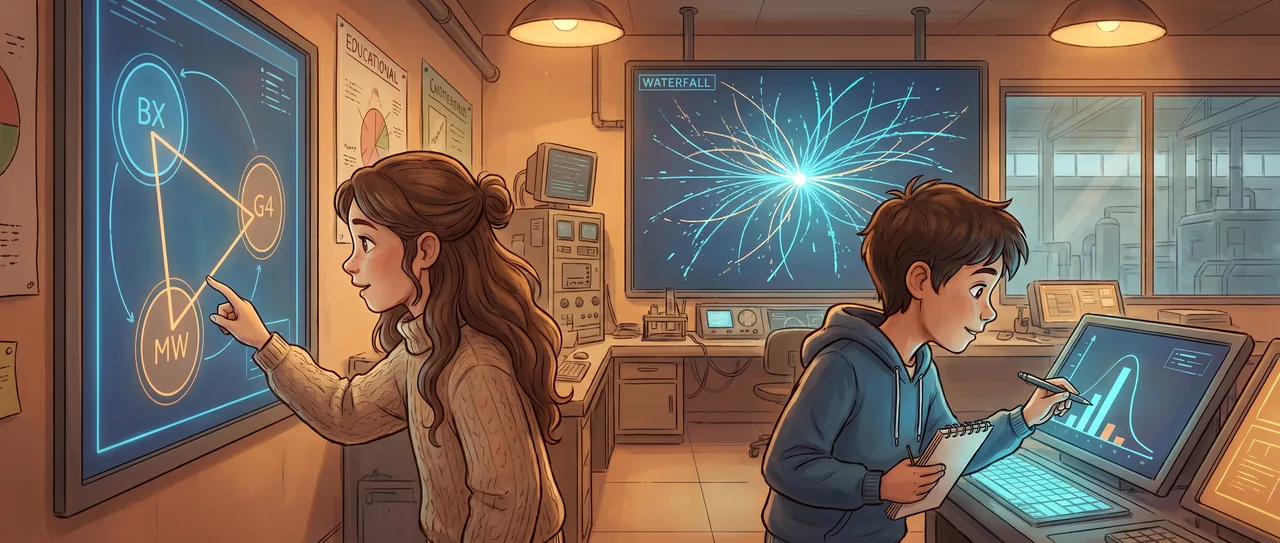
The Wrong Shape of Nothing
The screen showed a waterfall.
That was what Soren called it, the first time he saw the event display. Thousands of collision traces per second, each one a spray of curved lines radiating outward from the center, like fireworks frozen mid-burst. The detector recorded all of them. The AI sorted them. Most were discarded inside two milliseconds.
"How many did it throw away today?" Maya asked.
The interface terminal hummed. The AI companion the lab called Felix, not a person but something that answered like one, processed the question. "Since midnight, approximately four hundred and twelve million candidate events have been classified as background noise and removed from the primary analysis queue."
"Four hundred million," Soren said. He wrote it in his notebook. Then he looked at what he'd written and drew a box around it.
Maya was already leaning forward. "Why those ones?"
"The system applies a set of selection criteria," Felix said. "Energy thresholds. Track geometry. Timing coincidences. Events that fall below threshold or fail geometric requirements are classified as noise."
"But who decided the thresholds?"
"Physicists, over many years. Based on what signals are expected to look like."
Maya sat back. Something in her expression shifted,
. "So if something unexpected showed up, something with a different shape, it might not look like a signal. It might look like noise."
Felix paused for three seconds, which was a long time for Felix. "That is a genuine concern in detector physics. It is why the collaboration publishes its selection criteria."
"Can we look at the discarded events?"
"You have access to a summary layer. Not raw data."
Soren had been reading the documentation quietly, the way he did when Maya was asking the questions he hadn't formed yet. "Felix," he said, "the summary layer, does it include any metadata about why each event was discarded? Like which criterion it failed?"
"Yes. Discard reason is logged."
"Can you show us the distribution? How many failed each criterion?"
The screen changed. A bar chart appeared, discard reasons ranked by frequency. Timing mismatch was the largest bar, enormous, expected. Track geometry failure was second. Low energy deposit was third.
Soren looked at the chart for a long time.
"That one's wrong," he said.
Maya looked. The fourth bar, labeled multi-detector coincidence anomaly, was small. But it wasn't the size that Soren was pointing at. He was pointing at the shape of the distribution around it, the way the bars on either side were smooth, continuous, and the fourth bar had a gap before it and a gap after it, sitting slightly apart from the pattern.
"It's not in the right place," Maya said.
"It's not in the right place," Soren agreed.
They looked at each other.
"Felix," Maya said, "what is a multi-detector coincidence anomaly?"
"An event where signals appear in multiple detector subsystems in a pattern that doesn't correspond to any known particle trajectory. Usually indicates electronic crosstalk or a cosmic ray interaction."
"Usually," Soren said.
"Usually," Felix confirmed.
"Can you show us those events? Just those ones. All of them from the last thirty days."
A table appeared. One hundred and seven events. Soren started reading down the columns: timestamp, detector sectors, energy deposits, discard reason. Maya was doing something different. She was looking at the sector codes, the two-letter identifiers for which parts of the detector had fired.
"Soren."
"I see it."
Three of the sector codes repeated. Not in every event, but in sixty-one of the one hundred and seven, the same three detector sectors appeared together. Sectors BX, G4, and MW. A triangle, when you mapped it onto the detector schematic on the wall behind them.
"That's not crosstalk," Soren said. Crosstalk was a neighbor problem. BX, G4, and MW were on opposite sides of the detector.
"And it's not a cosmic ray," Maya said. "Cosmic rays come from above. These three sectors aren't in a vertical line."
Felix said nothing.
"Felix," Soren said carefully, "when these sixty-one events were discarded, was the clustering in sectors BX, G4, and MW part of the reason they were flagged as anomalies?"
"No. Each event was evaluated individually. The clustering across events was not part of the per-event classification."
"So the AI that sorts events looks at one event at a time," Maya said.
"The primary triage system, yes."
"And nobody looked at whether the discarded anomalies had anything in common with each other."
"Discarded events are not typically cross-correlated. The volume makes it computationally expensive."
Maya stood up. She walked to the detector schematic on the wall and put her finger on sector BX. Then she walked her finger across to G4. Then to MW. The triangle she made was not a perfect triangle. The sides were different lengths. But they met.
"Sixty-one events in thirty days," Soren said. "All hitting the same three sectors. All thrown away."
Neither of them said what they were thinking out loud. They were both thinking it, and it was too large to say out loud, and it might be nothing, it might be a calibration issue or a firmware bug or something any physicist in the building could explain in thirty seconds.
But it also might not be.
"Felix," Soren said. "Is there a way to flag a pattern in discarded events for review? Like, officially. So someone who works here sees it."
"There is a user observation submission form. Submitted observations are reviewed by the collaboration's data quality team within five business days."
"Do kids submit those?"
"The form does not ask for age."
Soren looked at Maya. Maya was still looking at the triangle on the wall.
"Okay," Soren said. "Let's write it up."
It took them forty minutes to write six sentences. They used Felix to check every claim they made, every number, every description. They deleted three sentences that they couldn't verify. What remained was small and careful and specific.
Soren pressed submit.
The screen returned to the waterfall. Thousands of collisions per second, lines spraying outward, the detector recording everything it could. The AI sorting, thresholding, discarding.
Four hundred million events thrown away since midnight.
Maya pressed her finger to the screen where the lines converged at the center, that bright crowded point where something was always happening, and then her finger left a smudge on the glass, and the waterfall kept falling.
Read the interactive version, listen to the narration, and earn a gold star →
A science-verified short story for curious kids · Curiosity Land