The Wrong Layer
The road crew had gone home for the day, and Maya was standing where they weren't supposed to stand.
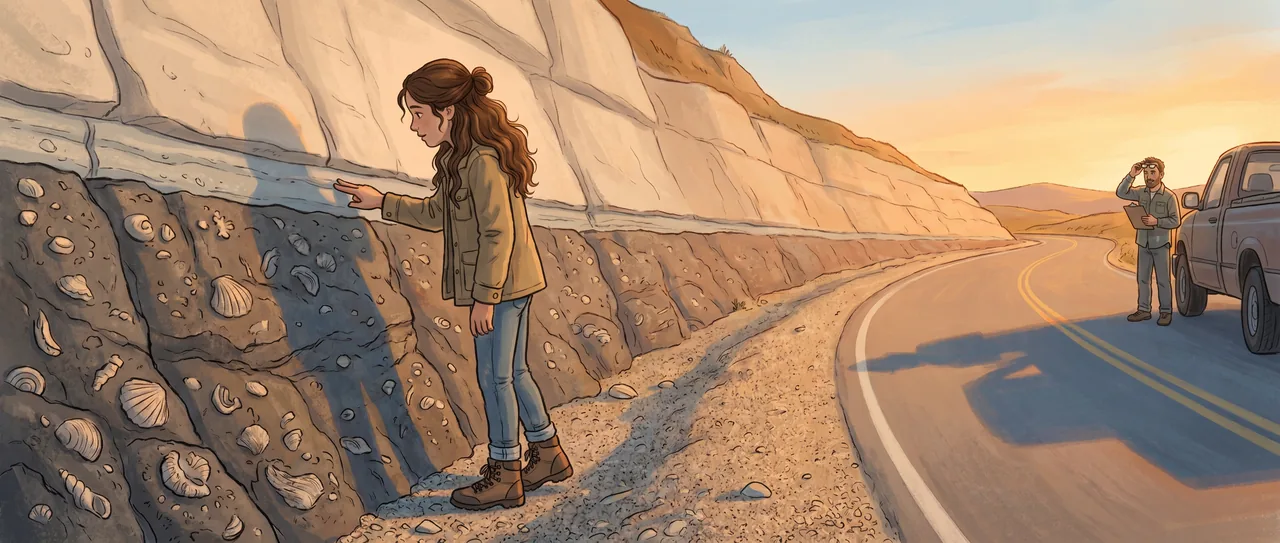
The cut ran maybe forty feet high, the hillside sliced open like a book laid flat. Her dad was back at the truck filling out forms for his geology survey, the kind of forms that took forever and required total silence, which suited Maya fine.
She had been staring at the layers for eleven minutes.
Not because anyone told her to. Because something was wrong.
The rock came in stripes. She'd learned that much from tagging along on her dad's surveys since she was six. Dark shale, pale limestone, dark shale again, a thick band of sandstone the color of old teeth. The stripes were not perfectly horizontal but they were orderly. Each one sat on top of the one before it, oldest at the bottom, youngest at the top, the whole history of the hill written in layers the way a cake is written in layers.
But there was a line about two thirds of the way up that didn't look like a layer.
It looked like a pause.
Maya climbed the gravel berm at the base of the cut, arms out for balance, until she was close enough to touch it. The line was maybe two inches thick at most, a band of pale grayish clay sitting between a rough dark layer below and a smoother pale layer above. It wasn't dramatic. If she hadn't been looking for things that didn't fit, she would have walked right past it.
She pressed her thumb against it. Softer than the surrounding rock. A little chalky.
The dark layer below had things in it. She could see the cross-sections of tiny shells, fragments of coral, the suggestion of something that might have been a snail. Crowded in there. The rock practically hummed with old life.
The pale layer above the line had almost nothing. She looked for three full minutes. A few faint marks she wasn't sure about. That was it.
Her dad was still at the truck. She could see him bent over the clipboard.
She looked at the line again. Two inches of pale clay, and on one side of it the rock was full of creatures, and on the other side it was empty.
She had a feeling. The kind she didn't always have words for immediately.
She picked up a piece of the fallen dark layer from the gravel at her feet, a chunk about the size of her fist with shell fragments studded through it like raisins. Then she picked up a piece of the pale layer above. Smooth. Almost plain.
She carried both back to the truck.
Her dad looked up from his clipboard. He had chalk dust on his sleeve and his reading glasses pushed up onto his forehead.
"You're supposed to stay on the shoulder," he said.
"I know," Maya said. She held up both pieces. "What's the difference between these?"
He glanced at them. Then he put the clipboard down and took the dark piece first, turned it over, held it up to the late afternoon light.
"Devonian," he said. "Maybe three hundred and seventy million years old. Nice marine fauna."
He took the pale piece. His expression changed slightly. Not dramatic. Just a small shift, like a door that wasn't quite level.
"Where did you get this?"
"Above the clay line," Maya said. "The thin grayish one."
Her dad was quiet for a moment in a way that felt different from ordinary quiet.
"That clay," he said slowly, "is the boundary. You found the end-Devonian boundary. That line is where roughly seventy-five percent of all species on Earth disappeared."
Maya looked at the pale rock in his hand. Not at him. At the rock.
"All of them," she said. "At once?"
"Over a long time, but yes. The ocean lost most of its life. Reefs, fish lineages, most of what was in that bottom piece. Gone. Probably from massive volcanic activity changing the atmosphere, oceans losing oxygen, maybe other things we still don't fully understand. The world after that line was almost empty. It took millions of years to fill back up."
Maya looked back at the hill. At the line. Two inches.
"Has it happened more than once?"
"Five times," her dad said. "At least five times we can see clearly in the record. Each one took out more than three quarters of everything alive. The last one, sixty-six million years ago, was the asteroid. But there was one two hundred and fifty million years ago that was even worse. The Permian. Something like ninety percent of all species."
"Ninety," Maya said.
"Ninety."
She thought about the crowded dark rock. The shells. The coral fragments. How full that layer was, how loud with small preserved lives. And the pale quiet rock above the line.
She thought about standing on the living side of that boundary right now, in a world that had refilled itself five times after being emptied, refilled with different things each time, stranger things, and the world that existed right now was just one of the possible worlds that could have existed, one branch of what survived.
Her dad handed her the pale piece back. "Good eye," he said, and picked up his clipboard again.
Maya walked back to the cut.
The light was getting orange and long, and the hill threw a shadow across the road. She stood in front of the boundary layer and looked at the two inches of gray clay and thought about how you could walk past a thing every day, hundreds of people, a road crew with jackhammers and graders, and none of them would know that what they were looking at was the silence after everything died.
She reached up and pressed two fingers flat against the clay line, the pale soft gap between the full world and the empty one.
The rock was cool. The shadow came the rest of the way across the road.
Read the interactive version, listen to the narration, and earn a gold star →
A science-verified short story for curious kids · Curiosity Land