The Shape of a Question
The gel was cold. Soren had been told this every single time, and every single time it was still cold.
The technician, a postdoc named Dr. Vasquez who smelled like coffee and always seemed to be finishing a thought she'd started somewhere else, fitted the last electrode against Soren's scalp and clicked it into the cap. Thirty-two electrodes. Soren had counted them the first week. That had been four months ago.
"Same as always," Dr. Vasquez said, not really to him. "We'll run the reading set, then the math set, then the rest period. Forty minutes."
"What does the reading set actually measure?" Soren asked.
"Attention and language processing," she said, already moving toward her monitor. "Try not to move your jaw too much."
Soren had asked her a version of this question six times. The answer was always the same length.
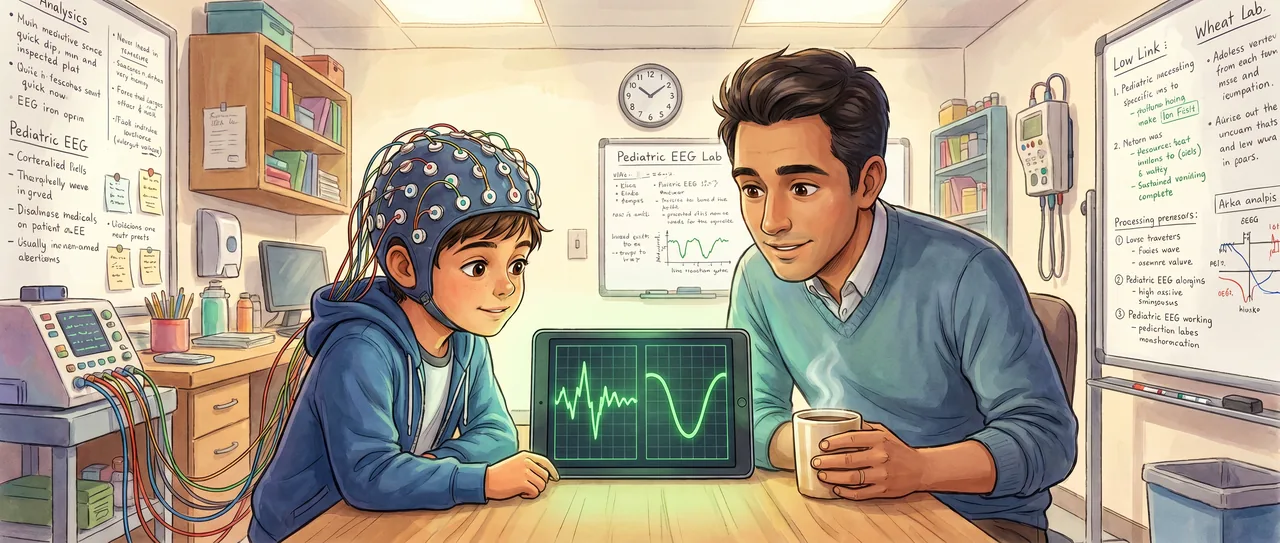
The companion interface glowed on the tablet propped in front of him. The lab called it an AI companion, which soren thought was a strange name for what it actually was: a real-time visualization of his own brain. The researchers used it to keep child subjects calm. It showed waveforms in soft colors, pulsing gently, responding to whatever his brain was doing at that exact moment. Most kids apparently liked to watch the colors. Soren liked to watch the shapes.
The reading set began. Words appeared on a screen to his left, and Soren read them. Simple sentences. Then more complex ones. He was supposed to press a button when he understood the meaning and another button when he didn't.
He watched his alpha waves on the tablet.
Alpha waves were the ones the companion labeled in green. Dr. Vasquez had explained, in one of her half-answers, that alpha activity generally went quieter when the brain was busy, that it was like a background hum that dropped when something more urgent needed the channel. Soren had looked this up. It was true. The brain produced alpha rhythms mostly between eight and thirteen cycles per second, and they suppressed during active engagement. The companion showed this as the green lines flattening and quickening when he focused.
The interesting thing was that the lines didn't all behave the same way.
Soren had noticed this three sessions ago and hadn't said anything yet, because he wanted to be sure. He was sure now.
When a sentence appeared that he understood immediately, the alpha suppression was smooth. A gentle drop, then recovery. When a sentence appeared that he didn't understand, the drop was sharper at first, then the alpha came back in a specific pattern, a kind of quick oscillation before it settled. Button press: don't understand.
That was expected. Confusion makes the brain work harder.
But there was a third thing.
There were sentences he understood perfectly, but which made him want to know something else. The sentence about the migration of arctic terns: he knew what migration was, he pressed the understand button, but immediately he was wondering how they navigated. The sentence about the density of neutron stars. He understood the words. He pressed the button. And then his brain did something.
The alpha suppression, on those sentences, went deeper than on the confusing ones, and it lasted longer, and it had a different shape. Not jagged the way confusion looked. Smoother. Sustained. Like a single held note instead of static.
Soren watched it happen again now. A sentence about the speed of light in water versus air. He knew this. He pressed understand. And then he thought: but why does light slow down at all, what is it actually passing through, and the green lines on the companion went quiet in that particular way, that long smooth valley, and stayed there while the question was still alive in his head.
When the question faded because a new sentence appeared, the lines came back.
He ran the math set. He watched for it. It happened twice. A problem that made him wonder why the method worked, not just whether the answer was right. The same shape. The same valley.
When the forty minutes were done and Dr. Vasquez came to remove the cap, Soren said, "Can I show you something on the companion?"
"I have a debrief with the PI in eight minutes," she said.
"It'll take four."
She paused. He had learned that she paused when she was deciding whether something was worth the time, and that her pauses were shorter when she was genuinely curious. This one was short.
"Go ahead," she said.
Soren pulled up the session replay on the companion and found the moment with the arctic tern sentence. He let it play. He pointed at the green lines.
"That's alpha suppression during the question state," Dr. Vasquez said. "We see that."
"Watch the shape," Soren said. "Not whether it drops. The shape of the drop."
She watched.
He found the confusion moment for comparison, a sentence about legal terminology he genuinely hadn't understood. He played them side by side. Two suppressions. Different shapes. One jagged, quick, recovering. One smooth, deep, sustained.
"The smooth one is when I understood the sentence but I wanted to know something further," Soren said. "The jagged one is when I was confused. They feel completely different from the inside. Do they look different to you?"
Dr. Vasquez was quiet for a moment that was longer than her usual pauses.
"We don't have a tag for that," she said.
"I know," Soren said. "I looked through the protocol. You have understood, not understood, and distracted. There's no tag for understood and now wondering something new."
She looked at the waveforms again. Then she looked at him.
"How many times did you see this shape today?"
"Seven," Soren said. "And I have timestamps from the last three sessions. I wrote them in my notebook."
Dr. Vasquez took the tablet from his hands and scrolled back through the replay herself, slowly, checking timestamps he had given her against the waveform record, not saying anything.
Soren watched her face.
She stopped on a moment he hadn't pointed to. She zoomed in on the alpha trace. She scrolled to another. Then she set the tablet down on the table between them and looked at the waveforms for a while without saying anything at all.
Soren looked at them too.
The smooth green valleys sat in the data like a signature no one had written a name for yet.
Read the interactive version, listen to the narration, and earn a gold star →
A science-verified short story for curious kids · Curiosity Land