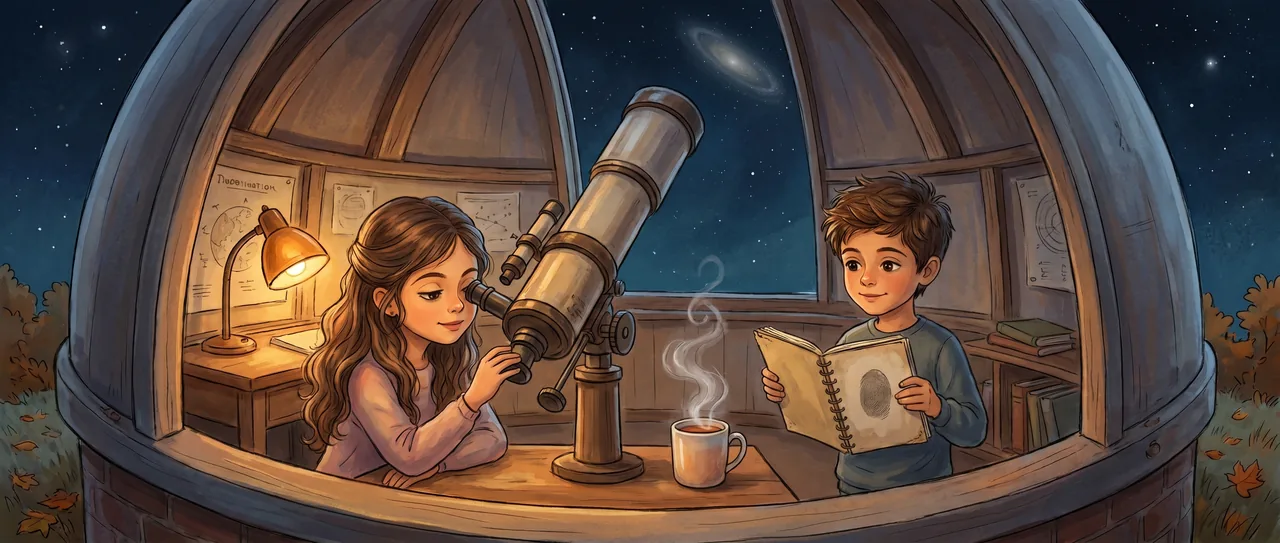
The Oldest Thing You Will Ever See
The motor was broken.
Soren had read about it in the sign-up sheet, right there at the bottom in small print: manual operation only, tracking inoperative. He had signed up anyway. He had also brought his notebook, which the other kids in the astronomy club called the Dinosaur, and which he did not care about them calling the Dinosaur.
Maya was already inside when he arrived, her eye against the eyepiece, one hand resting on the slow-motion knob like she was defusing something.
"It keeps drifting," she said, not looking up. "You have to keep nudging it or you lose it."
"Lose what?"
"Andromeda. Mr. Okafor showed me the coordinates before he went to do his grading. He said to stay under a million miles away from the telescope." She paused. "I think he meant don't break anything."
Soren looked around the small dome. Mr. Okafor had left a mug of tea on the desk that was still steaming. He was the kind of teacher who got absorbed in his own work and forgot where he had left students. This was not necessarily a problem.
Soren pulled the second stool up beside her. "Can I see?"
She moved aside.
He put his eye to the piece. He adjusted for a moment, the way you have to, letting his eye settle into the dark.
There it was.
Not dramatic. Not the pictures. Just a soft smear of light, faintly oval, barely brighter than the dark around it. If he looked directly at it, it almost disappeared. He had read about that, about how the center of your eye is worse at catching faint light than the edges, so he shifted his gaze a little sideways and the smear steadied, became more real.
He had to nudge the knob every few seconds to keep it from sliding away.
"It looks like a thumbprint," he said.
"Yeah."
"Made of what, though. That's the part."
"Billion stars," Maya said. "Give or take."
"A trillion, actually," Soren said. "More than the Milky Way."
Maya made a sound that was not quite arguing and not quite agreeing. She had her thinking face on, which meant she was already past the stars, chasing something he couldn't see yet.
"How far is it?" she asked.
"Two and a half million light years."
She was quiet for longer than usual.
"So," she said slowly, "that light."
"Yeah."
"It's been traveling for two and a half million years."
"Yes."
"So when it left," she said, and her voice changed on the word left, went careful, like she was picking up something she wasn't sure was safe, "what was here?"
Soren had read this part. He had read it three times, actually, because the first two times his brain had refused to keep hold of it.
"Not us," he said. "Not humans. Not the kind. There were things walking around that would become us, eventually, but they were making tools out of rocks. Chipping them. That's all."
Maya took the eyepiece back. She looked for a long time without speaking.
"So right now," she said, "we are seeing light that has been flying through space since before anyone could wonder about it."
Soren opened the Dinosaur. He did not write anything yet. He just held it.
"There's a second part," he said.
She waited.
"Light leaving Andromeda right now. This second. It's starting its trip."
"Okay."
"By the time it gets here," Soren said, "two and a half million years will have passed. For us. On Earth."
He let that sit.
"Whatever is here to see it," he said, "won't be us."
Maya did not move. Her hand stayed on the slow-motion knob, keeping Andromeda centered without seeming to think about it.
"That's not sad," she said, after a while.
"No," he agreed. "I don't think it is."
"It's just," she started, and then stopped.
"Yeah."
"It's like the light doesn't know," she said. "It just goes. It doesn't need anyone to be watching when it arrives. It goes anyway."
Soren wrote that down. Not for school. Just because the inside of his head felt too small for it and he needed somewhere to put it.
"And we're the only ones who figured that out," Maya said. There was no pride in it. It came out more like wonder, or maybe like responsibility. "The rock-tool people didn't know what they were under. But we know what we're looking at."
"For now," Soren said.
She looked at him.
"We know for now," he said. "Whatever's here in two and a half million years, they'll know something we can't even," he stopped, tried again, "something we don't have the words for yet."
From down the hall came the sound of a chair scraping, Mr. Okafor returning to himself and his cooling tea.
Neither of them moved.
Maya had her eye to the piece, one hand on the knob, keeping the galaxy from drifting. The light that had left before the first stone was ever shaped against another stone kept arriving, kept crossing the last few centimeters from lens to eye, kept landing.
Soren looked at what he had written.
He crossed it out.
He wrote it again differently.
He crossed that out too.
Then he just drew a small oval shape on the page, soft-edged, like a thumbprint, and left it.
Read the interactive version, listen to the narration, and earn a gold star →
A science-verified short story for curious kids · Curiosity Land