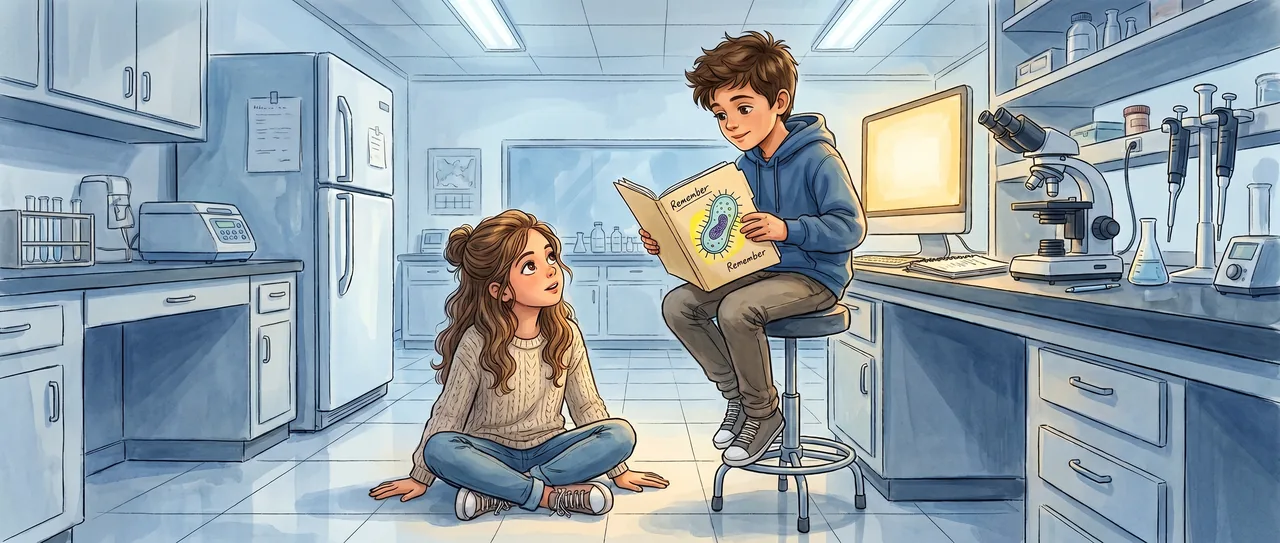
The Memory Inside the Cut
The petri dish smelled like nothing, which bothered Soren more than if it had smelled like something terrible.
He had expected a genomics lab to smell like the future. It smelled like the inside of a refrigerator.
"Your cousin said we could look at the slides," Maya said, already at the microscope.
"She said we could look at the slides she left out," Soren said. "The ones labeled."
"These are labeled."
"They're labeled with codes."
"That's still labeled."
Soren let it go. Maya was already adjusting the focus, her chin tilted down, one eye shut. He pulled a stool to the bench and opened the folder his cousin Drea had left for them. It was supposed to be an introduction. Diagrams. Some printed articles. A sticky note on top that said: Read first!! with two exclamation points, which meant she knew neither of them would.
Maya hadn't.
Soren read the sticky note again and opened the folder.
The first page had a diagram of a bacterium, which he'd seen a hundred times. Small oval. Label arrows. What he hadn't seen was the section highlighted in yellow at the bottom, where someone, probably Drea, had written a single word in the margin: Remember.
He read the highlighted paragraph.
He read it again.
"Maya."
"Mm."
"Bacteria have an immune system."
"Sure."
"No. I mean." He looked at the page. "When a virus attacks them, they cut out a little piece of the virus. A little strip of its DNA. And they keep it."
Maya looked up from the microscope.
"They store it," Soren said. "Inside themselves. So the next time that virus shows up, they recognize it. They remember the attack."
Maya was quiet for a second.
"Bacteria," she said.
"Bacteria."
"They remember things."
"Not like we remember things. But they built something. Inside their own DNA. A library of every virus that ever hurt them."
Maya slid off the stool and came to look at the page. Her finger moved down the diagram without touching it. The way she moved when something was pulling at her.
"And that's what CRISPR is," she said. It wasn't a question.
Soren nodded. "Scientists figured out how bacteria were doing the cutting. There's this protein, Cas9, it's like a pair of scissors. The bacterium tells it exactly where to cut by showing it the stored piece. The memory of the virus."
"So we stole the scissors."
"We learned how the scissors work. And we learned that the bacterium was using a memory to aim them."
"And now we can aim them at anything."
"At any DNA sequence we want to find. You write out the piece you're looking for. The scissors go find it and cut there."
Maya sat down on the floor, which was something she did when she was thinking hard and didn't want to also think about sitting upright. Soren had stopped finding this strange approximately eight months ago.
"So bacteria invented it," she said.
"They invented it to protect themselves."
"And they've had it for how long?"
Soren looked at the page. "The article says CRISPR sequences have been found in bacteria going back at least," he checked the number, "three point five billion years. Estimated."
Maya put both hands flat on the floor.
"Three point five billion years," she said.
"Approximately."
"And we figured it out in the last fifteen."
Soren put the folder down carefully. There was something he needed to think through and he was going to do it out loud because that was the only way it worked. "So bacteria have been running this system, this cut and remember and store system, since before there were fish. Since before there were any animals at all. And the whole time, the system was just there. In the soil. In the ocean. In everything. And no one knew what it was for."
"Someone knew," Maya said. "The bacteria knew."
That stopped him.
"Not knew like thinking," she said. "But the bacteria that survived were the ones that kept the memory. So the memory kept getting kept. For three and a half billion years."
Soren picked up his notebook. He wrote: The memory kept getting kept. Then he looked at it. Then he didn't write anything else.
"The thing is," Maya said, "there are probably other things like that. In bacteria. Or in fungi or whatever. Systems that were solving problems we haven't even named yet. And they've just been sitting there. Running. The whole time."
"We don't know that," Soren said.
"No," she agreed.
Neither of them said anything for a moment.
"How do you even find them," Soren asked. "If you don't know what you're looking for?"
"You look for the thing that doesn't make sense yet. You find the part that's too complicated to be an accident and you figure out what problem it was solving."
Soren thought about that. He thought about the kind of person who looks at a bacterium and thinks, wait, why does it have this, what was it keeping this for. He thought about how long bacteria had been doing this before anyone thought to ask.
"Drea said the hardest part of her work," Soren said slowly, "is that by the time you find something, you feel like it's been waiting for you. She said that's the part she can't explain to people."
"That doesn't sound hard," Maya said. "That sounds like the best part."
The door opened. Drea came in carrying a coffee that smelled like it had gone cold an hour ago and a stack of printouts she hadn't looked at yet. She was wearing the expression she wore when the data was not cooperating.
"Did you read the folder?" she asked.
"Yes," said Soren.
Drea looked at Maya on the floor.
"We have a question," Maya said.
"I have seventeen questions," Drea said, dropping into her chair. "Mine first."
She turned to her screen. The room went quiet except for the hum of the equipment and the occasional click of Drea's keyboard.
Soren looked down at his notebook. He looked at the line he'd written. Then he turned to a clean page and wrote: What other problems has it already solved.
He drew a line under it.
He left the rest of the page blank.
Read the interactive version, listen to the narration, and earn a gold star →
A science-verified short story for curious kids · Curiosity Land