The Color It Was Before
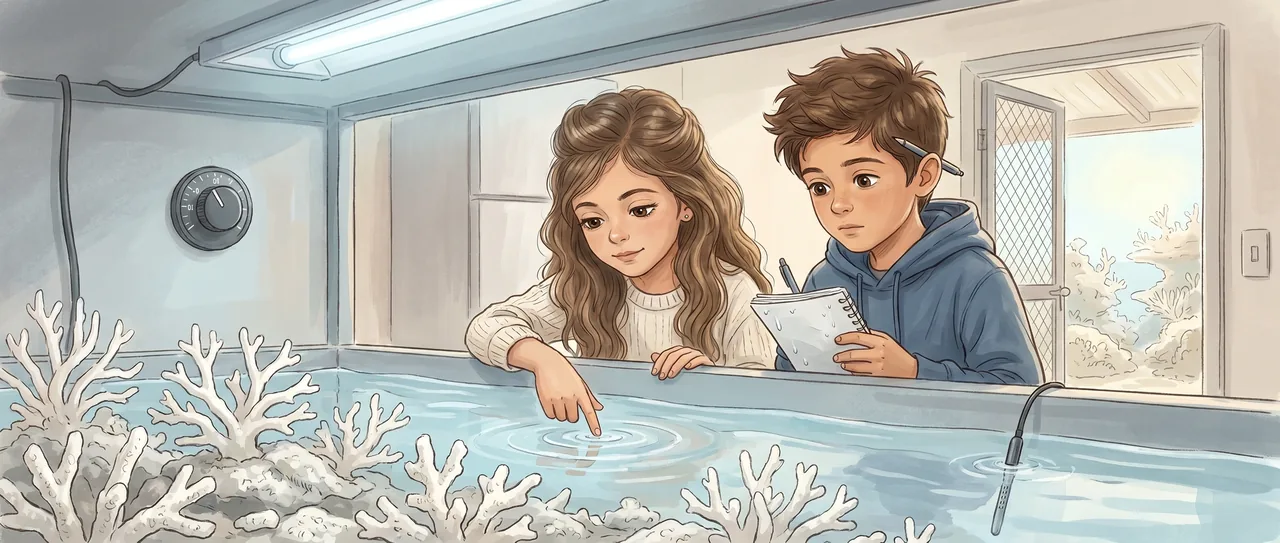
The tank was the color of old teeth.
Maya stood over it with her arms crossed. The coral fragments sat in four inches of seawater, pale as chalk, pale as paper, pale as something that used to be something else. Yesterday they had been orange and brown and one had been the particular green of old glass bottles. She had looked up the color in a book at the station: zooxanthellae, the book said. Algae that live inside coral tissue. That is where the color comes from.
Today the color was gone.
Soren came in from the dock with wet shoes and a pen behind his ear. He looked at the tank and stopped walking.
"They were fine this morning," he said.
"I know."
"The probe said twenty-nine degrees."
"I know."
He leaned over the tank. The fragments had not moved, because coral doesn't move, but they looked different in a way that was hard to name. Not dead. Not alive in the way they'd been alive. The white was very bright under the fluorescent light. It made Maya feel something she didn't have a word for.
"Dr. Reyes put this tank together on Monday," Soren said. "She said the temperature had to stay under twenty-eight."
"The probe said twenty-nine."
"The probe might be wrong."
"Or it might have been twenty-nine for a while before we checked."
Soren looked at the probe. It was clipped to the side of the tank, its cable going down into the water. He pulled out his notebook, which was damp at the corners from the dock, and wrote down twenty-nine point three, the number the probe was showing now.
"We should check the log," he said.
The probe logged readings every fifteen minutes to a little black box on the shelf. Dr. Reyes had shown them how to read it on the first day of the program, the same way she'd shown them how to sex a sea urchin, which Soren had written down and Maya had memorized immediately and not needed to. The log was full of numbers. Soren read them out and Maya listened with her eyes still on the tank.
Twenty-seven point eight. Twenty-seven point six. Then, starting at eleven forty-five last night, twenty-eight point nine. Twenty-nine point one. Twenty-nine point four.
"Eight hours," Soren said.
"Eight hours," Maya said.
The heater. It had to be the heater. They found it at the back of the tank, a long glass tube with a dial, and the dial was set two degrees higher than it should have been. Not broken. Turned. Like someone had bumped it, or reached past it for something else, and never noticed.
"Dr. Reyes was getting the big thermometer yesterday," Maya said. "From the shelf above."
"She would have noticed if she saw it."
"She wasn't looking at it. She was looking up."
Soren turned the dial back to twenty-six. He watched the probe number for a minute. It didn't change yet, because water is slow to cool. He wrote down the time.
"What happens now?" he asked.
Maya had already picked up the book. She turned back to the chapter she'd read the night before, the one with the diagram of the coral polyp and the little brown cells tucked inside. Zooxanthellae, it said again. The algae make food from sunlight and share it with the coral. The coral gives them shelter. If the water gets too warm, the coral gets stressed and pushes the algae out.
She read it again. The coral pushes them out.
"The coral does it to itself," she said.
"It's a stress response," Soren said. "That's what Dr. Reyes said Monday."
"No, but think about that. It ejects the thing that feeds it. While it's stressed." Maya put the book down. "That doesn't make sense."
"It doesn't make sense and it's true," Soren said. "Both things."
Maya looked at the white fragments. She thought about a living thing choosing, not choosing but doing, the thing that would hurt it most, under pressure. The book didn't explain why. It described what happened. The why, she realized, was just listed as unknown in the margin note at the bottom: mechanisms of thermal tolerance and symbiont expulsion remain an active research area.
She showed Soren the margin note.
He read it twice.
"So nobody knows," he said.
"Not yet."
They sat with that for a moment. Outside, through the screen door, the actual reef was out there, under the actual water, doing whatever it was doing in whatever the actual ocean temperature was today.
The probe showed twenty-eight point seven. Dropping.
"If the temperature comes back down in time," Soren said, reading further in the book now, "the algae can come back. The coral can reabsorb them."
"How long is in time?"
He scanned the page. "It doesn't say exactly. Weeks, maybe. If it stays too warm too long, the coral dies." He looked up. "We've got it cooling now. Eight hours might be okay."
"Might."
"Might," he agreed.
Dr. Reyes found them there an hour later, both leaning over the tank, watching the probe the way you watch a thermometer when someone has a fever. She saw the heater dial immediately. Her face did something complicated.
"I moved the probe wire yesterday," she said. "I must have caught the dial."
"We turned it back," Maya said. "It's been dropping for an hour. Twenty-eight point one now."
Dr. Reyes leaned over the tank and looked at the white fragments for a long time without saying anything. Then she said, "Good catch. We'll see."
Maya wanted to ask exactly how long they had. She wanted to ask why the coral expelled the algae instead of holding on. She wanted to ask what the coral was like on the inside of that decision, if that was even a question you could ask about coral.
She didn't ask any of it. She looked at the pale fragments in the cooling water, and at the probe, and at the number still going down by fractions, and she thought about a living thing giving up its color under pressure and the part of that nobody in the world had figured out yet.
The probe read twenty-seven point nine.
Maya put her finger in the water.
Read the interactive version, listen to the narration, and earn a gold star →
A science-verified short story for curious kids · Curiosity Land