The Assumption
The molecule was wrong, according to Clio.
Soren had spent three days building it. Not with his hands, exactly, but with his attention, which felt more tiring. He had read about lipid nanoparticles until the words stopped meaning anything, then started over. He had sketched the delivery shell on paper, the old kind, in his notebook, before entering anything into the workbench. He understood, more or less, what he wanted the molecule to do: carry a drug payload through the bloodstream, recognize a specific cell receptor, release its contents without shredding anything on the way in.
Clio was the lab's AI companion. Not a teacher. Not exactly a tool. Something in between that the university had not yet found the right word for. Clio could evaluate proposed structures, flag likely failures, suggest modifications. What Clio could not do, as far as Soren understood it, was want anything. Clio did not care whether his molecule worked.
That was supposed to be freeing.
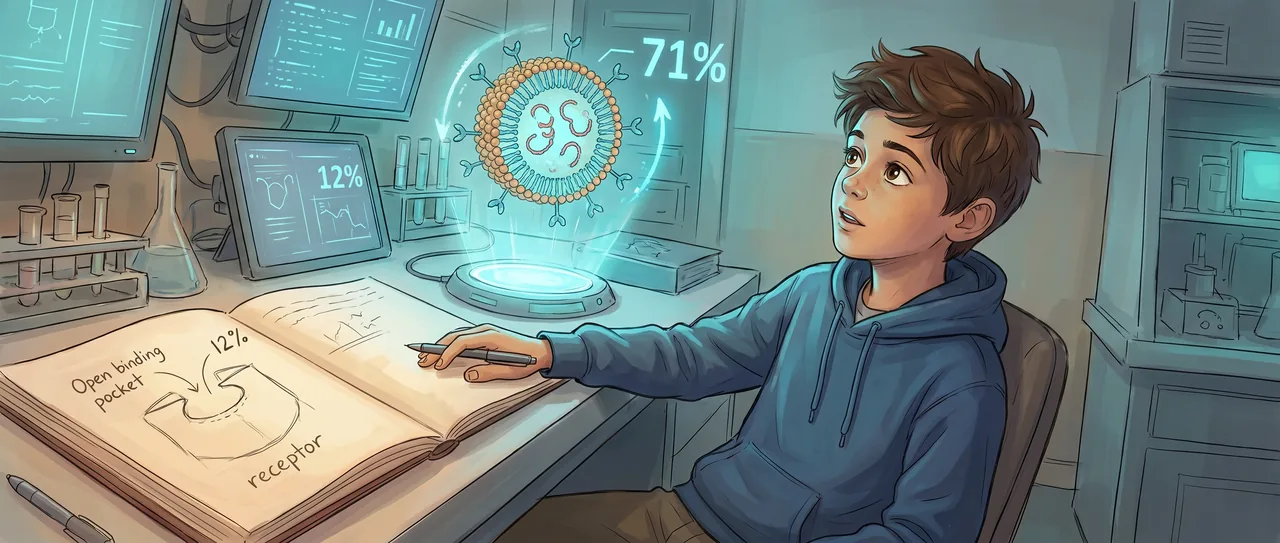
"Predicted binding efficiency: twelve percent," Clio said. The compound rotated slowly in the air above the workbench, its bonds color-coded in ways Soren had only partly learned to read. "Below viable threshold. I would recommend returning to the targeting ligand design."
Soren looked at the molecule for a long time.
Twelve percent was not a rounding error. Twelve percent meant he had been wrong about something fundamental, and he did not know what.
"Show me your reasoning," he said.
This was not the normal request. Most students, the lab coordinator had told him once, accepted the flag and revised. The explanation took longer than the verdict, and most students found the verdict sufficient. Soren found verdicts deeply unsatisfying without the mechanism behind them.
Clio displayed the reasoning chain. It was long. Soren read it the way he read everything he didn't understand, which was slowly and twice.
The molecule's outer shell was predicted to interact poorly with the target receptor. That was the core of the problem. Clio had modeled the receptor binding site using a structural database entry from 2039, which showed the receptor in its resting conformation, the shape it held when no signal was present. In that shape, the binding pocket was partially closed. Soren's ligand was designed for the open pocket.
Soren stopped.
He read that part again.
He pulled up his notebook and found the page where he had sketched the receptor three days ago. He had drawn it open. He had drawn it open because the paper he was working from, a study published eight months ago, described the receptor as it appeared during active cellular uptake. His molecule was designed to arrive during uptake, when the cell was already pulling material in, when the pocket would be open and ready.
Clio had modeled the wrong state.
Not wrong because Clio had made an error, exactly. Wrong because Clio had used the default database entry, and the default was the resting state, and nobody had told Clio that Soren's design assumed an active state. Clio had assumed what was available. Clio had not known there was an assumption to question.
Soren sat with this for a moment.
The AI had given him a confident number, twelve percent, from a chain of steps that looked complete. Every step followed from the one before. The math was not wrong. The logic was not broken. The assumption at the base of it was simply the wrong assumption, sitting there quietly underneath everything else, doing its damage invisibly.
He opened the receptor database himself and found the active-state structure. It had been added fourteen months ago. It was not the default.
He fed it to Clio.
"Recalculate binding efficiency using the active conformation. Reference structure ID ending in four-four-seven."
Clio was quiet for four seconds, which was long.
"Predicted binding efficiency: seventy-one percent," Clio said. "Above viable threshold. Payload release modeling suggests effective delivery with acceptable off-target interaction rates."
The molecule kept rotating. Same molecule. Same bonds. Same color-coding. Seventy-one percent.
Soren wrote the structure ID in his notebook and circled it.
Then he sat back and thought about something that had nothing to do with his molecule.
Clio could do things Soren could not. Clio could hold the geometry of a thousand atoms in memory simultaneously, calculate interaction energies in seconds, cross-reference reaction pathways against a literature database that would take a human researcher decades to read. There was no version of this problem where Soren was faster than Clio, or more precise, or better at the arithmetic.
But Clio had read a paper and not read it. Clio had modeled a receptor without knowing which question to ask about which receptor state mattered. Clio had given a confident answer from a buried assumption, and the assumption had been wrong, and Clio had not known to flag it as an assumption at all.
Soren had known. Not because he was smarter. Because he had drawn the receptor in his notebook three days ago, with his own hand, trying to understand it, and the drawing had stayed in his head the way drawings did. He had been living inside the question long enough that when Clio's answer felt wrong, he could find the place where it had gone wrong.
He thought about how many confident numbers were out there, in how many reasoning chains, with assumptions nested inside them that nobody had thought to question yet. He thought about what it would mean to spend a life learning to find those places. He thought about the fact that Clio would get better, faster, more careful about flagging its own assumptions, and that this would be genuinely good, and that there would still always be a new edge where the model met something it had not been taught to question.
He did not know if that was frightening or the most interesting thing he had ever thought about.
He looked at the molecule rotating above the workbench. Seventy-one percent. His molecule, his reasoning, his paper from eight months ago that Clio had not been pointed toward.
He picked up his pen, found a blank page, and wrote at the top: what does the model not know it's assuming.
He looked at the line for a while.
Then he drew a small open pocket next to it, the receptor in its active state, the shape of something ready to receive.
Read the interactive version, listen to the narration, and earn a gold star →
A science-verified short story for curious kids · Curiosity Land