What the Crack Remembered
Soren's mother had been very clear.
"The samples on the middle shelf are not toys. The samples on the top shelf are definitely not toys. The stool in the corner is broken, so do not sit on it. There is juice in the mini-fridge and crackers in the drawer, and I will be back in one hour."
She disappeared into the instrument room, where something expensive hummed behind a heavy door.
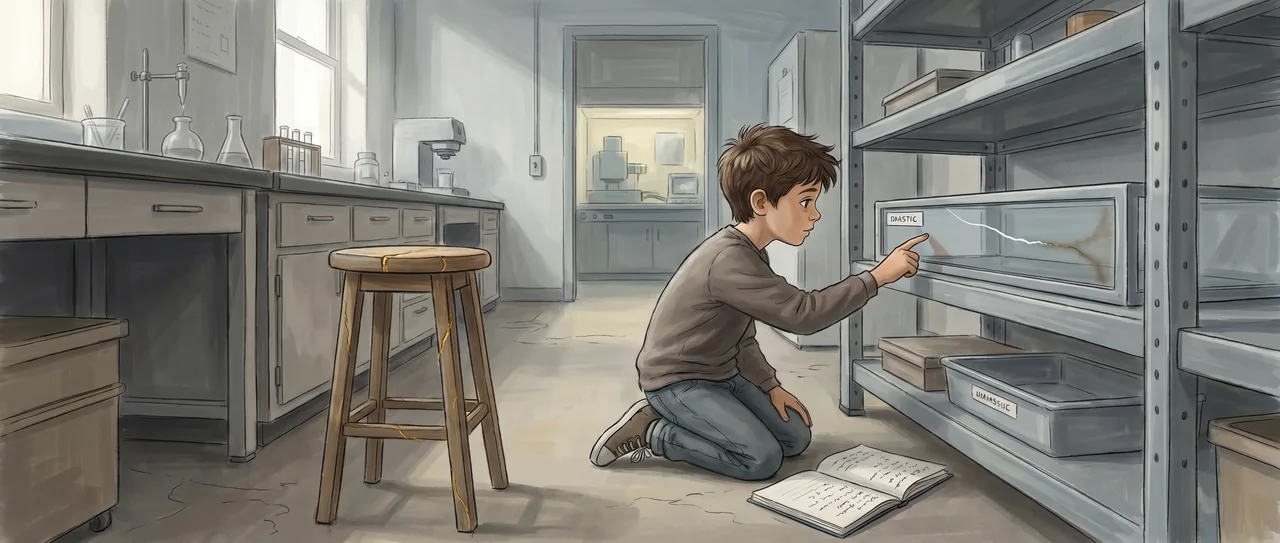
Soren sat on the floor. He did not sit on the broken stool. He did look at it, though, because the break was interesting. The leg had not snapped off clean. It had cracked partway through, a dark line running up the plastic like a river seen from above, and then stopped. Someone had tried to fix it with regular glue that had gone yellow at the edges. The glue had not worked. The crack was still there, slightly wider than before.
He looked at it for a while.
The problem with broken things, Soren thought, was that they remembered being broken. The crack stayed. The glue was just a stranger filling the gap.
He opened his notebook and wrote: a crack is not the absence of material. It is a place where the material decided to stop holding.
Then he crossed that out, because it wasn't precise.
He was still thinking about what precise would look like when he noticed the sample.
It was on the middle shelf. A flat rectangle of dull gray plastic, maybe the size of a paperback book, in a labeled tray. The label said: SHP-7, WEEK THREE OBSERVATION. HAIRLINE FRACTURE INTRODUCED MONDAY.
Soren did not touch it. He stood close and looked.
There was a crack across the surface. He could see where it started, near the left edge, a thin white line. But the line did not go all the way across. Somewhere near the center it became harder to see. And at the far right, where it should have ended, there was a faint brownish stain, like the ghost of a watermark.
He looked at the Monday label again. Today was Saturday.
Something had happened in this plastic between Monday and Saturday, and nobody was in the room to explain it.
His mother came out to refill her coffee. She glanced over and saw his face.
"That's one of Dr. Reyes's samples," she said. "Self-healing polymer. Don't touch it."
"It's healing?"
"It healed. Past tense, mostly. I've got about four minutes before the instrument finishes its cycle, so."
"How?"
She paused at the door. She had the expression she got when she wanted to explain something properly and didn't have time to. "Inside the plastic. Tiny capsules, smaller than you can see, filled with a liquid that bonds when it hits air. Crack forms, capsules break open, liquid flows into the crack, seals it." She held up a hand. "Like if you had little first-aid kits buried in your walls, and they opened automatically when a crack appeared."
Then she was gone again.
Soren stood very still.
He thought about the stool. The glue at the edges, yellowing, a stranger filling the gap.
Then he thought about the polymer. The capsules were inside the material before the crack existed. Before there was anything to heal. They were already there, waiting, part of the structure itself.
He looked at the sample again. The place where the crack faded. The faint brown stain where the liquid had done its work and dried.
The material had not been repaired. It had repaired itself. Those were not the same thing at all.
He wrote in his notebook: the healing agent was there before the damage. It was part of the design from the beginning.
He stared at what he'd written.
Then he wrote: so the crack triggered something that was already ready.
He thought about that for a long time. The instrument hummed behind the heavy door. Outside, a truck went past the window. Soren did not hear any of it.
Because here was what didn't fit.
If the capsules were inside the material from the start, then at the moment the plastic was made, it already contained its own response to something that hadn't happened yet. The engineers who designed it couldn't know exactly where the crack would form, or when, or how wide. They just knew that something would go wrong, somewhere, eventually. And so they built the answer into the material in advance, and then they waited.
They built in a readiness for damage they couldn't predict.
Soren pressed the end of his pen against his lower lip.
The plastic on the shelf didn't know it was plastic. It didn't decide anything. And yet it had something inside it that a cracked stool didn't have, and that difference was the whole story. One thing had been made to respond to its own breaking. One thing had just been made.
He looked at the faded end of the crack. The brownish stain of healing agent that had done its work and gone quiet.
He thought: what else gets built like that. What else is constructed with the response already inside, waiting for a fracture that hasn't arrived yet.
His mother's head appeared around the door. "Fifteen more minutes. Okay?"
"Okay."
She looked at him for a second, at whatever his face was doing.
"Don't spiral," she said, not unkindly.
"I'm not spiraling."
"You have your spiraling face."
"I'm just thinking."
She went back through the door.
Soren turned to the sample on the shelf. The gray rectangle sitting in its labeled tray, ordinary-looking, the crack fading to nearly nothing at the center, the brown watermark at the right edge where the chemistry had finished its quiet work days ago with no one watching.
He pressed his fingertip to the glass front of the tray, just above where the stain was.
Read the interactive version, listen to the narration, and earn a gold star →
A science-verified short story for curious kids · Curiosity Land