What the Board Knows
The gymnasium smelled like floor wax and someone's lunch.
Soren had lost in the second round. He was not upset about this. He had played an opponent who spent forty seconds on every move, which meant Soren had spent forty seconds per move staring at the board and thinking about how the pieces were arranged, and somewhere around move fourteen something had happened that he still couldn't explain.
He found Maya at the folding table near the water fountain, eating crackers.
"Did you watch the end of my game," he asked.
"The part where you lost?"
"Before that."
Maya handed him a cracker. "A little. You looked like you were asleep."
"I wasn't asleep. I was watching Dr. Ferris."
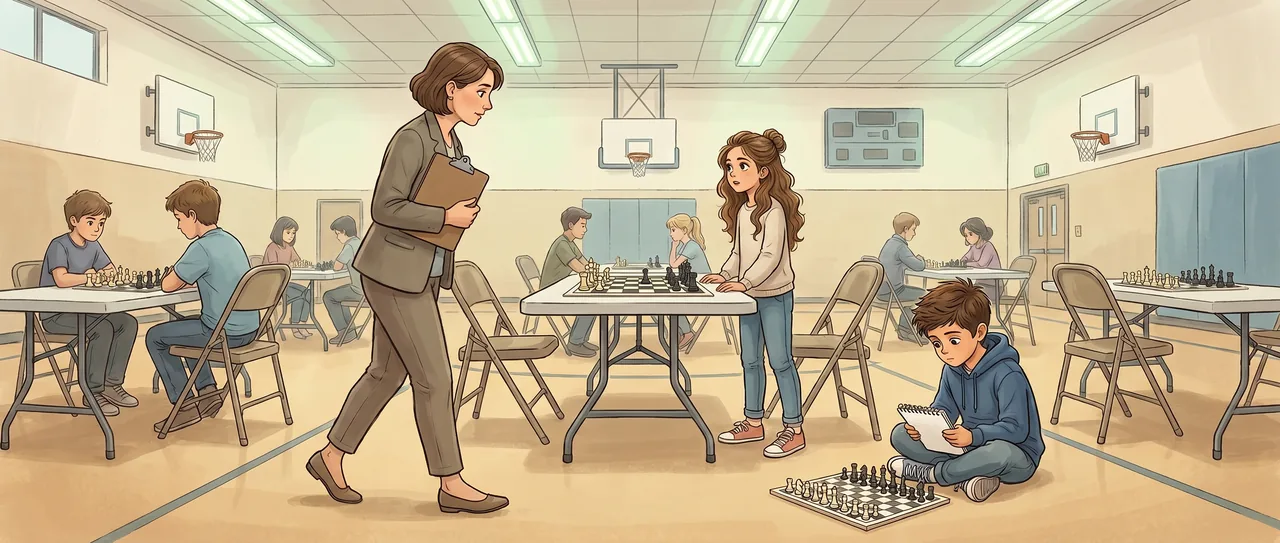
Dr. Ferris was the tournament director, which mostly meant she walked around slowly with a clipboard and told people to be quiet. She was also, according to the registration pamphlet, a former national champion who had played competitively for twenty-two years before she stopped. Soren had been watching her because she was doing something that didn't make sense to him.
Every time she passed a board, she glanced at it. Just glanced. One second, maybe less. And then she moved on.
"She knows what's happening on every board," Soren said. "But she barely looks."
"She's probably just checking the clocks."
"She's not looking at the clocks. She's looking at the middle of the board."
Maya was quiet for a second. That was her thinking-quiet, not her bored-quiet. Soren had learned the difference.
"Let's test it," Maya said.
They waited until a game two tables over finished and the players left. The board sat there, pieces still in the end position, a resignation somewhere around move thirty. Soren pulled out his notebook and sketched the position as fast as he could. He wasn't good enough to understand it, but he could draw it.
When Dr. Ferris came past on her next loop, Maya stepped slightly into her path. Not blocking. Just enough.
"Excuse me," Maya said. "Is white winning in that game or was it black?"
Dr. Ferris glanced at the board. One second.
"Black won," she said. "White's queen was trapped. It was over by move twenty-four, black probably should have resigned earlier." She was already moving, clipboard tucked under her arm.
Soren looked at the board. He looked at it for a long time. He could not find the trapped queen. He was not even completely sure which piece was the queen on sight, because he always had to remind himself that the queen was the taller one without the cross.
"Twenty-four," Maya said quietly. "She walked past this board three times. She's never been closer than four feet."
Soren wrote it down.
They tested it four more times. Finished boards, abandoned positions, once a board that a kid had accidentally knocked and then hastily reset wrong, with a pawn on a square where no pawn could legally be. That time Dr. Ferris stopped. She looked at it for almost three full seconds, which felt enormous compared to everything else. She straightened a piece that wasn't the problem, then paused, then looked again, and walked away with a slightly different expression.
"She knew something was wrong," Maya said.
"She didn't know what."
"She knew something."
Soren had been turning this over since his own game and now it was shaking loose. "She doesn't see pieces," he said slowly. "She sees shapes. Like, all of it at once. The whole structure. One thing."
"Like a word," Maya said.
Soren looked at her.
"You don't read letters," Maya said. "You stopped doing that in like first grade. You just see the whole word. The shape of it. C-A-T doesn't become cat, it just is cat, you can't even split it back apart anymore."
"But she does it with thirty-two pieces."
"She did it for twenty-two years."
Soren sat down on the gymnasium floor, which he knew was probably not allowed but he needed to think and his legs had made the decision without asking him. Maya sat down next to him.
"So what is she actually looking at," Soren said. "When she looks at a board. If it's not pieces."
"Danger," Maya said immediately. Then she paused. "Possibility. I don't know. Something we don't have a word for because we can't see it yet."
Soren wrote that down.
The thing that was bothering him, the thing that had been bothering him since move fourteen, was that at some point during his own game he had felt, just for a moment, something like that. A flicker. Not understanding. He didn't understand the position. But a sense of the whole thing at once, the weight of it, which pieces were nervous and which were settled, before he could have named any reason why.
And then it had gone. And he had lost.
"What if everyone's brain can do it," he said. "But only for things you've put enough time into."
Maya pulled her knees to her chest. "Like what."
"I don't know. Music, maybe. Sports. Maybe someone who's fixed enough engines sees a whole broken engine like she sees a board. One shape. You'd just know."
"Know what."
"Whatever is true about it."
Maya was quiet in her thinking-quiet way for a long time.
"That means," she said carefully, "that the world she lives in is different from the world we live in."
Soren clicked his pen. "Not different circumstances. Different what-she-actually-sees."
"And we can't see it. Not yet."
Dr. Ferris crossed the gymnasium again, clipboard, flat shoes, half a glance at a board in progress, not breaking stride. A boy at that board had his chin in his hand and was frowning at the pieces one by one.
She saw something he couldn't see.
Soren opened his notebook to a clean page and drew a chessboard, thirty-two pieces in their starting positions, every one of them in its own square, each one separate, each one just itself.
He stared at it for a long time.
Then he turned the page.
Read the interactive version, listen to the narration, and earn a gold star →
A science-verified short story for curious kids · Curiosity Land