The Still Point
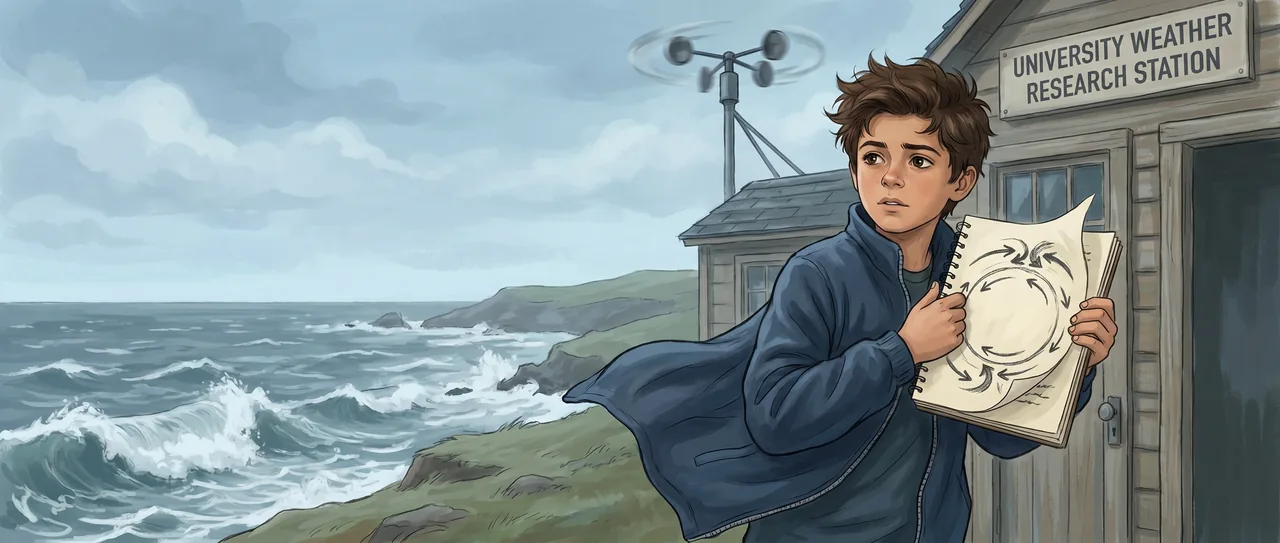
The wind off the headland was trying to take Soren's jacket. He held the zipper with one hand and pressed his notebook against his chest with the other and watched the anemometer on the roof of the research station spin so fast it was almost invisible.
His class had gone inside ten minutes ago.
Soren had not.
The meteorologist, Dr. Vasic, had said something at the end of the tour that Soren could not stop chewing on. She had said it quickly, while already turning toward her computer, the way adults say things they think are obvious. She had said: no matter how bad the storms get, there is always somewhere on Earth right now where the wind is perfectly still.
Not almost still. Not calm. Still.
Soren had asked her what she meant and she had said it was topology, actually, and that he should look it up, and then she had sat down and put her headphones on.
He was looking at it up the way he preferred, which was thinking.
He opened his notebook and drew a circle. He put arrows on it, all pointing sideways, meant to represent wind moving across a surface. He tried to make all the arrows point the same direction, flat and neat, the way you would comb hair.
The arrows on the sides were fine. But when he reached the top and the bottom, something went wrong. The arrows curled in from both sides and had nowhere to go. They crashed into each other. He drew it again. Same problem. He tried making them spiral. He tried making them fan out. Every time, the arrows at some point had to do something impossible, or they had to stop.
He stared at this for a while.
He thought about how you could take a tennis ball and try to brush every fiber of it perfectly flat. He had actually done this once with a hairbrush, in the bathroom, for reasons he had not been able to explain to his mother. There was always one spot, at least one, where the fibers swirled and refused. A cowlick. He had tried for twenty minutes and the cowlick had just moved around the ball, never disappearing.
He looked at his drawing again.
The arrows had to go somewhere. If you pushed the problem away from one place, it appeared somewhere else. You could not get rid of it. The math, apparently, would not allow it.
Which meant: if you covered the entire Earth with arrows showing which way the wind was blowing, the math said at least one of those arrows had to have zero length. Had to. Not because of weather. Not because of geography. Because of the shape.
Because Earth was a sphere.
Soren wrote that down carefully. He underlined sphere.
He tried to find the objection. He always tried to find the objection first. Maybe the wind could just skip that point, he thought. Maybe the rules of wind are different from the rules of arrows on paper.
But no. Wind was continuous. It did not teleport. It moved from one place to the next in connected, unbroken paths. And continuous vector fields on spheres, he was becoming fairly sure, behaved exactly like arrows on paper. The math did not care whether the arrows were wind or something else. The math only cared about the shape.
This was the part that made him put down his pen.
He had always thought of math as something that described things after you already knew what they were. You measure the wind. You write down numbers. Numbers are math.
But this was different. This was math looking at the shape of a thing and saying: here is what must be true, before you look, before you measure, regardless of the weather, regardless of the storms.
Right now, in this exact moment, on a planet with seven continents and five oceans and a hurricane he had seen on Dr. Vasic's monitor churning somewhere in the Pacific, there was a point where the air was not moving at all. Not because it happened to be calm there. Because the geometry of the planet demanded it.
He tried to imagine the point. It would just look like a regular place. A hillside maybe. A patch of ocean. Someone standing there might not even notice. The air around them would be moving, but at that precise location, for reasons written into the shape of the world, there would be nothing. A zero in the middle of all the noise.
He wondered whether anyone had ever stood at that point without knowing it.
He wondered whether the point was always the same or whether it drifted around the planet continuously, the way the cowlick had moved around the tennis ball. He suspected it moved. He had no proof. He wrote it as a question.
He wrote: does the still point move? How fast? Has it ever been over this headland?
The anemometer above him was still spinning hard. So the still point was not here. Not now.
He thought about all the meteorologists in the world, all the weather satellites, all the instruments, and how none of that was the reason the still point existed. They could find it, maybe. But the reason it was there had nothing to do with thermometers or pressure gradients or ocean temperatures. It was there because a mathematician, a very long time ago, had thought carefully about what happens when you try to comb a sphere.
Soren looked out at the water. The waves were enormous, white-capped, continuous, not pausing for anything.
Somewhere on the other side of the planet, a precise point in the air was doing nothing at all, and would keep doing nothing at all, not because of luck or weather, but because there was no other option.
The wind pulled at the corner of his notebook page, and Soren pressed his thumb down hard to hold it.
Read the interactive version, listen to the narration, and earn a gold star →
A science-verified short story for curious kids · Curiosity Land